
Recognized at the Blue Invest Forum in Lomé, the company founded by Dr. Ahama Kplolali and Kokoevi Agbevenou-Dovi (MSc) is developing a technology that combines fish farming and vegetable cultivation. The founders’ ambition is to establish a 3,000 m² commercial farm in the Togolese capital.
Climate Disruption as an Entrepreneurial Starting Point
In 2020, a late drought destroyed the Ahama family’s tomato crops in the commune of Noepe. In response, Dr. Ahama Kplolali, a plant physiologist and biotechnology expert, was tasked by her father to find an agricultural solution independent of climatic risks.
« He asked us to look into this problem and find a crop that would not depend on seasons or rainfall, » explains the co-founder of Aquaponie du Togo. This search led her toward soilless technologies, specifically aquaponics, a system combining aquaculture and hydroponics.
A Scientific Duo Tackling an Emerging Technology
Ahama Kplolali then partnered with Kokoevi Agbevenou, her classmate at the Faculty of Science of the University of Lomé, who became an expert in plant biosciences after completing a master’s in France specializing in microbiology and agro-bioscience. “We quickly embraced the project given the importance of this technology,” recalls Kokoevi. At the time, aquaponics was still relatively undocumented internationally.
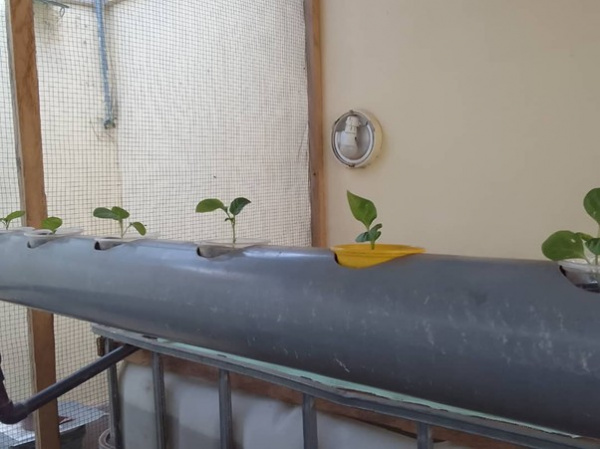
The two researchers spent three years studying the concept before its realization. “We started from scratch; there wasn’t much information available,” Kokoevi notes. The technical principle relies on a closed-loop ecosystem where fish waste acts as a natural fertilizer for plants, which in turn filter the water before returning it to the fish tanks.
Operational Prototype Funded with Personal Resources
In November 2023, Aquaponie du Togo installed its first functional system on a 40 m² area in Adidogomé-Yokoe, Lomé. Funding came from three sources: the founders’ personal savings, support from the French NGO KYNAROU, and backing from Apromafriq Pharma.
The prototype demonstrated commercial viability through a short-circuit model. “People come to buy directly from us,” Agbevenou explains. Demand even exceeds available production, for both fish and vegetables, encouraging the entrepreneurs to consider scaling up.
Three services are offered: producing and selling fish and vegetables, designing and installing aquaponics kits, and training in the technique.
International Recognition at the Blue Invest Forum
In October 2025, Aquaponie du Togo presented its 3,000 m² commercial farm project at the Blue Invest Forum in Lomé, organized by the European Union (EU). The Togolese initiative stood out in the aquaculture category and won the best pitch award.
« I was the only one selected from Togo, » says Ahama Kplolali, who represented the company. The initiative and preceding training program “opened doors and gave us credibility. People realized this was serious and providing real solutions,” she adds.
This recognition attracted attention from institutional actors, including the relevant ministry.
Persistent Structural Challenges
Despite these advances, scaling the prototype to a commercial farm faces several constraints. Financing remains the main challenge. “We are still fighting to find funding, partnerships, and technical support to launch this 3,000 m² commercial aquaponics farm,” summarizes Ahama Kplolali.
Access to urban land is another hurdle. In Lomé, high real estate pressure and land costs make it difficult to identify suitable sites for a large-scale aquaponics installation while maintaining proximity to urban consumers.
The regulatory context adds another layer of complexity. Aquaponics, a hybrid technology between agriculture and aquaculture, does not fit neatly into existing frameworks. “Authorities need to understand this technology to better regulate it,” notes Kokoevi.
Finally, specialized inputs present logistical challenges. Some equipment and materials needed for aquaponics are not locally available, requiring imports that increase the initial investment.
Regional Expansion Strategy
Beyond Lomé, Aquaponie du Togo aims for broader deployment. “We plan not only to expand across Togo, but also into neighboring countries like Benin or Burkina Faso,” says one co-founder, targeting regions facing similar climate challenges.
This vision includes an educational dimension. The entrepreneurs plan awareness sessions in Togolese schools. “Children in Togo need to learn about this innovative agricultural technology that addresses real climate challenges,” argues Kokoevi.
The business model combines commercial production with technology transfer, aiming to make aquaponics accessible to urban households while supplying fresh, organic products through short supply chains.
Call for Financial and Institutional Partners
« It should not stop here. We call on all structures, public institutions, NGOs, and even the government to support the project, » affirms Ahama Kplolali.
The symbolic aspect is also important. “We are two women entrepreneurs in the green sector,” she reminds, in an ecosystem where female-led agritech initiatives remain rare.
Funding needs, not publicly disclosed, concern basic infrastructure: greenhouses, fish tanks, filtration systems, climate control devices, and hydraulic installations. Investment also covers the initial working capital for the production cycle before first sales.
Development Outlook and Challenges
The aquaponics model developed by the Togolese company fits a global trend of seeking agricultural alternatives to climate constraints. In West Africa, where rainfall variability affects food security, these systems offer significant adaptation potential, according to the founders.
The competitive advantage lies in several factors: estimated 90% water savings compared to conventional agriculture, year-round production independent of seasons, absence of chemical pesticides, and optimized space usage in dense urban areas.
Commercial success will depend on Aquaponie du Togo’s ability to structure its supply chain, standardize production processes, and build a recognized brand. It will also require training qualified personnel to operate the technical installations, alongside a growing base of private users.
« It is not an impossible model; it is really feasible and we know where we are going, » concludes Dr. Ahama Kplolali. The coming months will determine whether this scientific conviction can secure the financial and institutional support necessary for industrial-scale implementation in Lomé.