Since the last two days of January 2026, a rare and almost unimaginable event has occurred: the waters of the Goulette Sea as well as the waters of the old port of Tunis have overflowed.
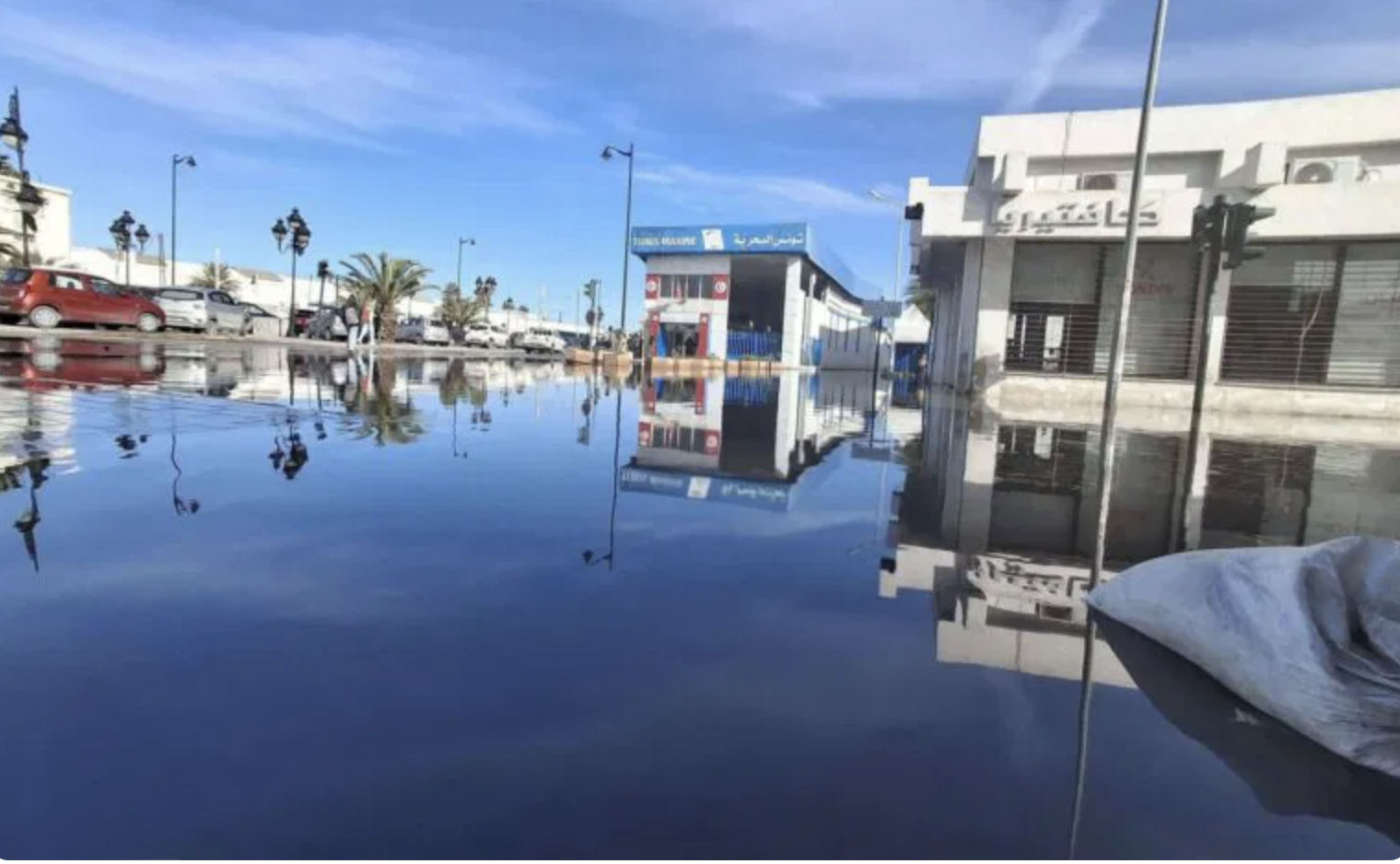
The Tunis-Marine district and the beginning of Avenue Bourguiba now look like floating squares as the water covers almost all the soil… Social networks are teeming with photos and videos illustrating these facts.
Comments fly from everywhere… Some having circulated near the florists installed in Tunis-Marine, swear to have seen fish swimming at the beginning of Bourguiba Avenue! Main artery, which, just yesterday, was baptized the beating heart of downtown Tunis and which now risks losing its entrance. This seems to be gradually becoming an aquatic continuity of the old port of Tunis…
The entrance to the capital is really marine…
The images shared on social networks are breathtaking! Residents of the square, residents of buildings, residents of the famous El Béhi hotel and other merchants installed on both banks of the avenue are calling for help.
Some screaming that they can no longer get off their building whose entrance is submerged by water. The latter have long believed that it was rainwater that submerged the soils.
It’s wrong, it’s indeed the seawater that has overflowed! Even today, the gateway to the capital is still submerged by the waters of the Mediterranean.
The overflow of the canal connecting Lake Tunis to the port of La Goulette has spit out its surplus transforming the beginning of Habib Bourguiba Avenue into a vast expanse of brackeish water, paralyzing traffic and isolating access to the TGM terminus.
Is nature resuming its course?
This overflow of seawater has caused significant disruptions and many concerns. Cars that pass on the highway leading to La Goulette report that they are driving on water…
That said, if experts have warned of the growing vulnerability of the coast to rising sea levels, Tunisians of yesteryear say that the sea takes back what is rightfully its…
Yes, the older ones say that in the past the so-called Bab-bhar (SIC sea gate) owes its name to the existence of the sea on the current Place de Tunis Marine.
These same old people are convinced that water has a strong memory, that it never forgets these natural circuits and that it always ends up getting back on its good old path…
The underside of overflow
This phenomenon, although spectacular, is not the result of chance. And even if seniors think that it is nature that has resumed its course from the past, the experts have a completely different vision.
Tunis Marine under the waters: the Mediterranean Sea invites itself to the heart of the capital – La Presse de Tunisie 20/02/2026 8:34 AM
Indeed, climatological people point to a combination of three critical factors that caused this situation. In this case, these are the marine surcharge, the rise in sea level and the saturation of evacuation networks…
Experts agree that the strong atmospheric depressions recorded for weeks in the Mediterranean basin have caused a temporary but brutal rise in sea level.
Pushed by violent winds from the Northeast sector, the water plunged forcefully into the Goulette canal, unable to absorb this surplus volume.
They also explain that this overflow illustrates the growing vulnerability of the low- lying areas of the Tunisian coast. « With the global rise in water, the threshold of tolerance of Tunis’ port and urban infrastructures, built at level zero, is now regularly crossed during strong storms, » they note.
And to add that the absence of flood expansion zones around the port and the saturation of rainwater drainage networks add a layer to this situation.
« This lack of expansion has prevented any rapid withdrawal of water, creating this situation of stagnation at the level of strategic crossroads, » they explain.
The submersion of Tunis Marine is no longer a hypothesis, but a reality to which future development plans will imperatively respond to protect the historical heart and economic nerve of Tunis from sinking under water…
source : la presse