
Vietnam is focusing on a green and sustainable maritime economy to balance the exploitation of ocean potential, environmental protection, and ecosystem preservation, while ensuring sustainable livelihoods for future generations.
- Vietnam is determined to strictly penalize any violations related to IUU fishing.
- Vietnam is committed to responsible fishing under the WTO’s FSA 2022 Plan.
- Marine aquaculture: moving towards industrial, green, and sustainable production.
As the 14th National Congress of the Communist Party of Vietnam approaches, digital transformation and ecological transition are emerging as strategic priorities. Within this framework, developing a sustainable maritime economy is a decisive choice, reflecting a long-term vision for the country.
Vietnam is a maritime nation, with over 3,000 km of coastline, an extensive exclusive economic zone, and thousands of islands of all sizes. The sea is not only a vital space and a strategic line of defense but also a key driver of the country’s socio-economic development.
Harnessing Maritime Potential
Rather than exploiting raw resources, Vietnam is focusing on high-value sectors of the green maritime economy, including environmentally friendly shipping, sustainable tourism, high-tech aquaculture, and offshore renewable energy. The development of a green maritime economy must go hand in hand with improving the living conditions of coastal populations.
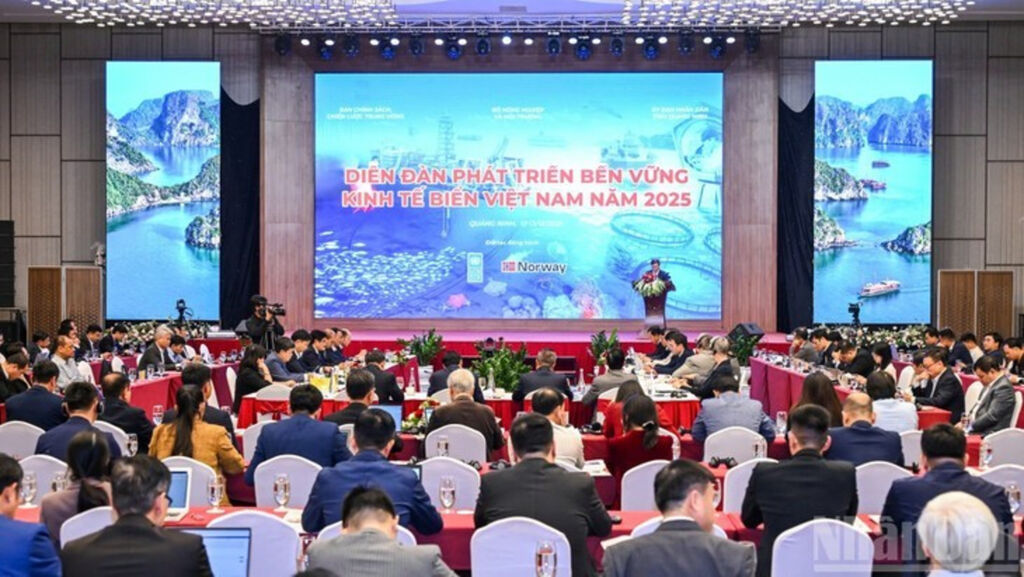
At the 2025 Forum on Sustainable Development of Vietnam’s Maritime Economy, held on 12–13 December in Quang Ninh province, Hoàng Thanh Vinh, head of the Circular Economy and Ocean Program at the United Nations Development Programme (UNDP), praised the establishment of industrial clusters dedicated to marine aquaculture currently being deployed in Vietnam.
“The creation of marine aquaculture industrial clusters allows local communities to participate in a structured way, similar to industrial zones. It provides access to robust infrastructure and a complete supply and distribution chain. This is a particularly important strategic direction.”
Environmental Protection at the Core
Alongside its economic development, Vietnam places environmental and marine ecosystem protection at the heart of its strategy. Management and conservation of marine areas are being strengthened, the exploitation of fishery resources is strictly regulated according to sustainable criteria, and the fight against illegal, unreported, and unregulated (IUU) fishing is conducted firmly to preserve resources in the long term while meeting international integration requirements.
Restoration of mangroves and coral reefs, as well as the reduction of marine plastic waste, are gradually creating true “green shields” along the coasts. Sustainable maritime transport is also emerging as an essential trend, offering businesses competitive advantages and enhancing resilience, as noted by Dào Trong Khoa, Permanent Vice President of the Vietnam Association of Logistics Service Enterprises.

“Sustainability and rapid adaptability are two key elements of any supply chain, particularly in a global context marked by geopolitical instability and increasing demands for ‘greening’ to reduce emissions worldwide. Today, the transition to green and flexible maritime logistics represents a crucial step, contributing to the reduction of carbon emissions in Vietnam’s maritime logistics sector.”
Growth, Security, Environment, and International Position
To develop a green maritime economy, Vietnam is gradually strengthening its institutional framework, adopting national strategies for green growth and circular economy, and integrating environmental protection objectives into socio-economic development plans. Resolution No. 36 on the Sustainable Development Strategy for the Maritime Economy, with a vision to 2045, illustrates this commitment.
Several sectors are already recording concrete progress. Renewable energy, particularly offshore wind with a potential exceeding 600 GW, contributes to diversifying the energy mix and reducing dependence on fossil fuels. At the same time, Vietnam has mastered technologies to exploit maritime resources through a green approach.
To create green maritime growth hubs and strengthen connections between major economic centers, Vietnam is ready to cooperate and actively contribute to the global maritime network, as emphasized by Prime Minister Pham Minh Chinh during the United Nations Ocean Conference held last September in France.
“As a maritime nation, Vietnam is committed to being a reliable partner and supporting global efforts to protect the oceans. The country actively participates in cooperation mechanisms for green and sustainable maritime development. Vietnam is also ready to propose fair and sustainable financial initiatives, strengthen marine science research and applications, promote technology transfer and experience sharing, while efficiently using resources to support the sustainable development of the maritime economy.”
For Vietnam, developing a green and sustainable maritime economy is not just a necessity; it is a key strategy to harness the wealth of the sea while preserving this vital space and contributing to global sustainable development goals.
Source: lecourrier