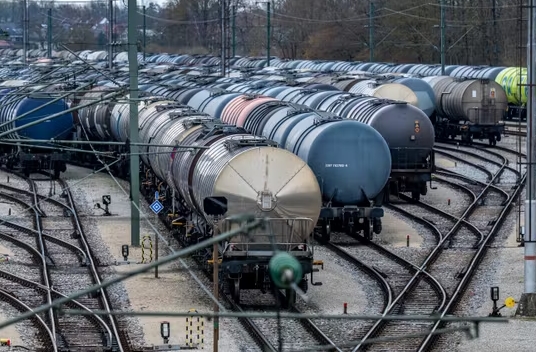
For a month and the outbreak of the American-Israeli war against Iran, it is the entire industry dependent on chemistry that has been suffering a price shock with the rise in hydrocarbon prices and the quasi-blocking of the Strait of Hormuz.
By Zeliha Chaffin
« It was almost immediate. I had never seen this, even during the Covid-19 pandemic or the crisis linked to the war in Ukraine. On the phone, Guillaume Clément, boss of the Lyon group Blanchon, rewinds the thread of the last few weeks. « The conflict in the Middle East began on February 28 and, less than a fortnight later, the first announcements from our suppliers reporting force majeure were dropped. Then the contracts we had signed before the conflict, which included fixed price clauses on the purchase of our raw materials, were all denounced, « he says. Since then, not a day or almost has passed without one of its suppliers informing it of new rate increases.
Between the surge in hydrocarbon prices and the paralysis of the Strait of Hormuz, this tricolor manufacturer of paints, varnishes and stains for floors, products that are mainly based on petroleum-derived base materials, has seen its production costs skyrocket. « In ten days, the price of resins, which make up 40 to 60% of the raw materials of our products, increased by 15 to 30%, solvents, other essential elements, took 50% and so on, » says the business manager. And the bill could get even heavier in the coming weeks if the conflict continues.
The Rhône-alpine society is far from being the only one to make this observation. For a month, the entire chemical-dependent industry has been suffering this price shock. Methanol, acetone, urea, ammonia, polypropylene, polyethylene, sulfur, bromine… the list of products whose costs are soaring continues to grow, to the point that it becomes difficult to provide an exhaustive inventory.
The quasi-blockage of the Strait of Hormuz, by destabilizing global gas and oil traffic, both essential to the production of chemical inputs, has indeed triggered a tsunami whose waves are just beginning to reach European shores.
« Scascade effects »
« Chemistry is particularly sensitive to gas price increases », which can represent « up to 80% of the variable cost » for highly energy-intensive activities, such as, among others, the production of ammonia (used in particular in fertilizers), nylon (synthetic fiber present in textiles and many industrial parts), methionine (an amino acid essential for animal feed), or isopropanol (a solvent used, among other things, in cleaning products), notes France Chimie, the federation representing the industrialists of the sector in France.
The industry is just as much so to fluctuations in oil, from which a multitude of key components that irrigate the manufacturing industry are derived, such as naphtha and ethylene, « the main inputs of vaporic craqueurs, upstream of all polymers », from which plastics in particular derive, continues the professional organization, which warns of « cascasing effects ».
Already, « the observation is dramatic, » says Joseph Tayefeh, secretary general of Plastalliance, a union representing the plastics sector and bringing together more than 50,000 companies in Europe. Unambiguously, he believes that in the event of a continuation of the war in Iran waged by the United States and Israel, « it is the entire European industry dependent on plastic that risks being beheaded ».
European plastics engineers, already shaken by the 2022 energy crisis, where some, for lack of profitability, had to temporarily stop production, fear that they will no longer be able to financially cope with the surge in the prices of their raw materials.
Tension on packaging
Since the beginning of the conflict, the prices of these materials, which are among the most affected by the crisis, have skylled, often registering up to 50% increase. From polyethylene to polypropylene, through polyvinyl chloride and polyethylene terephthalate, better known by their acronyms PVC and PET, or polystyrene and polycarbonates, none of them escapes this inflationary spiral.
However, plastics are omnipresent in the economy. They are found, to varying degrees, in the automobile industry, where they constitute 14 to 18% of the mass of a vehicle, but also in construction, aerospace, electronics, household appliances, sports and leisure equipment and, above all, in packaging. These, which include a variety of products – bottles of water and soda, trays of meat and fish, jars of yogurt, bottles of shampoo and shower gel, cans of laundry and household products, tarpaulins and silage films used by farmers, medicine blisters – alone represent about 40% of plastic consumption in Europe.
This price shock should not stop at the doors of factories. In the impossibility of cashing in on such increases, manufacturers warn that they will have no choice but to pass them on to their customers, with a good chance that they will then be transmitted to consumers, fueling inflation that has already risen to 1.7% in March in France.
Beyond that, another concern begins to stand out: that of a shortage of raw materials. « The risk is real if the conflict in the Middle East were to extend over several months. Many suppliers have already closed their order books for the entire month prematurely as of March 15. And it may be the same in April, « says Bibiane Barbaza, head of economic affairs at Polyvia, the national union of plastics manufacturers.
« For now, we manage to tinker »
At the Eurocoat show, a biennial meeting of professionals in paints, inks, glues, varnishes and adhesives held in Paris from March 24 to 26, the major distributors of chemicals present do not yet speak of ruptures, but describe an increasingly feverish market. “Producers are starting to turn off the taps. For now, we can tinker with our stocks, but if this continues, it will become complicated, especially on high-turnover products, « observes one of them, who wanted to remain anonymous.
But the reserves are not inexhaustible. On the plastics engineers’ side, « stocks vary, depending on the company, from two weeks to two months, » says Joseph Tayefeh, of Plastalliance.