
Beneath the waters of the North Atlantic, brown kelp forests, crucial for marine biodiversity, are shrinking in the face of increasingly hot summers. In Brittany, scientists are observing a silent but alarming transformation of underwater ecosystems.
Beneath the surface, marine ecosystems are shifting at an increasingly rapid pace. Where once teeming forests of kelp thrived, the landscapes are flattening, stripped of their biological refuges. Far from being insignificant, this silent transformation marks a critical stage in the decline of kelp forests, sensitive indicators of an ocean that is warming and becoming increasingly murky at an alarming rate.
The vital role of underwater forests in coastal ecosystems
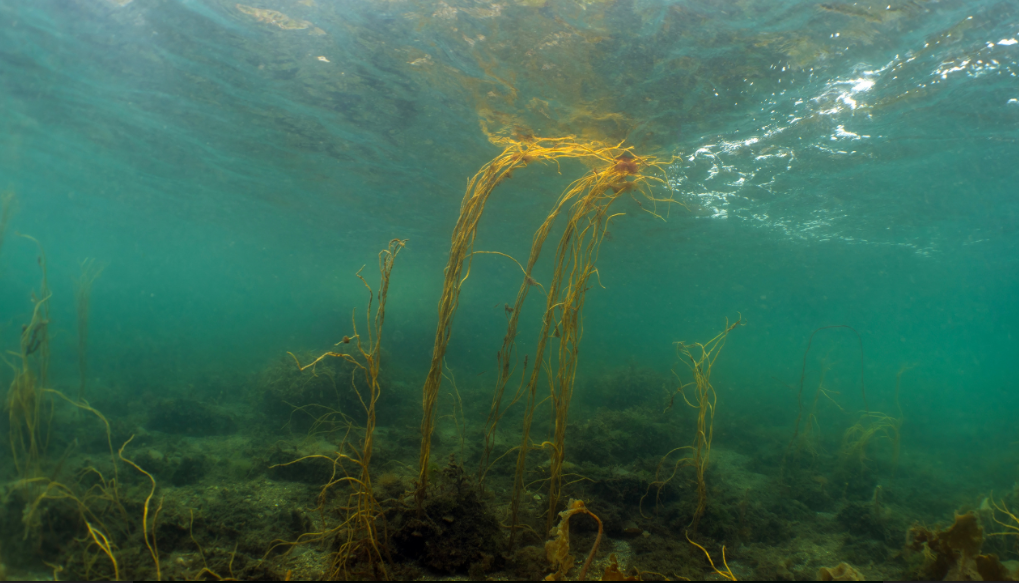
They sway with the currents like miniature forests. Kelp, these large brown algae , sometimes rise to over three meters and form a protective canopy where marine life thrives. Beneath their fronds, crabs, abalone, sea urchins, and juvenile fish find shelter and food. Their density creates a marine microclimate, tempering the waves and filtering the light, like a submerged forest floor.
In the Molène archipelago, off the coast of Finistère, Ifremer divers monitor the health of these seaweed beds every year . Their surveys reveal entire areas depleted of biodiversity, where kelp is becoming scarce and smaller. Researchers describe a silent collapse, sometimes involving the loss of several thousand tons of biomass in just a few seasons. The ocean, once teeming with life, is becoming, in places, a barren plain.
This loss doesn’t just affect biodiversity. In Breton ports, seaweed harvesting supports dozens of seaweed harvesting families. When kelp forests decline, a whole sector of the coastal economy falters. These marine forests are therefore not only a biological refuge, but also a resource and a natural barrier against erosion and swells.
The decline of kelp forests, a symptom of ocean warming
The main cause of this decline lies in a single figure: 18°C. Above this temperature, kelp ceases to reproduce and enters a state of stress. Researchers at Ifremer have observed that several species, notably Laminaria hyperborea and Laminaria digitata , are gradually disappearing from areas where the surface water exceeds this threshold. In southern Brittany, some populations have already been wiped out.
Research published in PLOS One by Virginie Raybaud and her team confirms this trend on a European scale. By modeling the distribution of Laminaria digitata , scientists predict a massive northward retreat during the 21st century. The French , English, and Danish coasts could lose almost all of their underwater forests by 2050, according to the most pessimistic climate scenarios. These models predict that only Norway will still offer viable conditions by the end of the century.
Heat is not the only threat. Increased rainfall and runoff are loading the ocean with fresh, turbid water, reducing the light essential for photosynthesis . Climate change is therefore a double-edged sword. It stifles algae growth while simultaneously blurring the light on which they depend.
Each warmer summer accelerates this vicious cycle. As temperatures rise, kelp declines, and with it, the species associated with it disappear. These algae play a fundamental role in the oceanic carbon cycle. They capture CO₂ and stabilize sediments. Their disappearance therefore exacerbates the imbalance they are experiencing.
Towards new marine balances or a silent extinction?
In Roscoff, marine biologists are measuring the last gasps of these brown forests. Ecological models show a high probability of local disappearance as early as the first half of the century. In some areas, natural competition is already giving way to new species such as Saccorhiza polyschides , a fast-growing pioneer alga. But this replacement does not replicate either the biological complexity or the stability of the kelp forests.
Coastal ecosystems are being profoundly altered. Fishermen are reporting fewer lobsters, pollack, and abalone. Habitats are becoming fragmented, and young fish, deprived of refuge, are becoming vulnerable. On a continental scale, the loss of these marine forests could reduce fish productivity and permanently alter the food web.
Some northern areas could become temporary sanctuaries. In Norway, kelp still finds cool, clear waters conducive to its growth. But the question is no longer simply where it will survive. It is about understanding what kind of ocean we will leave behind when these forests have disappeared from southern Europe.
According to France Info , divers exploring the Iroise Sea are already seeing the difference. Entire landscapes are emptying out, light filters through unimpeded, and silence reigns. Where dense forests once stood, only a fading memory remains. The once-lush marine canopy is slowly receding under the effects of climate change , taking with it an invisible part of the richness of life.
source : science et vie