

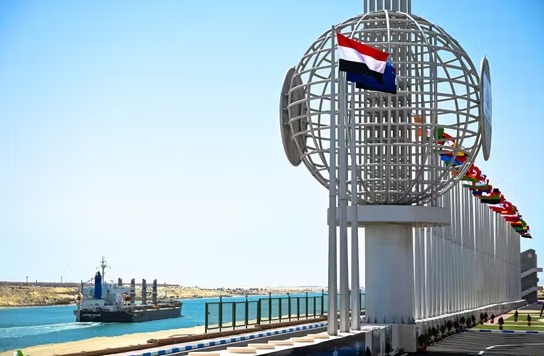
The ceasefire agreement between Israel and Hamas foreshadows a massive resumption of traffic through the Egyptian canal, targeted since the end of 2023 by the Houthi rebels off Yemen. But the reuse of a shorter route between the Indian Ocean and the Mediterranean would increase capacity in a context of low demand.
The Suez Canal, in Ismailia (Egypt), on April 16, 2025. KHALED DESOUKI/AFP
On December 19, 2025, the Container boat Sebarok of the Danish group Maersk crossed the Suez Canal, which connects the Mediterranean Sea to the Red Sea and by extension to the Indian Ocean. For the world’s second largest shipowner, this was a first since December 2023, when he stopped, like the large shipping companies, using this strategic passage, due to the attacks of the Houthi rebels in Yemen against Western ships using the Bab Al-Mandab Strait, which connects the Red Sea to the Gulf of Aden and the Indian Ocean, to attack, according to them, Israel’s allies and provide their support to the Palestinians.
From 2023 to 2024, the number of tanner ships passing through the Suez Canal decreased by almost 90% and overall ship traffic fell by half, according to data published by the Suez Canal Authority (SCA).
The ceasefire between Yemeni rebels and the United States in May 2025, and even more so between Israel and Hamas in October 2025, foreshadowed a massive recovery in traffic where, in normal times, more than 10% of the world’s goods. The shipowners would a priori have every reason to resume as soon as possible the most direct route between Asian factories, the Mediterranean and Europe. Doing without the shortcut pierced by Ferdinand de Lesseps (1805-1894) in the 19th century requires ships to pass through the Cape of Good Hope, off the coast of South Africa, a detour that lengthens the eleven-day journeys. However, shipowners are cautious, even cold, to the idea of returning to the road through the Red Sea.
Geopolitical uncertainty remains and no one can certify that the lull that everyone is seeing is permanent. « The Houthis attack less, but no one knows precisely what capacities they still have to attack again, » summarizes Jérôme de Ricqlès, maritime expert for the French start-up Upply. The latter also notes « a revival of a very structured piracy in the Gulf of Aden » which does not advocate a reorganization of roads in this region, always considered by insurers as a war zone.
The fear of price collapse
The hesitations of shipowners are also economical. The crisis in the Middle East came after prosperous years for shipping. After the health crisis due to Covid-19, the exceptional volumes transported and historically high freight prices allowed them to generate huge profits, largely reinvested in the order of new ships. These boats are gradually taking to sea as the global economy is disrupted by US customs duties. As a result, the sector is again faced with an endemic evil, overcapacity. « The bypass of Africa was an opportunity to freeze the capacities acquired after the Covid period, » summarizes Paul Tourret, director of the Higher Institute of Maritime Economics.
In other words, according to the United Nations Conference on Trade and Development, the volume of goods transported grew by 2.2% in 2024 and the distance they traveled increased by 5.9%. This phenomenon is far from anecdotal, since it is estimated that 5% to 6% of the world’s container capacity is thus used to avoid the Suez Canal.
A return through the Egyptian passage would therefore imply reinjecting this capacity, while international trade promises to be dim in 2026. And this while the global fleet was to increase by 1.37 million containers equivalent to 20 feet for the coming year, an increase of 4% in total capacity.
Showners fear that this imbalance between growing supply and limited demand will cause a collapse in prices. These have already largely paid the price for a chaotic year 2025. According to the World Container Index of the British firm Drewry, the average cost of transporting a 40-foot container (a little over 12 meters) was nearly $4,000 (€3,405) in January 2025, compared to $2,182 on December 18, 2025 – up after seventeen weeks of fall and a minimum in October, to $1,651.
To limit overcapacity, shipowners have several options, such as canceling certain services or limiting the speed of their vessels, which reduces fuel costs in the process. Or even adopt more drastic solutions, such as sending boats to the scrapyard. In November 2025, during the presentation of the financial results for the third quarter, Ramon Fernandez, financial director of the French shipowner CMA CGM, estimated that there were « candidates for scrapping [dismantling] » in the company’s fleet. Finally, in a kind of collective discipline, the dominant actors can also decide, individually, not to break the prices.
A « bubbure of relative comfort »
For the moment, « everything is now happening as if we no longer needed the Suez Canal, » notes Mr. Tourret This is also the paradoxical observation made by shipowners’ customers. « After years of crisis, chargers find themselves in a bubble of relative comfort. There has been a re-re-end of supply chains via the Cape of Good Hope. Of course, supplies are extended, but prices remain reasonable and supply chains are running well. The status quo is fine for them, finally, » analyzes Mr. de Ricqlès.
They are in all the less hurry when another danger lurks. When traffic resumes through Suez, « two types of trips will collide, the long ones through Africa and the short ones through Suez. This may clog European ports, which have become accustomed to a new normal for two years, » predicts Arthur Barillas de Thé, president of the Ovrsea freight forwarder. « Such congestion will reduce the efficiency of [maritime transport] and have an inflationary effect. If this happens in high season [between June and August], freight rates could rise very high very quickly, before falling to reflect the true relationship between supply and demand, « he adds.
The Egyptian government and the SCA are ultimately the only ones who want to hasten a return of the boats. The second was pleased, on November 25, 2025, with a return to « full capacity » of the CMA CGM ships in December 2025 and a beginning of standardization for Maersk. Remarks dryly denied by the Danish shipowner, who assured not to foresee anything like this. After the passage of the Sebarok, Maersk warned that this was a first step, but in no way the massive return hoped for. CMA CGM did not react officially, but Egyptian hope was denied by the facts.
Even if the XXL Jacques-Saadé tannel carrier went down the canal on December 22, 2025, the majority of its ships still pass through southern Africa, as do those scheduled for the beginning of 2026. Only a few units continue to use the Suez Canal, as they have been doing for two years – according to our information, 300 ships of the company have passed there since December 2023 -, taking advantage of the protection of the European naval operation « Aspides ».
Everything suggests that Suez is a minor problem, even an epiphenomenon, for a sector that must face almost existential problems and apprehend the recomposition of international trade following the trade war and the decoupling between China and the United States.
Orders for small container carriers on the rise
Despite geopolitical, pricing and economic uncertainties, orders for new container carriers increased in 2025 compared to 2024. According to the company Veson Nautical, which specializes in the management of maritime assets, the shipowners have signed contracts for 600 new units, compared to 413 the previous year. In detail, this growth is no longer driven by orders for very large vessels that can carry more than 14,000 20-foot equivalent containers, which fall by 13%. Shipowners preferred medium and small capacity boats whose orders grew by 48% and 548% respectively. The interest in small ships is explained by the sector’s fear of overcapacity and the reorganization of sea routes following the trade war led by the United States.
Source : Le Monde