
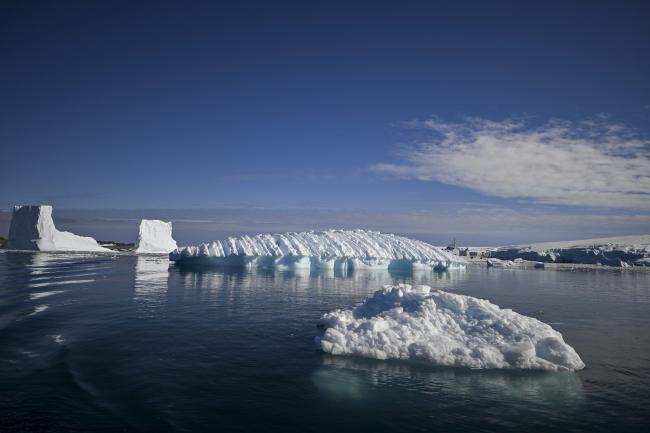
A huge expanse of ice at the South Pole, Antarctica is now protected by a unique status in the world on which about sixty countries agree and which ensures peace and priority to science. But until when?
A single status
The 14 million km2 ice continent – larger than Europe – is protected by the Antarctic Treaty, signed in 1959 by twelve countries, and of which 58 countries are now members. He consecrates the continent as a land of science and peace while freezing territorial claims.
The treaty provides that « Antarctica should only be used for peaceful purposes », and highlights « freedom of scientific research » and « cooperation » in this regard.
« This is where the sea level rise is at stake, this is where the global climate is at stake, » says Yan Ropert-Coudert, researcher and former director of the French Polar Institute, to AFP. The continent accumulates about 90% of the world’s fresh water.
To monitor possible non-compliance with the commitments of member countries, States regularly conduct unannounced inspections of the stations of others, as permitted by the treaty.
An international presence
About thirty countries operate in a hundred bases or infrastructures on site.
Landscape view at Palmer Station in the United States on the island of Antwerp, Antarctica, on January 21, 2024AFP/Archives
Some countries are very present, such as the United States with seven infrastructures, Russia (11), Argentina and Chile (13 and 14), reports COMNAP, an international association that brings together states on site and includes permanent research stations, seasonal, and other smaller infrastructures.
Other smaller states have also established themselves, such as Belarus, Bulgaria and Ukraine.
France operates the Dumont d’Urville stations on the coast on the eastern side, and Concordia on the interior of the continent, the latter with Italy.
At a time of global geopolitical disorders and the ambitions of American conquest in Greenland, and the opening of maritime trade routes in the Arctic made possible by the melting of ice, the question of power relations also arises at the South Pole.
New Chinese resorts
Chinese development in the region as well as Moscow and Beijing’s opposition to the creation of new marine protected areas are among the « weak signals » that could threaten the continent’s status in the long run, analyzes AFP the French ambassador for the poles, Olivier Poivre d’Arvor.
Satellite image, taken by Maxar Technologies on March 7, 2023 and released on April 28, 2023 showing the Chinese Zhongshan research station in AntarcticaSatellite image ©2023 Maxar Technologies/AFP/Archives
In addition, « China does not hide its interest in the natural resources of Antarctica, » yet difficult to access, notes Anna Wahlin, Swedish co-president of the Scientific Committee for Antarctic Research (SCAR), which coordinates international research efforts on the continent.
« It’s no secret: there are large maps, when you visit their polar research secretariat, with natural resources, oil, gold, » she continues.
After inaugurating a fifth research station in 2024, Beijing, which also produces a lot of scientific research, is considering a sixth.
American disengagement
The Chinese attraction to Antarctica comes hand in hand with the American disengagement on science.
The 14 million km2 ice continent – larger than Europe – is protected by the Antarctic Treaty, signed in 1959AFP/Archives
For the first time in six decades, the United States no longer has an icebreaker in the Southern Ocean, after budget cuts forced the National Science Foundation in 2025 to return the Nathaniel B. Palmer, which she had been renting since 1992.
In addition, « delegations in international meetings on the subject are reduced to a skin of grief, » notes Yan Ropert-Coudert, against the background of Donald Trump’s questioning of science.
Towards a review of the treaty?
Whatever happens, a diplomatic window could open in 2048 since the Madrid Protocol of 4 October 1991, which came into force in 1998, provides that the treaty can be reviewed after 50 years, if one of the parties requests it.
For the moment, there is nothing to think that a country could activate this mechanism, in the opinion of several experts interviewed.
Beyond the legal argument, however, « what we see today suggests that in twenty years, strength can always be an additional argument » for a reshaling of the particular status of Antarctica, warns Olivier Poivre d’Arvor.
source : tv5monde