
he ocean keeps warming up. Its vast areas reach just over 21 °C on average on the surface, according to provisional data from the European Copernicus program, resulting in particular from satellite information, as of Tuesday, March 31. This is nearly 0.5 °C higher than the average estimated between 1993 and 2022 by its maritime service, implemented by the scientific organization Mercator Ocean International. The University of Maine, which is based on data from the National Oceanic and Atmospheric Administration, reports close preliminary estimates (21.12 °C as of March 31, just behind 21.16 °C at the end of March 2024, or + 0.57 °C compared to the period 1991-2020).
« These data show that we are at an exceptionally high overall temperature level, close to the 2024 records, » to within a few hundredths of a degree, says Thibault Guinaldo, oceanographer at the National Center for Meteorological Research (Météo-France/National Center for Scientific Research). Overheating is even higher in some oceanic regions such as the Gulf of Mexico, the South Atlantic or the tropical Oceans. Anomalies exceeding + 1.5 °C have also been recorded locally in northeastern Europe.
If the situation is not uniform, for example, some areas of the North Atlantic being cooler than average, the current indicators suggest a very hot year. It is due, in the first place, to the thermal inertia of the ocean. « The meters are not reset in January: the basins inherit the temperatures they experienced previously, » explains Thibault Guinaldo. However, 2025 was the third hottest year ever recorded in the ocean, behind 2024 and 2023, « preconditioning » it to extreme levels in 2026. Very high temperatures have been recorded at sea since the beginning of the year.
Understanding global warming 9 indicators of the climate emergency
Since then, like atmospheric surveys, they have continued to climb. The global marine thermal cycle includes two « summits », in March and August, corresponding to the maximums reached in each hemisphere: around the end of August for the north, towards March for the south, in the late southern summer. The weeks that have just passed have been the second hottest month of March ever recorded, says Mercator Ocean International to Le Monde. In addition, during this period, about 15% of the world’s ocean surface exceeded its local average temperature by at least 1 °C.
What to expect for the end of 2026? The natural phenomenon El Niño – at the origin of a warming of the equatorial Pacific, which modifies atmospheric and oceanic circulation – is likely to make a comeback. The « Pacific enfant terrible » could once again give a major heat stroke to the planet, as between 2023 and 2024. If this episode is confirmed.
With more than 21 °C on average, the ocean is close to new temperature records ocean temperatures may be very high. These natural variabilities overlap with global change due to human greenhouse gas emissions, » says Karina von Schuckmann, oceanographer at Mercator Ocean International, recalling that « most of the excess heat in the Earth’s system is stored in the ocean. »
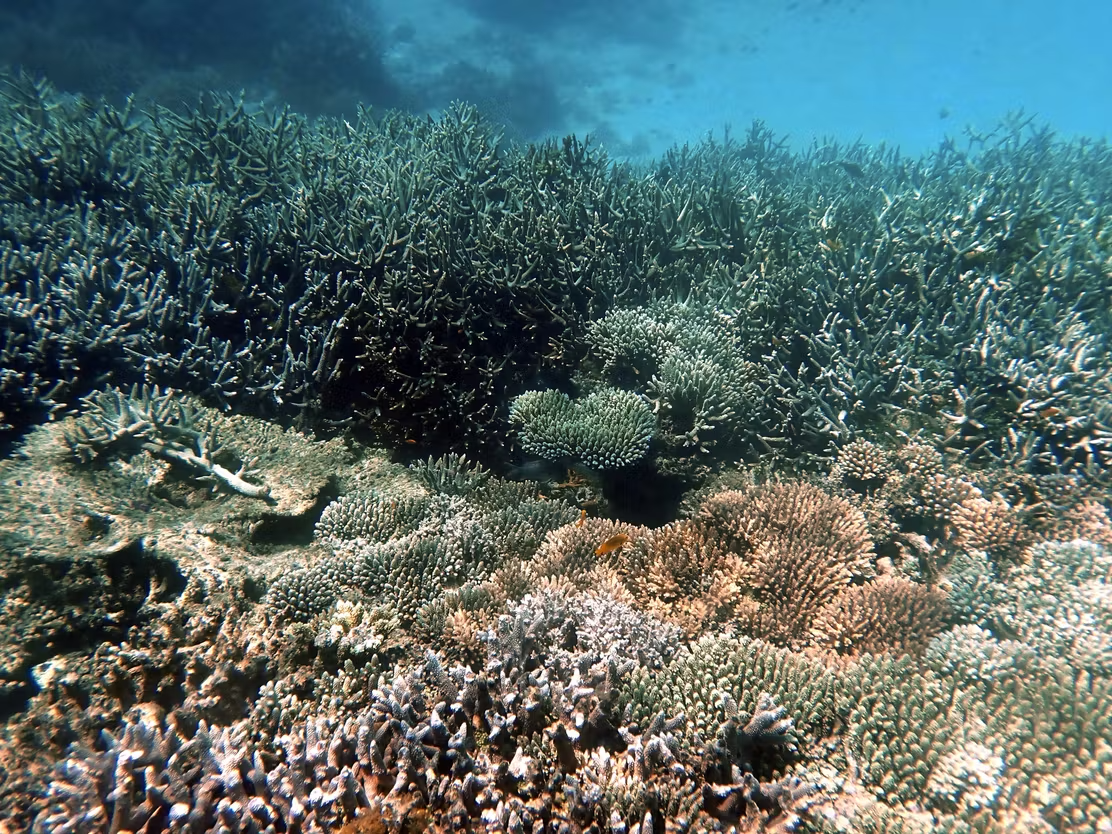
As a result of this accumulation, the structure of the ocean changes: it is stratified – the mixture of surface hot water layers and deeper and colder waters becomes increasingly difficult. « This further amplifies the warming on the surface, » says Thibault Guinaldo. Overseas territories, such as Mayotte, would be particularly exposed to a new furnace. These islands are very sensitive to waves of marine heat that are, among other things, maleating coral reefs, subject to bleaching episodes. « However, these are home to a monumental diversity that allows fishing for example, but they also serve to protect the coasts from waves and submersion, » details the oceanographer.
The Mediterranean is « tropicalized »
The intensification of phenomena alarms researchers, including near France. The Mediterranean, for example, is « tropicalizing »: several waves of marine heat have followed one another in recent years, leading, for example, to a major episode of gorgon mortality in 2022.
These overheating is exhausting ecosystems. « It’s as if we had a forest fire every year, » summarizes Nathaniel Bensoussan, researcher at Ifremer. The warming of the waters occurs on the surface, but also more in depth: « It’s the two that you have to look at, to take the pulse of the ocean, » says the scientist.
Species that can move are also affected. « The accumulation of years marked by extreme thermal conditions poses the risk of seeing large fish populations disappear in the near future, » worries Shahar Chaikin, an ecologist at the Museum 3/4.
With more than 21 °C on average, the ocean is close to new national temperature records for the natural sciences of Spain in Madrid. Rising temperatures are disrupting reproduction and the development of marine species.
Certainly, some populations seem to take advantage of higher temperatures, according to the work that Shahar Chaikin published at the end of March in the journal Nature Ecology and Evolution. This is the case of the sprat, a fish that resembles herring and can enjoy warmer waters in the Baltic Sea. But vertebrates are vulnerable in the western Mediterranean – the semi-closed sea is located at the « warm » limit of its range.
In the oceans, impressive temperature records and the localized benefits of hot years and marine heat waves can give « the illusion of an abundance of fish, but this is temporary, says Shahar Chaikin. Global warming of our oceans leads to a large-scale decline in fish biomass. » The researcher suggests integrating these issues into fisheries management systems, especially since marine species are affected by many other anthropogenic pressures. Among them: water acidification, which results from the dissolution of CO2 at sea and therefore also from greenhouse gas emissions from human activities. « The climate crisis and the biodiversity crisis are two sides of the same piece, » observes Nathaniel Bensoussan, of Ifremer, who insists on the speed of the changes underway.
source Le Monde