
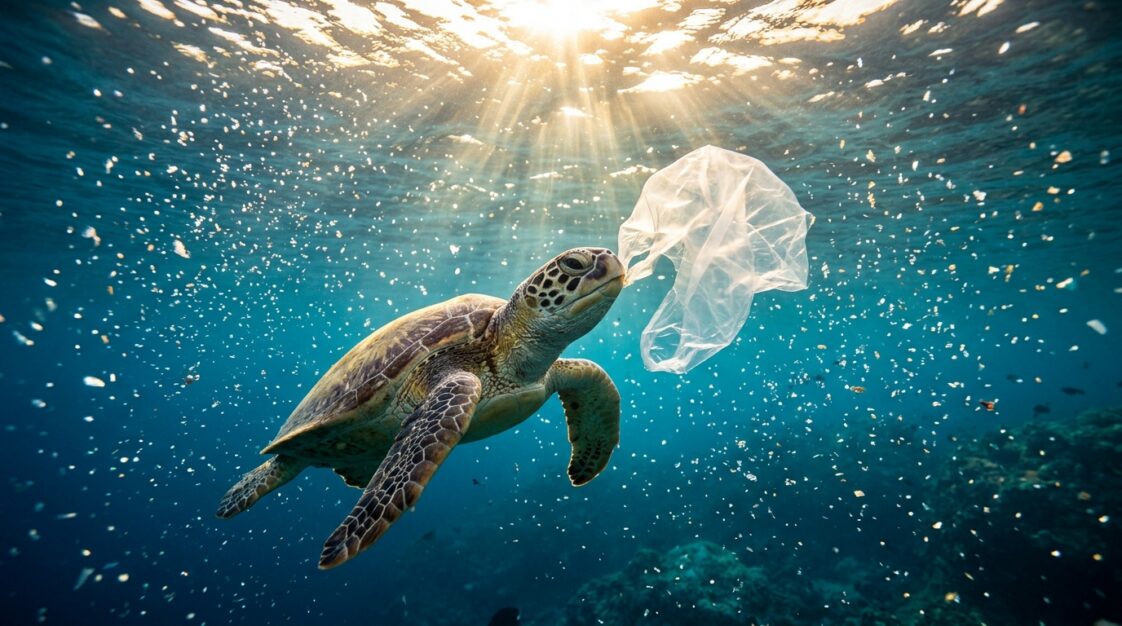
Imagine a huge bathtub, filled with salt water, where we would throw every year enough to fill hundreds of garbage trucks with plastic, without ever emptying the bathtub. This is pretty much what is at stake in the Mediterranean. The problem has been known for a long time: this sea is sing with plastic waste. The cause is more surprising than it seems, because it is not only due to our unbridled consumption of disposable objects, but to the very geography of this sea, almost hermetically closed, and to a few countries that, alone, concentrate most of the discharges. According to data compiled by IUCN, the International Union for Conservation of Nature, about 229,000 tons of plastic rush into Mediterranean waters every year. A dizzying figure that deserves to be discussed, as it reveals both ecological and human mechanisms that are exciting to dissect.To remember
- The Mediterranean, an almost closed sea whose waters are renewed in about a century, permanently traps the plastic waste it receives.
- Egypt (74,000 tons), Italy (34,000 tons) and Turkey (24,000 tons) are the three main countries responsible for these plastic discharges, according to the IUCN Mare Plasticum report.
- This plastic fragments into microplastics that contaminate plankton, fish and move the food chain up to seafood consumed by humans.
Summary
- A closed sea that never rinses its waste
- Egypt, Italy and Turkey, the trio that pollutes the most
- Microplastics even in the fish on our plates
- What this figure reveals about the future of the Mediterranean
A closed sea that never rinses its waste
The Mediterranean is not an ocean like any other. It is an almost closed sea, connected to the Atlantic by the only Strait of Gibraltar, a bottleneck a few kilometers wide. Result: water exchanges with the high sea are extremely slow. It is estimated that it will take about a century for all the Mediterranean waters to be completely renewed. In other words, what enters this sea remains there for a very long time, stuck between the European, African and Middle Eastern coasts.
This phenomenon transforms the Mediterranean into a kind of basin where plastic waste accumulates without ever being really evacuated. Unlike an open ocean, where currents disperse part of the pollution over thousands of kilometers, here a large part remains trapped. The seabed, beaches and surface currents are gradually becoming real waste reservoirs, which partly explains why this sea, which represents only a tiny portion of the world’s oceans, is now one of the most polluted on the planet in terms of plastic.
Egypt, Italy and Turkey, the trio that pollutes the most
Behind this overall figure of 229,000 tons lies a precise geographical reality. According to the Mare Plasticum: The Mediterranean report, published in 2020 by the IUCN, three countries concentrate the overwhelming majority of plastic discharges in this sea. In the lead, Egypt, with about 74,000 tons dumped each year, followed by Italy, which rejects nearly 34,000 tons, and finally Turkey, responsible for about 24,000 tons. Together, these countries therefore represent more than half of the total volume of plastic that enters the Mediterranean Sea each year.
How to explain these figures? Several factors are combined. First, a failing management of waste on land, with collection and treatment systems often overtaken by the scale of plastic production. Secondly, a particularly high coastal population density in these regions, where millions of inhabitants live in the immediate vicinity of the coast, multiplying the risks of waste leaking into the sea. Finally, the lack of adapted recycling infrastructure only aggravates the situation, letting what could have been recovered or treated correctly run towards the waves.
Microplastics even in the fish on our plates
This plastic does not remain forever in the form of recognizable bottles or bags. Under the effect of the sun, salt and waves, it gradually fragments into tiny particles, the famous microplastics, invisible to the naked eye but present throughout the water column. These fragments end up being ingested by plankton, then by small fish, which are themselves eaten by larger species, thus going up the entire food chain to our plates.
The Mediterranean, with its water that renews itself very slowly, acts as a real concentrator of these particles. Fish, crustaceans and shellfish caught in these waters can thus contain traces of microplastics, a phenomenon that is increasingly worrying scientists working on food security and the health of marine ecosystems. A subject that, at this time when stalls are full of Mediterranean seafood, deserves to be kept in mind.
What this figure reveals about the future of the Mediterranean
This figure of 229,000 tonnes is not just an isolated statistic, it reflects a fundamental trend. As long as global plastic production continues to increase and waste treatment infrastructure struggles to keep up in some riparian countries, this pollution is likely to worsen rather than subside. The unique geographical configuration of the Mediterranean, unable to quickly evacuate what it receives, acts as a relentless revealer of our collective failures in waste management.
Faced with this observation, efforts are already in several riparian countries to improve collection and recycling, but the road is still long. The good news is that a closed sea can also become a formidable laboratory for testing large-scale solutions, since the effects of a reduction in discharges would be felt more quickly than elsewhere.
In summary, these 229,000 tons per year tell much more than just marine pollution, they draw the contours of a challenge shared between several nations, where geography amplifies every management error. It remains to be seen whether the countries concerned will be able to transform this alarming observation into a real lever for action before the Mediterranean definitively becomes this bathtub whose water could never be emptied again.