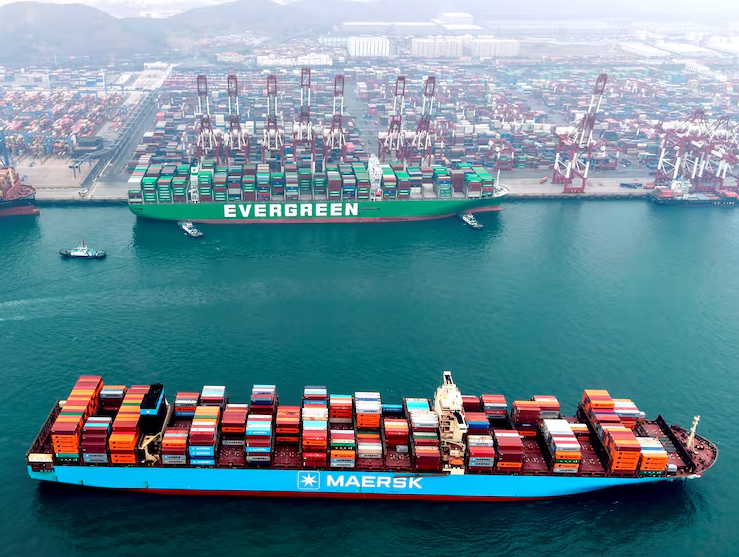
THE FIGURE OF THE WEEK. Global crude oil transport has declined since the 2000s, in favor of dry cargo. Of the top five ports for container traffic, four are Chinese.
According to estimates from the United Nations Conference on Trade and Development (UNCTAD), global maritime transport, which carries more than 80% of international merchandise trade, increased in volume by 0.5% in 2025 compared to 2024, when it reached 12.72 billion tons. Meanwhile, containerized trade saw a 1.4% increase last year.
« Until the early 2000s, maritime trade was dominated by liquid bulk cargo, mainly oil, » notes UNCTAD. « But with the rise of containerization and the expansion of global value chains, it has shifted towards dry goods, including coal, iron ore, cereals, and manufactured products. »
As a result, the share of crude oil fell from 29% in 2000 to 18% in 2023, while that of dry bulk goods increased from 27% to 36% over the same period.
The world fleet and its 112,500 merchant ships
Meanwhile, the share of developing countries in global maritime freight increased from 38% in 2000 to 54% in 2023, a significant rise driven primarily by Asia, and especially China. According to data compiled by the logistics and transport platform Upply, fifteen of the world’s top twenty ports for container traffic were projected to be located in Asia by 2025, with Chinese ports securing four of the top five spots and six of the top ten.
As of January 1 , 2025, the global fleet comprised 112,500 merchant ships, with a total capacity of 2.44 billion deadweight tons (DWT). The three main flags of registration for merchant ships were Liberia (17.4%), Panama (15.2%), and the Marshall Islands (12.5%), together accounting for nearly half (45.1%) of global shipping capacity.
The three main countries of origin of the ships accounted for 40.7% of the world fleet, with Greece ranking first, with a share of 16.4%, ahead of China (14.4%) and Japan (9.9%).
source : le point