
In 2024, the NRP Arpão will become the first Portuguese Navy submarine to operate under the ice pack. This mission has been closely studied by Canada, which is seeking to strengthen its fleet and expand its tactical options for submarine warfare in the far north.
In 2024, the NRP Arpão , a submarine of the Portuguese Navy, marked a historic first by operating under the Arctic ice pack, an area long considered to be reserved for powers with nuclear submarines.
Canada, engaged in a major modernization of its submarine fleet and facing increasing challenges in the Arctic, is closely following the lessons learned from the NRP Arpão mission . Ottawa considers the ability to operate under ice a central criterion for its future submarines, in a context where the Arctic occupies a major strategic place for its sovereignty and security.
A rapidly changing and increasingly frequented Arctic
Arctic sea ice is warming almost four times faster than the rest of the planet, opening up new shipping routes and economic opportunities. For centuries, the far north has also been observed as a scientific area and a reservoir of strategic resources.
The latest report from the Arctic Council (source in Portuguese) reports a 40% increase in the number of distinct vessels operating in this area over the past 12 years, while the distance travelled has jumped by 95%, from 6.1 million to 11.9 million nautical miles.
This data includes the fleets of the eight Arctic states (United States, Canada, Iceland, Norway, Sweden, Finland, Denmark and Russia), as well as those that frequently enter the area delimited by the Polar Code under the flag of the Arctic Council observer states.
Extreme navigation
Navigation there remains extremely difficult. Warming weakens the ice, making it thinner and more unstable, leading to increased fragmentation and the formation of unpredictable icebergs and drifting ice floes. In densely populated areas, a conventional submarine with limited range may even be unable to surface, with additional risks of flooding or fire.
Since the 1950s, only nuclear propulsion has allowed for prolonged operations under the ice.

Arpão Marinha submarine
The Arpão, a first Western operation under the ice floe
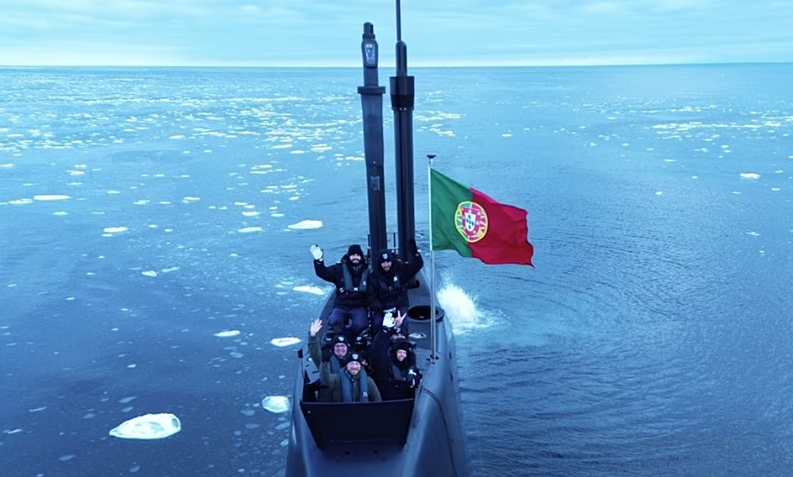
Between April and June 2024, despite reservations expressed, including within NATO, the Portuguese submarine Arpão carried out a mission under the ice pack off Greenland.
Commanded by Commander Taveira Pinto, the crew of about thirty sailors remained under the ice for four days, demonstrating advanced operational mastery and crossing thresholds previously considered inaccessible.
Portugal thus joins a very small circle of countries – the United States, the United Kingdom and Russia – that have already conducted operations under the polar ice cap, until now using nuclear submarines.
The NRP Arpão departed Lisbon on April 3, 2024, as part of NATO’s Operation Brilliant Shield , for a 78-day mission conducted with the support of the US, Canadian, and Danish navies. In total, the submarine accumulated 1,800 hours of navigation, including 1,500 hours submerged.

Former Chief of Naval Staff, Gouveia e Melo, on board the submarine Arpão in the Arctic Marinha de Portugal
This mission was made possible by the air-independent propulsion (AIP) system, which allows the submarine to generate power while submerged without external air, extending its endurance to several weeks. It also relied on seven months of preparation, including a thorough study of the area and technical adaptations, notably the installation of a high-frequency sonar and sensors dedicated to detecting and measuring ice, as well as enhanced protection for sensitive equipment.
In the official documentary about this experience, former Chief of Staff of the Portuguese Navy Gouveia e Melo recounts that the crew of the Arpão encountered veritable « mountains » of ice that extended up to 90 meters below the surface.
With initial support from American specialists, the Portuguese Navy emphasizes that it has largely developed its capabilities for analysis, operational readiness and sensor operation independently.

Marginal ice zone in the Arctic Marinha de Portugal
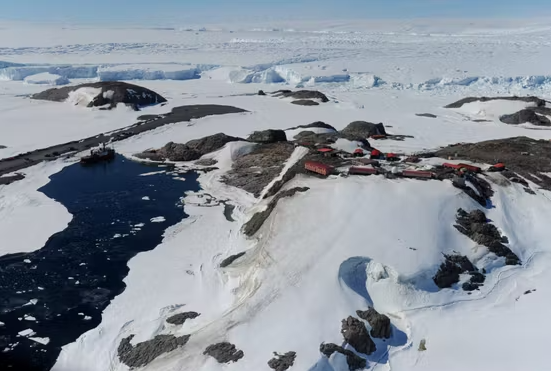
One of the key moments of the mission was the operation in the Marginal Ice Zone (MIZ), an unstable area where compact ice meets open water. Characterized by fragmented ice, unpredictable trajectories, and high ambient noise that interferes with sonar, this zone had been largely avoided until now. No Western submarine had ventured there since World War II.
By developing a technique allowing operation at periscope depth under these conditions, the Arpão transformed this space into a navigable zone with a level of safety deemed acceptable.
« The technique developed by the NRP Arpão to return to the periscope depth made the difference and made it possible to transform a traditionally avoided area into a space where it is now possible to operate under acceptable safety conditions, » the Navy stated.

Arpão submarine in the Marinha de Portugal marginal ice zone
Operational expertise exported to allies, particularly Canada
Beyond performance, the mission produced unprecedented operational knowledge, recorded in an Arctic navigation manual intended for its allies.
This feedback includes the analysis of acoustic conditions, ice assessment, risk management, and the adaptation of procedures. These lessons have already been incorporated by Canada to adjust its future submarine fleet and strengthen its ability to operate in the Arctic, which represents a major part of its territory and coastline.
« What struck me most was the way the crew of the NRP Arpão and the Portuguese Navy approached the mission. They were calm, professional and meticulously prepared, » Harrison Nguyen-Huynh, commander of the Canadian Navy, who was on board the Arpão during the 2024 operation as a liaison officer, responsible for supporting the crew, told Euronews.

Harrison Nguyen – Huynh, Deputy Commander of the Canadian Submarine Force
Commending the attitude and spirit of cooperation of the Portuguese submariners, Commander Nguyen stressed that this NATO exercise provided another important opportunity for collaboration with allies « in order to obtain information on some of the challenges of the operation in the North ».
Modernization of the Canadian submarine fleet
The Portuguese experience is of direct interest to Ottawa, which has been engaged since 2021 in a vast program to renew its submarine fleet.
In a press release (source in Portuguese) published in August 2025, the Canadian government, led by Mark Carney, confirmed its intention to purchase up to 12 submarines to replace the Victoria-class vessels by the end of the 2030s, with a particular focus on their ability to operate in the Arctic environment. This potentially colossal project could cost up to $100 billion, according to the Canadian daily newspaper, the Ottawa Citizen (source in Portuguese) .
According to the same newspaper, this could be the largest military acquisition in Canadian history. The government wants to expedite the process, and the contract could be signed this year, but the Canadian Navy already estimated in 2025 that the first submarine would not be fully operational until 2037.
The new submersibles will not arrive with all the capabilities necessary for navigation under Arctic ice, revealed Canadian Navy Vice Admiral Angus Topshee, quoted by The Globe and Mail.

Arpão Marinha de Portugal
Another essential aspect, Harrison Nguyen-Huynh points out, is the efficiency, largely ensured during the 2024 mission by the specialized sonar installed atop the conning tower, which was used to map the surface ice and detect areas of open water. Arctic operations require two-dimensional vision (upward and downward), and by integrating this additional capability to monitor the ice ceiling , the Arpão provided more refined maritime situational awareness.
For future Arctic missions with diesel-electric submarines, the Portuguese experience provides important guidance for conducting static maneuvers and understanding the specific characteristics of the marginal zone, where noise generated by ice movement affects sensor performance. The mixing of fresh and salt water can also influence sound propagation and analysis, notes the Canadian NATO Association (source in Portuguese). The recordings made by the Portuguese will therefore be a valuable resource for, for example, better identifying false echoes near the ice and improving detection.
The Navy told Euronews that the results achieved by the Arpão were received a « very positive reception » by allies and that, after the mission, several meetings were organized to share knowledge and define « lines of action for future plans » .
« Sharing information and best practices with our allies strengthens our collective capability and increases the effectiveness of our operations , » says Commander Nguyen, emphasizing that Canada, as an « Arctic nation , » considers campaigns conducted in the « North » as « essential » to the protection of its sovereignty.
Portugal, a credible actor within NATO in the Arctic
At this stage, Lisbon does not foresee any new submarine missions in the Arctic, citing « other operational and strategic priorities » , but remains attentive to a region « where geopolitical competition is intensifying » .
The Arctic is indeed becoming increasingly militarized. Russia is concentrating significant resources there, particularly on the Kola Peninsula, where it deploys nuclear submarines, while its activity is intensifying around the strategic GIUK passage, key to accessing the North Atlantic. According to NATO officials, this level of activity could now surpass that of the Cold War.
Meanwhile, China, which defines itself as a « quasi-arctic state » , is continuing its investments in the « Polar Silk Road » , aiming to develop new trade routes between Asia and Europe.
In this context, the Portuguese Navy affirms that it is contributing to a « collective effort » for stability, recalling that deterrence and the defense of the Euro-Atlantic area rely on concrete and operational capabilities.

Arpão in the Arctic Marinha de Portugal
The mission of the NRP Arpão demonstrates that, despite their limitations, conventional submarines can play an increased role in underwater warfare, including under ice. While slower and less endurance-capable than their nuclear counterparts, they offer a key advantage: greater stealth when operating on batteries, invaluable for surveillance and intelligence missions.
Operating in the North Atlantic « requires the ability to detect, track and, if necessary, counter underwater threats » , which involves « effective mastery of the different dimensions of combat » , the Portuguese Navy emphasizes.
On the political front, Portugal has proven itself to be a « credible actor » in the defense of the Alliance, with a range of action well beyond its immediate area, extending to « geographical spaces far from its continental territory but directly linked to the security of the Atlantic » .

Arpão Marinha
« At a time when NATO is increasing its focus on the High North, countries that have already demonstrated a real capacity to operate in this environment become particularly valuable partners , » says Sá Granja, adding that « the strategic relevance » of a country the size of Portugal is not only due to « the scale of its resources » , but also to « its ability to offer differentiated skills useful to the Alliance » .
The Navy will continue to monitor developments in the Arctic and says it is « ready, if asked, to contribute again in similar scenarios » , particularly within the framework of NATO.
source : euro news