
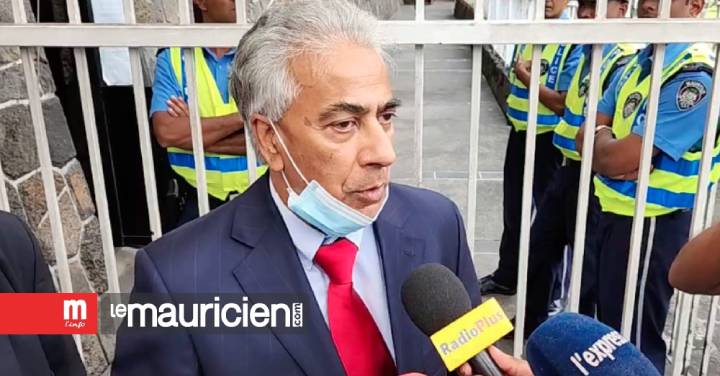
The launch of Ocean Week marks a « pirching moment » for Mauritius, called to accelerate its transition to a sustainable and resilient blue economy. This is what the Minister of Agro-Industry said. He reiterates the fact that the country has one of the largest exclusive economic zones (EEZ) in Africa — the 20th largest in the world.
Dealying on the responsibilities that result, the minister makes it clear that « as a large oceanic state and small island state in development, we have rights, but also the obligation to adopt sustainable oceanic plans. «
The conference is structured around three high-level round tables devoted to blue finance, renewable marine energies and the blue economy. « The ocean represents much more than a natural heritage. It is the next economic, social and environmental frontier. If the ocean economy already contributes about 10% of GDP, the objective is clear: to double this contribution in ten years, » he says.- Advertising –
However, Arvin Boolell warned that this expansion should not be at the expense of biodiversity. « A well-protected and sustainable ocean offers opportunities for increased sustainable economic activity or new derivative of the ocean. Progress and prospects for ocean-related energy, such as offshore wind and tidal energy, look promising. Aquaculture and maritime trade, among others, are key sectors that deserve a priority, » he says.
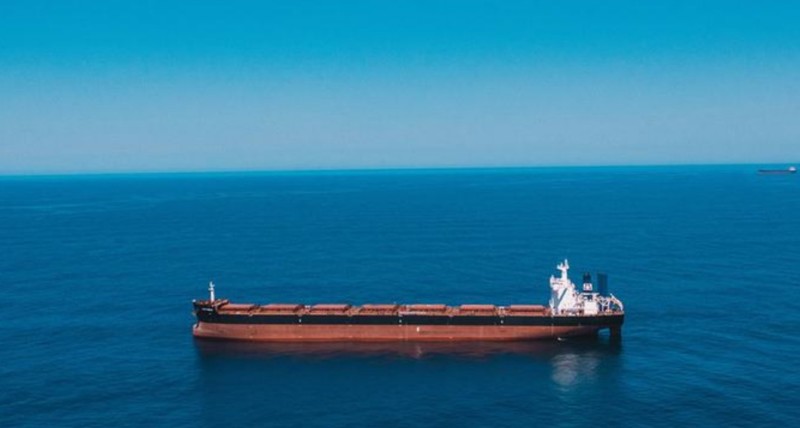
The minister mentioned the lessons learned from the coastal erosion in Tamarin as well as the Wakashio Oil Spill oil spill, noting the importance of protecting and restoring marine ecosystems. « There are lessons to be learned from the wreck of Wakashio and the application of Innocent passage as defined by UNCLOS Article 19.
Damage means legal repair. Our case will be heard before the international court. As a responsible sovernment, we have released the findings of the report of the Court of Investigation on wreck of Wakashio the third biggest cape size vessel, » he continues.
« Coral reefs and Mangroves are natural fortresses, » he argues, highlighting their role in coastal protection and carbon capture.
Priority sectors include aquaculture, maritime trade, and marine energy, including offshore wind and tidal energy. The minister reaffirms the importance of fighting illegal, unreported and unregulated fishing (IUU), responsible for estimated losses of between $10 billion and $11 billion per year in the SADC region. « Tuna is our white gold, » he says.
At the strategic level, four lines of action have been defined. The first concerns the human, with a call for better integration between economic sectors, from tourism to fisheries to energy.
« Transforming Mauritius into an attractive island port, with transhipment regardless of the performance of leading container ports, is a top priority for our government. Mauritius will be the star and the key to the Indian Ocean. The passage of more than 38,000 ships on the South-West Sea Route is an opportunity. The escalation of tensions in the Middle East gives us a comparative advantage. We pray for a lasting peace, « he says.
The second axis concerns politics, with a bill on the blue economy and the creation of dedicated institutions to structure the sector. « Renowned legal advisor Judith Swan worked on the bill, including a policy development framework designed to guide the country towards a diversified and sustainable blue economy. This will pave the way for the establishment of the Department of the Blue Economy and a Blue Economy Council, both with very distinct but interconnected mandates, » he announces.
The third pillar, finance, focuses on innovative mechanisms such as blue bonds and debt-to-nature exchanges. He noted that blue finance is an emerging concept.
For his part, Junior Minister Fabrice David participated in a peer exchange in Cape Verde and, since then, a committee has been working to exploit the mechanism of innovative financing tools.
The minister also cited the example of the Seychelles, which significantly expanded their marine protected areas and issued the first sovereign blue bond in 2018.
Finally, science is the fourth lever, with projects focused on blue carbon and ecosystem restoration. The ministry is working on a project to promote the research, conservation and restoration of these ecosystems through a voluntary blue carbon market mechanism.
“Smangroves, seagrass meadows and coral reefs are not just ecosystems but natural fortresses. They protect us against erosion, provide nurseries for fish and capture carbon at ten times higher rates than terrestrial forests. Mauritius has the largest carbon sink in the Indian Ocean. The Mahla Saya, with its vast area of sea herbariums, is the Amazon of the ocean, « acknowledges the Minister of Agro-Industry.
In addition, the National Blue Carbon Task Force, the National Coral Reef Network and the Sea Turtle Network are in the process of relaunching to collaborate with the public, private sector and NGOs, strengthening conservation and restoration programs and giving new impetus to the protection and conservation of marine ecosystems. As a result, Mauritius intends to develop a Blue Carbon Tech Hub with the support of the United Nations Development Program (UNDP).
In conclusion, Arvin Boolell called for a collective mobilization by saying that « Ocean Week is more than an event. It’s time to write a new chapter, fully involving the younger generations. »
source : le mauricien