
After spending years destroying corals when he was a fisherman, Yerson Granados now plants them delicately, like a gardener, to save them from extinction in the Colombian Caribbean.
The dynamite, nets and anchors used for fishing are now a thing of the past: at 56, Mr. Granados became a guardian of the sea.
He is part of a group of former fishermen who joined a project to rebuild the coral ecosystem in the tourist town of Santa Marta, in northern Colombia.

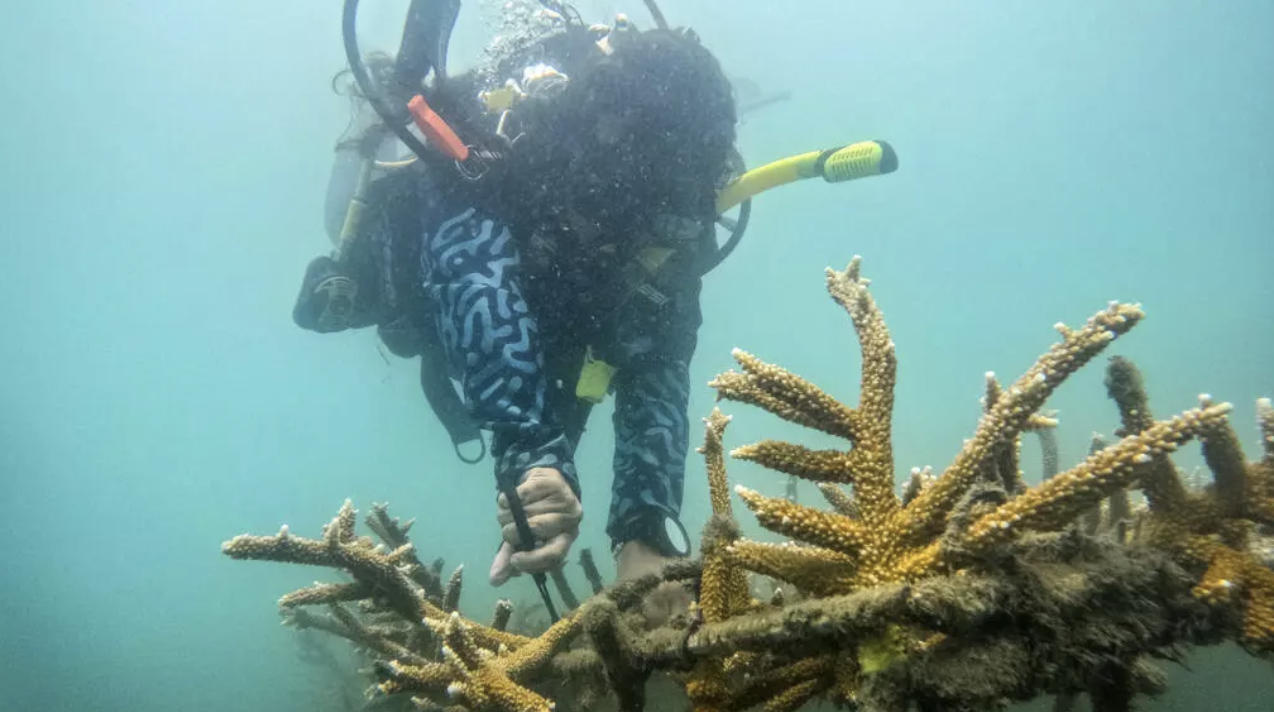
A coral farmer, as part of an environmental initiative, on April 19, 2026 in Santa Marta, Colombia © Luis ACOSTA / AFP
In a diving suit, he fixes coral fragments on a structure that he then places in the sea to repopulate this area. Corals that have grown in this nursery are transplanted into reefs once they have reached the appropriate size.
Yerson Granados’ job is also to dive with an oxygen tank to monitor plantations 10 meters deep.
At one time, the former fisherman did not understand the impact of the destruction of these ecosystems, he says half submerged, a diving mask on the front.

Former fisherman Yerson Granados in Santa Marta, Colombia on April 19, 2026 © Luis ACOSTA / AFP
« Before, we damaged » the coral, « we did not know it was a living being, for us it looked like stones, » he confides in an interview with AFP. Today, he knows he has to protect them because corals are « like homes for fish ».
Other former fishermen participating in the project have also become aware of the stakes. « For me, a coral, now it’s life, » says Kevin Monsalvo, 26.
Diana Tarazona, scientific director of the CIM Caribe Foundation, highlights the key role of fishermen in reviving these « underwater cities ». « Working with them means accessing (…) their innate knowledge » about marine life, she says.

Fish near corals replanted in a nursery in a bay in Santa Marta, Colombia, on April 19, 2026 © Luis ACOSTA / AFP
The NGO claims 1.5 hectares of about twenty species of coral planted since 2017, thanks to the work of Mr. Granados and other converted fishermen.
It aims to restore some 36 hectares by 2030 in a country whose coral areas are also affected by rising sea temperatures.
According to the International Union for Conservation of Nature, 44% of coral species in the world were « threatened with extinction » in 2024, mainly due to climate change.
source : france 24