
To assess sea cucumber stocks and determine fishing quotas in the Saint-Pierre-et-Miquelon area in 2025, Ifremer scientists used cameras instead of trawlers. They have already allowed them to detect concentrations in certain places.
To feed themselves, one of the techniques of sea cucumbers is to suck up the sand and sediment from the seabed, which they release cleaned of their organic waste, which they have absorbed. They thus contribute to the oxygenation and good health of the oceans. Hence the fishing quotas.
A fragile species
« We know that this species is very sensitive to exploitation. After ten, twenty years, overexploited stocks have disappeared in the Arctic zone, » recalls Laurent Dubroca, researcher at the French Institute for Research for the Exploitation of the Sea (Ifremer), head of the fishing laboratory of Port-en-Bessin, which works with Saint-Pierre-et-Miquelon. In 2025, he directly participated in the stock assessment mission in the archipelago’s fishing zone.
Ifremer has been conducting evaluation campaigns on the territory since 2021, financed as part of the State’s fishing plan. Main objective: to determine which quantities can be fished without endangering the sustainability of the stock. In other words, the quota that will be fixed by prefectural order.
Videos that can also provide knowledge about the shell
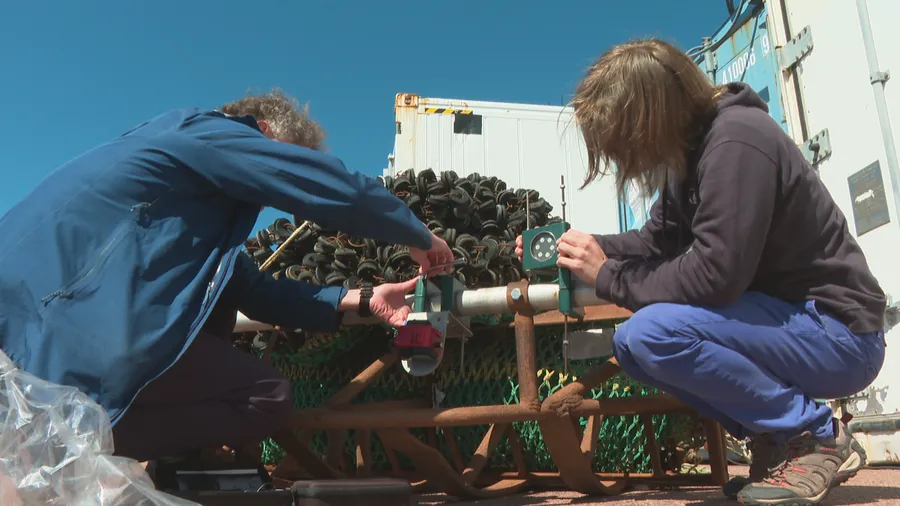
In 2025, the evaluation technique has changed. Rather than trawls, with which holothuries are brought back on board before being counted, they were used cameras. Clinging to a dredge, dragged for 500 or 600 meters, they make it possible to explore the spatial distribution of these very special animals.
« Are they scattered, aggregated, is there a law, are they distributed at random? Is there a link with the typology of sediments? What is the link with exploitation?” So many questions that scientists have begun to look at from the videos.
Concentrations so far unexplained
In particular, they observed « stronger concentration areas » in some places. Without being able to establish a relationship with the types of sediments for the moment. Eventually, they hope to be able to create models of population dynamics and provide finer assessments.
A topic of the Science Congress 2026
A first scientific publication is planned by the summer, before a more general public decryption at the Saint-Pierre-et-Miquelon Aquatic Sciences Congress, in September/October 2026, where a global sea cucumber specialist is expected.
After a blank year due to a lack of agreement with Canada and processing opportunities here, the sea cucumber fishing campaign may have started.
Even if it did not resume, « it is important to continue this work, » says Laurent Dubroca. For several reasons. « Currently, there is a lack of knowledge about the sea cucumber. »The video “also gives a vision of other species in the area, scallops for example.” Data that could one day also be exploited.
In any case, resources have been allocated by the State to continue the evaluations until 2030. That of 2026 has not yet been able to take place, the new public contract is not finalized.
source : franceinfo