Many think he is already gone, and others believe he is condemned. The legendary dugong is still observed in Mayotte, which is said to have six individuals. The associations want to protect the last individuals.
At the helm of his boat north of Mayotte, El Assad Makine remembers the only time he met a dugong, this large herbivorous marine mammal so rare in the Mahorais lagoon that he became an almost legendary figure.
« It was a normal day. I was at the M’tsamboro island, » says the nautical service provider, known as Giggs. Shortly after lunch, children say they saw a « weirde douphin » resembling a seal.
« There, I immediately knew that they were talking about the dugong, » he continues. Neither one nor two, he flies his drone to immortalize the show: a mother and her little one swimming in the turquoise waters of the lagoon, one of the largest and most preserved in the Indian Ocean.
Dugongs, a species decimated by fishing
For El Assad Makine, having seen this « mythical animal » is « an achievement« . Few people can boast of having seen this manatee cousin, sometimes nicknamed « sea cow ».
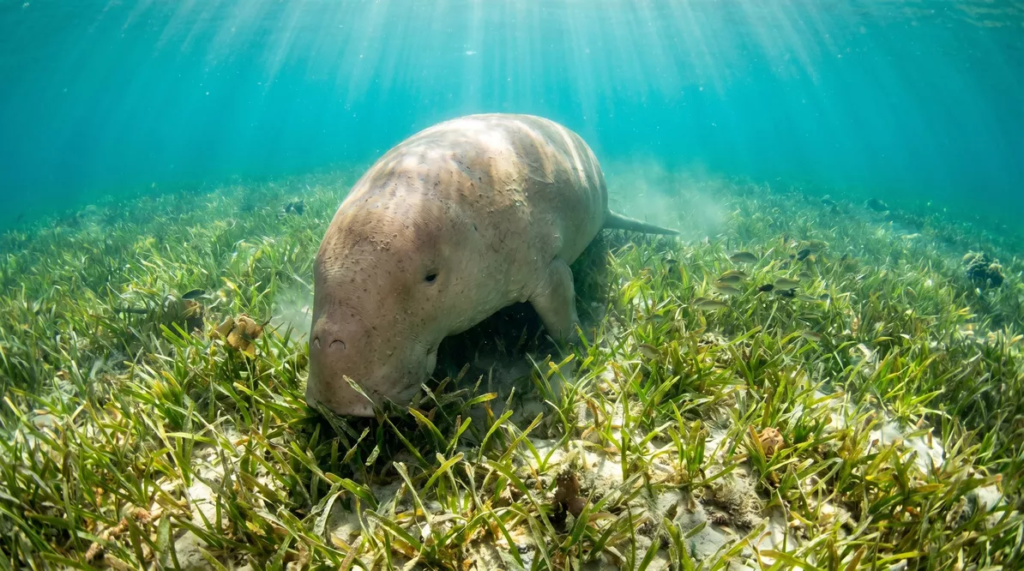
Tapered silhouette, slate gray skin, split tail like that of a whale, the dugong can reach three to four meters and weigh several hundred kilos. Peaceful grazer, it swallows tens of kilos of sea grasses every day.
The International Union for Conservation of Nature (IUCN) ranks it among the vulnerable species, and considers the subpopulation residing in the southwestern Indian Ocean « at risk ».
In Mayotte, there are only six individuals, while they were estimated at more than a hundred before the 1970s, according to David Lorieux, scientific coordinator for the Marine Mammal Protection Association Ceta’Maore
For thirty years, fishing almost decimated the species, until its protection in 1995. « The population has stagnated at less than ten since the 2000s. The alarm bell was pulled too late for it to grow again, » females can only give birth to a young child from the age of 10, then every four to seven years old, laments Mr. Lorieux.
With the persistent risks of accidental capture and the degradation of the herbs that feed it, the preservation of the dugong is essential to avoid its extinction in the 101st department of France.
Resent the dugongs still alive
On board Giggs’ boat, Auriane Serval, project manager for the conservation of dugongs at the Les Naturalistes association, is preparing to dive. Five days earlier, a dozen filtering sensors were placed in the north of the lagoon, hoping to detect the animal.
« Species lose DNA with desquamation (loss of skin cells, ed.). By analyzing this suspended DNA in the laboratory, we can determine if a dugong has passed recently, » explains the marine biologist.
Under water, she recovers the capsules at the coral level, before her team conditions the samples on the bridge. This so-called « passive » method is not the only one used. For the first time in Mayotte, an « active » filtration protocol is also used. « We have a pump at the end of which we put a filter with a membrane, to which the DNA will adhere, » details Mrs. Serval when installing the equipment.
For forty minutes, the boat slowly advances three kilometers to pump 60 liters of water. « With these two methods, we have different information: one over five days, and the other instantaneous, » justifies the scientist.
The objective of this mission launched in April: to determine when the dugongs are present, and where. « This then allows us to make a conservation effort on target areas, » she adds.
« These are not just legends »
The associations hope that by preserving the remaining individuals and their habitat, the population can one day grow back, perhaps helped by some regional migrations. A rather sedentary animal, faithful to its underwater meadows, the dugong is able to travel several hundred kilometers to reach new grasslands or warmer waters.
In the meantime, awareness remains necessary, according to David Lorieux. « People think that there are already no more, or that the dugong is already doomed. However, there are observations, it must be protected, it is not just legends, » he concludes.
source : Le Figaro