
A heat that settles outside its historical calendar
In the traditional climatology of Mediterranean countries, episodes of high heat belonged mainly to a relatively circumscribed summer window. Spring was still a phase of thermal transition, allowing a gradual adaptation of ecosystems, soils and human activities.
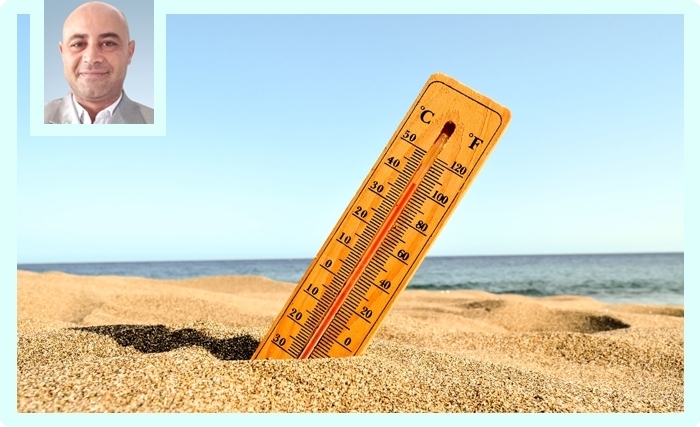
However, a discreet but significant evolution seems to be necessary: intense heat appears earlier in the year, extends over longer periods and disrupts nocturnal cooling cycles in several urban and rural areas.
This time slippage profoundly changes the perception of climate. It is no longer just about high temperatures, but a gradual extension of the hot thermal season.
A systemic transformation rather than a meteorological phenomenon
The heat wave can no longer be interpreted as a mere one-off atmospheric event. It is now a systemic factor in interaction with several components of the Mediterranean territories.
It intensifies the pressure on already structurally limited water resources. It increases the energy needs related to the cooling of urban spaces. It weakens health systems during thermal peaks. Finally, it disrupts the biological and agricultural cycles.
In this perspective, extreme heat becomes a structuring parameter of the organization of societies, in the same way as water or energy.
The Mediterranean agricultural system in the face of thermal stress
The agricultural systems of the Mediterranean basin are historically adapted to climatic regimes characterized by a high seasonality.
However, the increase in extreme temperatures, the downward trend in precipitation during certain seasons, as well as the increase in their interannual variability, gradually change the conditions of production.
Water and thermal stresses already affect several strategic crops, with impacts on plant physiology, soil fertility and yield stability. Some traditionally resilient species in Mediterranean areas now show signs of vulnerability in contexts of prolonged heat.
This evolution raises a structuring question: the transition from an adaptation agriculture to an agriculture of biological and functional resilience.
In this context, the life sciences are becoming decisive. Understanding the genetic mechanisms of stress tolerance, genetic selection assisted by genomic tools and the development of data-driven agricultural systems are essential levers. The challenge is no longer only productive: it becomes biological and genetic.
Mediterranean cities as thermal amplifiers
Urban dynamics accentuate the effects of heat waves. Soil waterproofing, built-in density and low vegetation contribute to creating urban microclimates where heat concentrates and persists, especially during the night.
In several Mediterranean cities, the decrease in nocturnal cooling becomes a phenomenon directly affecting sleep, health and social rhythms.
This situation questions the urban models inherited from the 20th century, conceived in a relatively stable climate context. It requires a progressive reconfiguration of urban planning approaches, integrating more thermal, energy and water parameters.
A silent transformation of the social relationship to climate
Beyond the material impacts, a deeper change is at work: the modification of the psychological and social relationship to the climate.
Mediterranean societies have long evolved in a relatively stable and predictable seasonal framework.Today, the multiplication of extreme episodes, the recurrence of early heat waves and the feeling of increasing climate instability introduce a form of lasting uncertainty.
This phenomenon is not only a matter of meteorology. It touches on collective representations of environmental security and long-term habitability.
Towards a scientific reading of regional climate transitions
Faced with these transformations, exclusively reactive reading becomes insufficient. The Mediterranean basin is entering a phase where scientific anticipation becomes central.
This involves several levels of action:
• The integration of environmental data into agricultural and urban planning;
• Strengthening climate extreme monitoring capabilities;
• The integration of predictive biology approaches in the adaptation of agricultural systems;
• The construction of public policies based on risk modeling.
In this perspective, the climate issue goes beyond the classic environmental field. It becomes a question of knowledge production, data infrastructure and scientific anticipation capacity.
Conclusion: the Mediterranean as a climate laboratory of the future
The Mediterranean basin could be one of the first areas in the world where the combined effects of warming, water stress and dense urbanization make some characteristics of the future climate visible today.
This region is no longer just an area exposed to climate change. It becomes a territory of advanced observation of the transformations in progress, where the contours of the constraints that will structure other regions of the world in the coming decades are already emerging.
Understanding these dynamics is no longer just about environmental analysis. It is now a question of scientific governance of natural, agricultural and social systems in transformation.
source : leaders