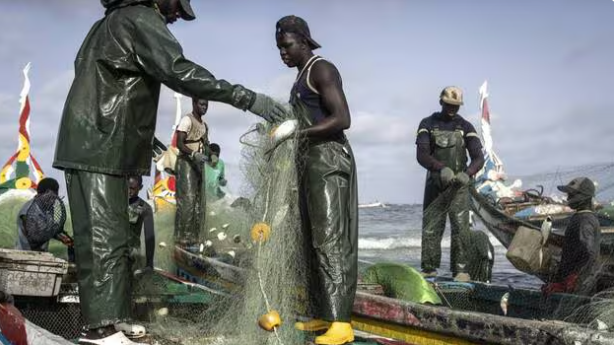

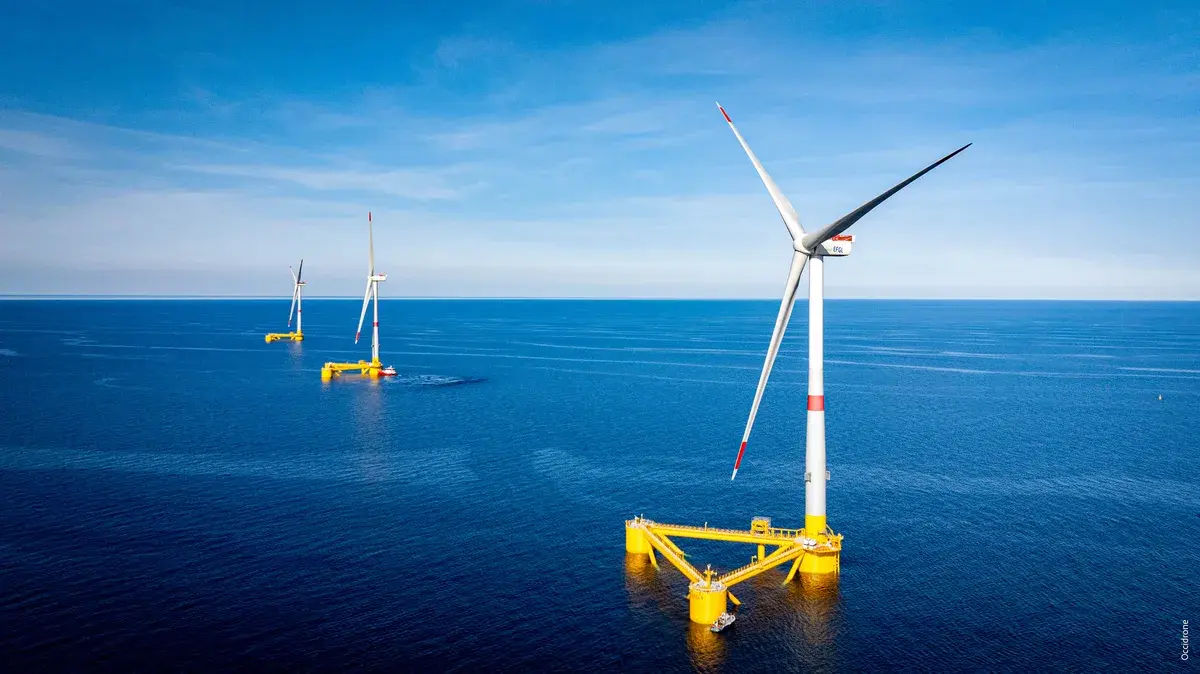
Floating wind turbines will settle in the Mediterranean. For fishermen, this means losing access to part of their work areas. In Brittany, this conflict ended in court. In the Mediterranean, a fishermen’s organization decided to sit at the developers’ table instead of waiting for the procedures.
This Tuesday, June 2, in Port-La Nouvelle, the Wind’Occ day brought together engineers, investors, elected officials and developers around a single topic: how to industrialize floating wind energy in the Mediterranean. A sector driven by a national ten gigawatt tender launched in April 2026 and by the first pilot farms that have been running for a few weeks off the coast of Leucate. In this assembly, Bertrand Wendling had an unexpected introduction. The general manager of Sathoan, an organization that brings together 110 fishing vessels on the Mediterranean facade, did not talk about megawatts or connection. He spoke of « octopom ».
« Behind every wind project, there are ecosystems, project leaders, but also fishermen, » he said at the beginning. « The question is no longer how to manage biodiversity and fisheries. It’s about knowing how we make them live together. »
Behind the formula, a reality: to install a gigawatt of floating wind power, it takes 150 to 200 square kilometers of maritime right-of-way. « In the long run, the projects planned in the French Mediterranean could represent more than 1,000 km², or about 10% of the available fishing space, » he says. The loss is quantifiable: « one million euros of turnover per year and per gigawatt produced ».For Sathoan ships, many of which are working precisely on the areas anticipated for future parks, the equation is direct.
Do not reproduce the previous one
To understand why this speech counts, we must look at what happened elsewhere. On the Atlantic façade, the dialogue between fishermen and wind promoters did not take place at the right time. So the Regional Fisheries Committee of Brittany committed itself in 2025 to an appeal against the site selected off the coast of Roscoff, frequented by about fifty ships without the possibility of postponement. In February 2026, Breton associations attacked the national energy programming itself before the Council of State. « There, the fishermen were informed, not associated. » The result: procedures that slow down projects and a lasting distrust of the profession towards the entire sector.
It is precisely this scenario that Sathoan wants to kill in the bud with « FishWind ».
Test before decisions are made
FishWind is a research-action project funded by the European Fund for Maritime Affairs, Fisheries and Aquaculture (FEAMPA) and the Occitanie Region. It is carried by Sathoan in partnership with Cepalmar, Ifremer scientists, Alès Mining School and developers including ENBW Valeco Offshore.
His principle: go to sea now, before commercial parks exist, « to document what is really practicable inside a floating wind farm ». Three areas have been pre-identified in the Mediterranean, « deep enough and far from the coasts to resemble the future parks ». In these areas, fishermen tested five types of dormant machines (bottom net, longline, sliding surface turns, trap and octopus pot), « in virtual parks reproducing the real geometry of a 250 megawatt commercial farm ».
« The idea of the FishWind project is to arrive at concrete recommendations for state services and wind project leaders, » summarizes Bertrand Wendling. The results are expected at the end of 2026, i.e. before the AO10 authorization phases. That is to say before the dice are thrown.
On the developer side, ENBW Valeco Offshore fully assumes this type of approach. « In all the territories in which we wish to establish ourselves, we work to identify solution levers by creating partnerships, by setting up R&D projects with local actors, on the one hand to have solutions specific to the needs of the territories and on the other hand to be proactive, » explains Matthew Hebert, head of the company’s fisheries and environment. It is in this sense that ENBW Valeco is also working with the Montpellier start-up Lineup Ocean on eco-designed modules designed to enrich biodiversity even inside the parks.
Compensate for what you take away with what you create
« Our vision is to imagine a future where offshore platforms will be only industrial areas, but also living habitats where ecosystems can regenerate and where fishing can still have its place. We do not adopt the sea to the industry. We are looking to adapt the industry to regenerate the sea, » says Bertrand Wendling.
This is where FishWind changes its nature and carries a more ambitious scientific bet. If parks inevitably reduce the available fishing space, can they at least replenish some of the fishing resource? The project is working on eco-designed artificial reefs to be deployed inside parks, compatible according to Matthew Hebert with « the installation, maintenance and removal of parks », an essential condition for developers to agree to integrate them into their projects.
FishWind plans to « make one or two experimental modules by the end of 2026 », then follow them for three to five years in a real park.
This is not a solution to the loss of surface. The actors themselves do not claim it. It is an attempt to prove that fishermen, rather than undergoing decisions, can shape the conditions.
source : echo des tribunes