MENA Oceans Initiative , June 8, 2026, World Ocean Day 1 2026 Theme: Solid MPAs for our blue planet
For the first time in history, more than 10% of the world’s ocean is located within an officially designated marine protected area. Achieved in early 2026, this milestone reflects more than a decade of sustained political commitment, scientific advocacy, and multilateral cooperation.
The theme of World Ocean Day 2026, “Strong Marine Protected Areas for Our Blue Planet,” builds on this foundation and directly addresses the actions needed to make this possibility a regional success. “Strong” refers to the fully enabling environment that an MPA requires: science-based design, active and resource-rich management, meaningful regulatory protection, and the genuine involvement of coastal communities as partners in responsible management. These are the characteristics that distinguish MPAs that ensure ecological recovery from those that continue to build it.
The global vision: a decade of momentum and the road to 30×30
As recently as January 2025, ocean protection coverage stood at 8.2%. By December 2025, it had climbed to 9.9%, the largest annual increase in nearly a decade, driven by major designations across the Pacific, Atlantic, and Indian Oceans. The entry into force of the BBNJ Agreement (the High Seas Treaty) at the UN General Assembly in September 2025 represents the most significant structural advance: for the first time, international law provides a mechanism for establishing MPAs in waters beyond national jurisdiction, which cover 61% of the world’s oceans.
The challenge now is to close the remaining 20 percentage points by 2030, as required by Target 3 of the Kunming-Montreal Global Biodiversity Framework – the 30×30 commitment to which 196 nations are party. Science published in npj Ocean Sustainability in late 2025 clearly shows that successful conservation depends not on the area enclosed, but on the quality of the protection it provides. The Marine Protection Atlas, applying the framework of the Peer-Reviewed MPA Guide, reports that by March 2026, approximately 3.3% of the world’s ocean is fully or strongly protected in practice – reflecting the time, resources, and institutional capacity required to move a protected area from political commitment to active on-water management.

MENA marine conservation landscape: shared dynamics across distinct marine landscapes
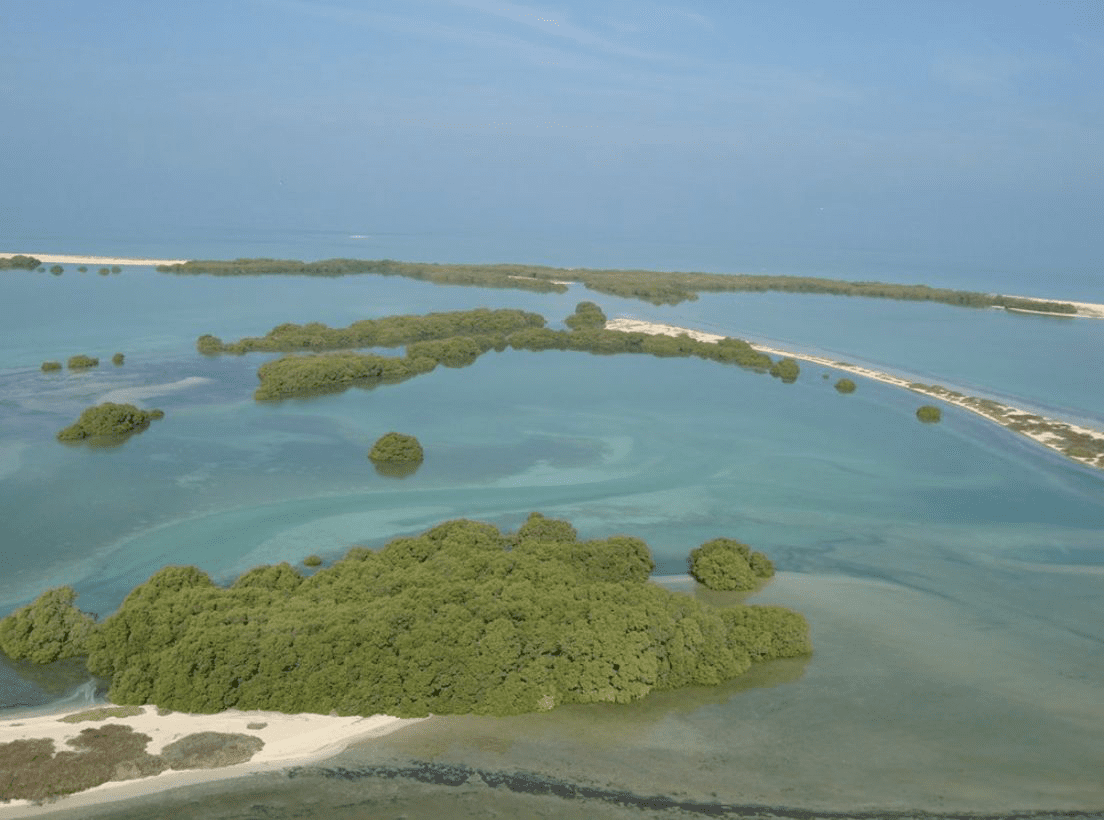
The MENA region spans three ecologically distinct marine environments: the Mediterranean, the Red Sea and the Arabian Gulf, each with its own conservation landscape, governance frameworks and trajectory of progress.
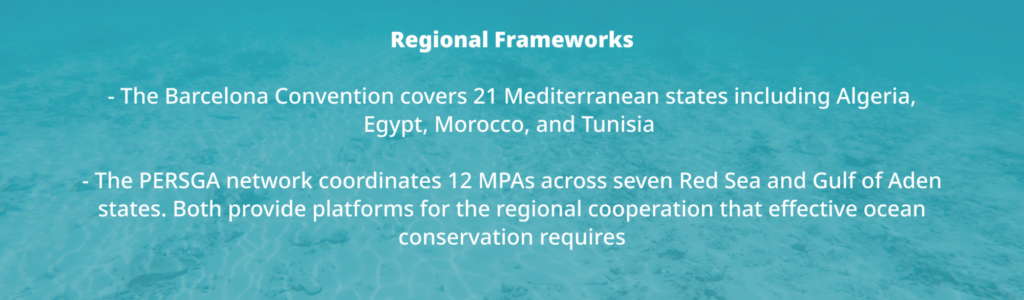
Across North Africa, a growing number of countries are establishing and strengthening marine conservation frameworks with sustained regional and international support. Morocco has emerged as one of the most active countries in the southern Mediterranean, with established MPAs such as Jbel Moussa, a National Blue Economy Strategy that integrates marine protection into broader development priorities, and formal reporting on other effective area-based conservation measures – placing it among a small number of countries globally. The EU-funded IMAP-MPA program has supported Morocco, Tunisia, Algeria, Egypt, and Libya with direct technical capacity on MPA monitoring, management planning, and stakeholder governance. The Kerkennah Islands MPA in Tunisia’s Gulf of Gabes is a focal point for community co-governance. and the Rachgoun Island MPA in Algeria, designated in 2023, represent significant recent additions to the regional domain. The Egyptian marine environment, encompassing the globally important coral reefs of the Sinai Peninsula in the Red Sea and Ras Mohammed National Park along its Mediterranean coast, participates in both the Barcelona Convention and the PERSGA governance frameworks.
In the Gulf and the Red Sea, the PERSGA network, which coordinates 12 MPAs across seven member states, including Ras Mohammed in Egypt, Aqaba Marine Park in Jordan, Farasan Islands in Saudi Arabia, and Socotra Islands in Yemen, represents a well-developed framework for transboundary marine governance in the subregion. The Saudi Arabian National Wildlife Center coordinates systematic conservation surveys along the Red Sea and Arabian Gulf coasts, encompassing some of the world’s most studied coral reef systems for their climate resilience.
In the Arabian Gulf lies the UAE’s 4,255 km² Marawah Marine Biosphere Reserve – the largest in the region – home to globally important dugong populations, three seagrass species, and over 18 coral species; anchoring a national network of MPAs aligned with the UAE’s 2050 net-zero carbon commitments. Bahrain’s Hawar Islands, a Ramsar-designated wetland of international importance, Kuwait’s Kubbar Island reef systems, and the turtle nesting coasts of Oman each represent significant ecological assets under active national management. KAUST’s research mapping the blue carbon resources of seagrass meadows in the Red Sea through green turtle tracking illustrates how regional science is continually expanding the evidence base for marine conservation in MENA waters.
Preliminary data from MedPAN and SPA/RAC indicate that less than 9% of the Mediterranean Sea is currently designated as MPAs, with the vast majority located in EU waters. This reflects the early stage of MPA development in southern Mediterranean countries, as well as the resource and institutional constraints that regional partners are actively working to address. The MedFund, supported by the Global Environment Facility, provides sustainable direct funding to MPA management structures in Algeria, Tunisia, and Morocco—a recognition that effective long-term conservation requires a sustained financial commitment in addition to designation.
Favorable conditions and complementary tools: What a complete toolkit for ocean management encompasses
The MPA Guide published in Science in 2020 identifies four enabling conditions that together predict positive conservation outcomes: science-based design; active and adequately resourced management; significant levels of protection from extractive and harmful activities; and community and rights holder engagement as governance partners. These conditions are interdependent rather than sequential, and the experience of the IMAP-MPA program in building participatory governance frameworks at sites like Jbel Moussa and Kerkennah offers the MENA region a directly applicable model.
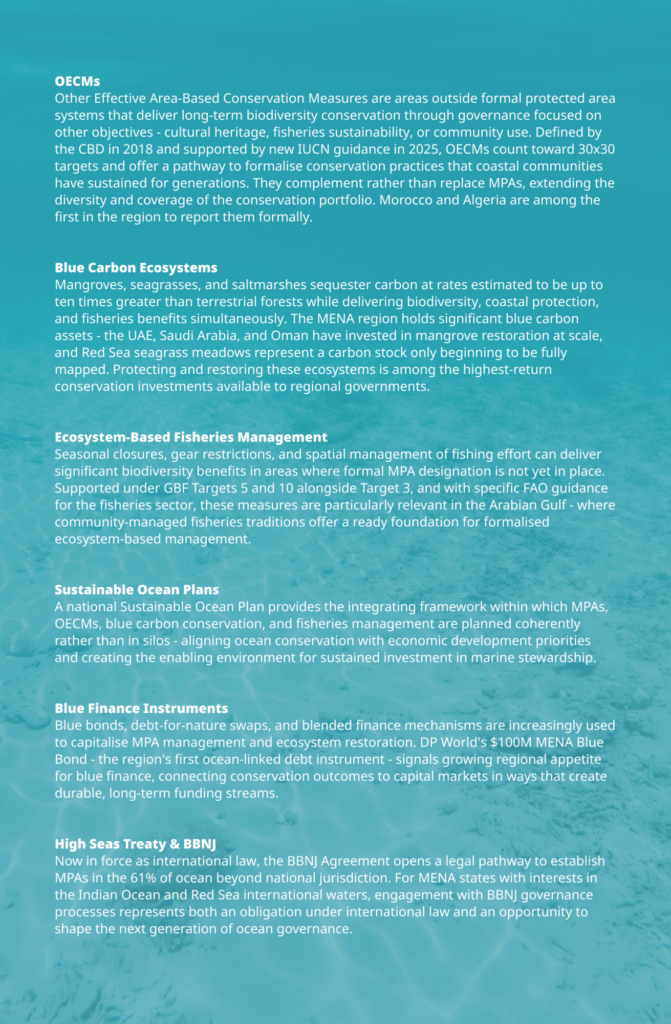
Achieving the 30×30 target and maintaining healthy marine ecosystems over the long term will also require a broader portfolio of tools working alongside MPAs. Research published in npj Ocean Sustainability in 2025 is explicit: the GBF targets require a portfolio of actions that goes beyond simple area-based conservation, tailored to national circumstances and ecological priorities.
A forward-looking program for the MENA Oceans Initiative
Across the MENA region, the direction of progress is encouraging. North African countries are expanding their marine protected area (MPA) frameworks with sustained global support. Gulf States are investing in national conservation programs, blue carbon restoration, and marine monitoring capacity. The PERSGA network provides a model for the transboundary coordination required for shared seas. And the MENA Ocean Action Agenda, developed over two years of cross-sectoral engagement across the region, provides the structural guidance to align these efforts toward a coherent regional vision.
Goumbook’s MENA Oceans Initiative champions three interconnected priorities for the region in the coming years: strengthening the enabling environment for effective MPAs – moving protected areas from designation to active and measurable conservation; unlocking the potential of complementary tools, particularly OECMs, blue carbon conservation and ecosystem-based fisheries management; and deepening regional cooperation on shared seas, transboundary ecosystems and the governance of international waters.
The MENA 2026 Ocean Summit, to be held in the United Arab Emirates from September 16-18, will advance the dialogues stemming from the in-depth MPA dive it hosted at the IUCN World Conservation Congress 2025 in Abu Dhabi – and will advance each of these priorities through cross-sectoral collaborations bringing together ministers, scientists, communities and investors around the common goal of a healthier and better-governed regional ocean.
Source : Goumbook