

The ocean plays a simultaneous role as a climate regulator, a provider of resources for our societies, and an area of growing tensions, yet it is too often viewed in a fragmented way. First presented at the third United Nations Ocean Conference (UNOC) in Nice in 2025, the Starfish barometer was developed by scientists to provide a comprehensive overview of the ocean’s health. The second edition is being unveiled on June 8, 2026, to coincide with World Ocean Day.
The ocean covers more than two-thirds of the Earth’s surface. It regulates the climate, supports our economies, transports the majority of our trade, and feeds billions of people. And yet, it remains one of the « great blind spots of our societies . «
This invisibility stems in part from the way the ocean appears to us—in fragments—and these different signals are not always connected. Climate change, biodiversity loss, multiple forms of pollution and other human pressures, food, biomedical, and energy resources, the transport of goods and digital data, and human migration routes, governance, and impacts on societies—these dimensions constantly interact. We see the symptoms, but rarely the system as a whole.
Yet, scientific knowledge about the ocean has never been so abundant, but it remains largely scattered and often inaccessible to the non-specialist public. At the United Nations Ocean Conference (UNOC 3), held in Nice in June 2025 , the idea emerged of providing decision-makers with a clear indicator, similar to the 1.5°C threshold for climate change. But the ocean cannot be reduced to a single number.
It is simultaneously a regulator, a resource, and a space of increasing tensions. It is a system on which the stability of our societies directly depends, now facing increased risks, the repercussions of which are already clearly visible: record water temperatures , rising sea levels , more intense storms due to climate change, but also unsustainable exploitation of resources, plastic pollution , and even the blockage of strategic points of passage for world trade , as current events remind us.
Rather than a single indicator, the idea of a multi-dimensional barometer emerged: thus was born the Starfish barometer , unveiled for the first time on June 8, 2025, on the occasion of World Ocean Day. Developed by a multidisciplinary team of experts, it was presented to delegations of heads of state and government at UNOC 3.
For the 2026 edition of the barometer, the team expanded, notably with the integration of members of the One Ocean Science Congress scientific committee (the scientific congress that coincided with UNOC), strengthening geographical representation with increased participation from experts from the Global South. Updated with more recent data, the 2026 Starfish barometer was unveiled on June 8, 2026, World Ocean Day having been chosen as the annual event.
A new framework for rethinking our interactions with the ocean
Rather than a single indicator, the Starfish barometer – whose results are published annually in a peer-reviewed scientific journal – offers an integrated reading of the ocean and its relationship with humanity.
This reading grid is based on five complementary dimensions, which form the five points of the starfish used to graphically represent the barometer:
- the state of the ocean,
- the pressures exerted on him,
- the measures put in place to protect him,
- the positive consequences for our societies,
- and finally the negative consequences for them.
This barometer does not produce new data but plays a complementary role: making existing, scattered knowledge more accessible. Each year, it presents a selection of major developments related to the ocean, based on the latest scientific findings. Designed on a global scale, it offers a comprehensive view of the ocean in all its complexity, transcending geographical boundaries and institutional divisions. It thus allows local or sectoral phenomena to be placed within a broader context and fosters a deeper understanding of the interdependencies that structure the ocean system. This approach connects issues often treated separately, from climate change to food security, from biodiversity to geopolitical tensions, by placing them within a single system of interactions.
The 2025 barometer thus painted a worrying picture: marine ecosystems continue to degrade under increasing human pressures. While protection efforts are progressing, they still fall far short of what is needed to reverse the trend.
We highlighted six key figures to illustrate the tension between the current trajectory and sustainability goals:
- the rise in sea level (23 cm since 1901),
- the number of marine species threatened with extinction (1677),
- overfishing (37.7% of fish stocks),
- $102 billion (or €88.5 billion) in global losses due to storms and floods,
- marine food production (115 million tonnes),
- and finally, the protection of only 8.34% of the ocean’s surface by marine protected areas.
New features of the 2026 edition
The main finding of the 2026 barometer remains that of an ocean whose condition continues to deteriorate, with even the first signs of acceleration.
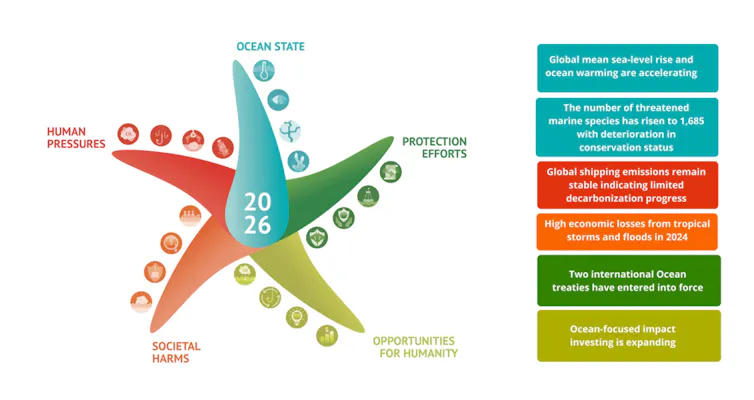
Human pressures, which remain high, are still a factor: greenhouse gas emissions from maritime transport show little sign of decarbonization , industrial fishing still lacks transparency , deep-sea mining exploration contracts are being awarded, and the amount of plastic waste in the oceans has reached record levels.
Societal impacts are also worsening: a sharp increase in long-term economic losses linked to storms and floods, with a particularly high peak in 2024. New estimates show that ocean-related damage represents a major part of the total socioeconomic cost of climate change, overexploitation of resources, loss of biodiversity and ocean pollution.
At the same time, the 2026 edition highlights structural advances in governance and solutions. The entry into force of two international agreements – the High Seas Treaty in January 2026 and the ban on certain harmful fisheries subsidies in September 2025 – as well as the strengthening of trade protections for threatened sharks and rays , constitute major steps for the protection of marine biodiversity.
At the same time, the expansion of marine protected areas – which has now exceeded the symbolic threshold of 10% – and the rise of circular economy initiatives and ocean finance demonstrate a potential for transformation.
Nevertheless, in-situ ocean observations are being jeopardized even as societal demand for ocean data increases. The US National Oceanic and Atmospheric Administration (NOAA), for example, which plays a key global role in ocean observation, has been the target of massive disinvestment by the current US administration .
A compass for public action
Beyond the monitoring tool that the barometer represents, the issue is more profound: changing the way we think about the ocean. The ocean is not simply a degraded space; it is, by its very nature, a pillar of the planet’s equilibrium. As long as it remains invisible or poorly understood, it will remain poorly governed. Conversely, a more integrated approach should allow us to better connect the causes, the consequences, and the levers for action. The Starfish barometer will support this still incomplete, but essential, awareness.
This analytical framework also opens up new perspectives for research. By comparing the different dimensions of the relationship between humanity and the oceans, it allows us to more clearly identify the blind spots in our knowledge: what we know and, above all, what we don’t yet know. In other words, it can help guide scientific priorities by revealing gaps, imbalances, and areas for further observation.
Ultimately, this approach could also be applied at the regional level. Such an adaptation would allow for better consideration of local specificities—ecological, economic, or social—while maintaining a systemic perspective. It would thus offer a coherent framework for evaluating public policies, linking more directly the pressures exerted on the ocean, the measures implemented, and their measurable effects.
The 2026 Barometer’s research areas were led by Thomas Frölicher (Ocean State), William Cheung (Human Pressures), Patrice Guillotreau (Societal Impacts), Joachim Claudet (Protection Efforts), and Peter Haugan (Opportunities for Humanity). Marina Lévy and Karina Von Schuckmann provided overall scientific direction. This edition of Starfish was greatly facilitated by Mahé Butel (Project Manager), Laurence Collet (Communications), Xi Ruan (Production Support), and Pierre Bahurel (Operational Management) .
Source : The Conversation