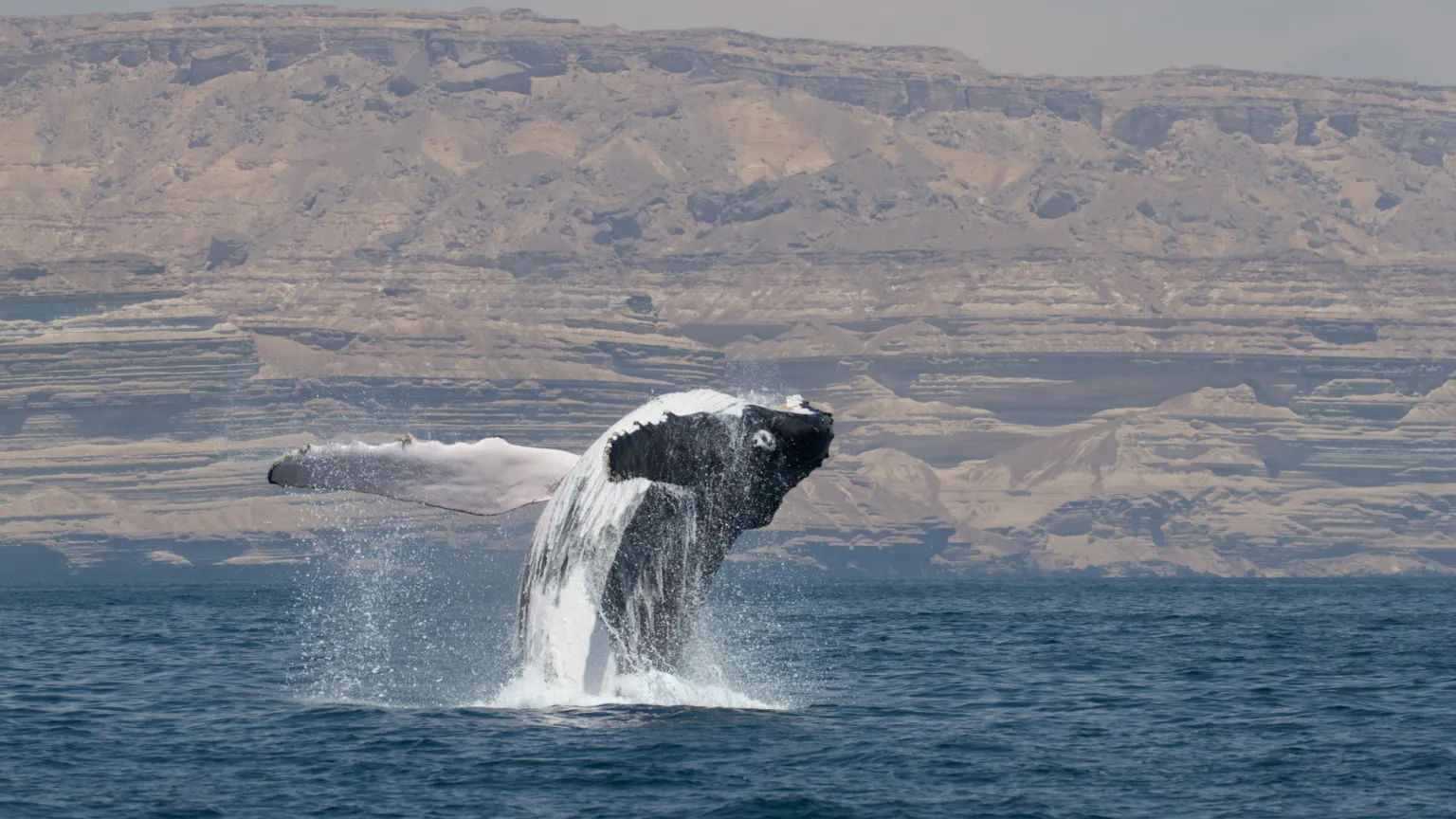
About 80 humpback whales live in the Arabian Sea without ever migrating like their cousins from the rest of the world – a unique exception for this species. But a study published in Frontiers in Marine Science has just documented an unexpected journey: a female named Luban traveled 7,000 kilometers to the Indian coast, questioning everything we thought we knew about this isolated population.
Don’t miss any of our publications:
What you will learn
- Why humpback whales in the Arabian Sea have abandoned migration for 70,000 years
- How 14 satellite beacons revealed their real movements between Oman and Yemen
- What Luban’s exceptional journey to India changes to the understanding of this population
A population that diverged 70,000 years ago
Humpback whales are known worldwide for their spectacular migrations between Alaska and Hawaii, or for their appearances off New England. But an isolated population of only about 80 individuals, living off the coast of Oman in the Arabian Sea, completely escapes this rule. Classified as endangered, these whales are the only ones of their species not to migrate seasonally.
Previous studies suggest that this population diverged from the humpback whales of the southern hemisphere about 70,000 years ago. Since then, it has remained confined to the Arabian Sea and southwest of the Indian Ocean – a unique sedentary lifestyle in this normally large traveling species.
An unprecedented satellite tracking
To understand the real movements of these mysterious whales, a team of researchers deployed 14 satellite beacons on individuals in Hallaniyat Bay to the north and the Gulf of Masirah to the south. These tags transmitted data for an average of 53 days, generating more than 1,800 positions in total.
The results confirm a strong geographical loyalty: 57% of the locations came from the Gulf of Masirah, 18% from the Bay of Hallaniyat – two areas less than 415 kilometers apart. The whales marked in Hallaniyat Bay have all sailed between this area, the Gulf of Masirah and northern Yemen.
The researchers attribute these movements to the hunting of coastal prey such as sardines, supplemented by deeper dives to hunt the krill beyond the continental shelf. The monsoons of the western Arabian Sea create a particularly productive water escalation area, guaranteeing year-round nutrition.

Credit: Oman Environmental Society/D. MacDonald
Luban’s Extraordinary Journey
Only one whale was radically distinguished from the group. Named Luban – from the Arabic name of the incense, in reference to the motif adorned with its caudal fin – this female crossed the Arabian Sea to the east to the western coasts of the Indian state of Goa, traveling about 7,000 kilometers on her way back.
This observation is the first direct evidence of a high-sea displacement across the Arabian Sea, confirming clues already identified by the whale song detected between the Omani and Indian coasts. Luban stayed for almost a month in an area off the coast of southern India, known for its abundance of food – researchers believe that food research and reproduction could jointly motivate this exceptional trip.
She has since been seen swimming in the Gulf of Masirah, to the great satisfaction of the research team.
A vulnerable population to climate change
This study goes beyond simple scientific curiosity. Parts of the Arabian Sea are warming about 1.5 times faster than the world’s ocean average — a direct threat to a population already reduced to a few dozen individuals.
Tracking data could also help keep fishing activities away from these critical areas for whales. For the Omanese fishing communities, who have been worshiping these animals for generations, this research offers an additional scientific argument in favor of their conservation, in a region in full economic modernization.
source : science post