

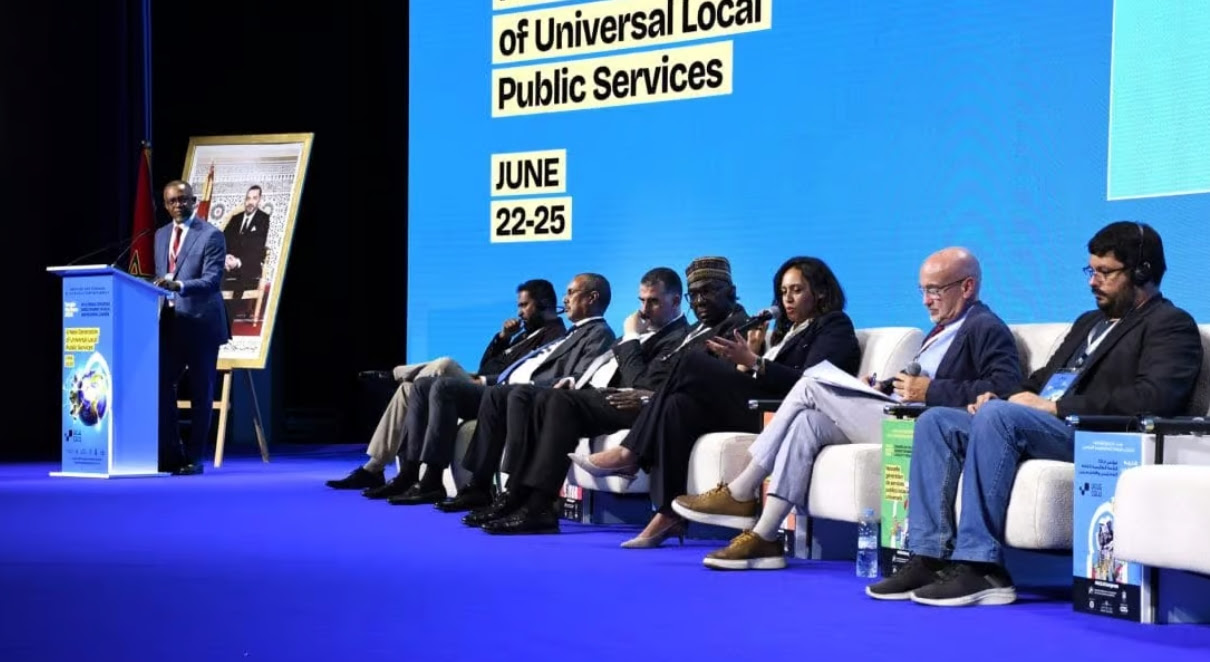
Meeting at the 8th World Congress of LGC in Tangier, public officials, experts and port actors highlighted the same conviction: ports are no longer simple transit infrastructures, but engines of economic integration, regional development and African cooperation. From Tangier Med to Cape Town, via dry ports, the speakers defended a broader vision of the port fact, now inseparable from territories, jobs and technologies.
On Tuesday, June 23, Tangier hosted a debate devoted to the growing role of African port cities in the continent’s territorial transformation, on the occasion of the 8th edition of the World Congress of the Organization of United Local Cities and Governments (GCLU). Organized by Tanger Med under the theme « Port-city ecosystems: artificial intelligence at the service of territorial multilateralism« , the meeting brought together institutional leaders, experts and port actors around the same question: how to make African ports real levers for integration, competitiveness and sustainable development?
In the course of the interventions, an observation was imposed; ports can no longer be thought of as simple transit points. They are now complex ecosystems, capable of structuring the economy of the territories, redistributing growth to the hinterland and supporting the rise of African regional cooperation. In this perspective, the port question goes far beyond the logistical field to affect spatial planning, industrialization, employment and economic sovereignty.
Dakhla Atlantic, a port at the service of a continental vision
The President of the Dakhla-Oued Eddahab Regional Council, Yanja El Khattat, insisted on the strategic scope of the port of Dakhla Atlantic, which he presented as an expression of a long-term vision. According to him, this infrastructure is part of both the Royal Development Strategy for the Southern Provinces and the Royal Initiative for the Sahel Countries. « The port of Dakhla is the product of a strategic vision, » he stressed, believing that a port « creates an economic ecosystem around it ». For him, the project should pave the way for a maritime corridor that generates investment, jobs and economic opportunities, while strengthening ties with the African continent.
El Khattat also focused on the integrative dimension of the project. In his eyes, Dakhla Atlantique should not only serve maritime traffic, but contribute to opening up the territories of the South and bring Morocco closer to its African environment.
The value of a port lies not only in its superstructure, believes the panelist, but in its ability to federate a development dynamic around it. He also recalled that the future of port infrastructure now involves « the integration of digital technologies and artificial intelligence », which he considers essential tools for more efficient and intelligent management.
In the same logic, the director of development and monitoring of the construction of the Dakhla Atlantic port, Nisrine Iouzzi, presented the project as a whole designed far beyond the maritime infrastructure itself. « The port itself is a passage, a link, » she said, insisting that the project’s ambition is to « connect the land to the sea » through a superstructure capable of draining both goods and people.
Iouzzi detailed the strategic axes of the project, structured around the construction of new generation ports, the economic development of port areas and the conversion of port spaces in connection with the city. Major contemporary port infrastructures are facing common challenges, she argued, including « urban congestion and the need to reconnect ports to their territorial environment ». Finally, she stressed that artificial intelligence is already mobilized in the construction phase, in particular for technical monitoring, quality control and security, specifying that « AI is an essential lever for building intelligent and sustainable port infrastructures ».
Dry ports, the keystone of interior opening
The governor of the state of Kwara, Nigeria, Abdulrahman Abdulrazak, also president of the Forum of the Regions of Africa (FORAF), for his part, advocated an extension of port ecosystems inland.
Dry ports and domestic logistics platforms, which he considers essential tools to benefit non-coastal regions from the fallout of maritime trade, are extremely important, he believes. According to him, these infrastructures make it possible to expand the economic reach of ports, stimulate employment and support the industrialization of territories.
« An African port cannot fully play its role if it remains isolated from its hinterland, » according to Abdulrazak. The challenge, he explained, is to « build continuous logistics chains, capable of connecting seaports to industrial areas, distribution centers and internal markets ». This approach, he added, would not only strengthen the competitiveness of African ports, but also their ability to serve as « catalysts for territorial integration ».
Tanger Med, model of an integrated port ecosystem
On the side of Tanger Med, the central director of the operation, Jaafar Amiyer, recalled that the complex is not only a port, but « a real model of integrated ecosystem ». Tanger Med has profoundly transformed the Northern region, by modifying both the urban landscape of Tangier, its economic attractiveness and its place in international trade, according to Amiyer.
According to this speaker, this model has allowed Morocco to strengthen its international connectivity and consolidate its position in global value chains. He cited the establishment of hundreds of companies in the area and the creation of thousands of jobs, while insisting on the role of the port in the country’s industrial development. « The success of Tangier Med is also due to its ability to create bridges with Africa, since the complex is connected to many ports on the continent, which make up a quarter of its connections, especially in West Africa, » he argued.
Through this meeting, the vision of a « Tangier-Cape Town » axis served as a common thread for exchanges that highlighted the strategic role of African port cities in the construction of new growth corridors. These ecosystems are increasingly appearing as instruments of South-South cooperation, regional integration and sustainable transformation of the continent. Above all, they are now called to a more important role, that of territorial multilateralism.
source : le brief

