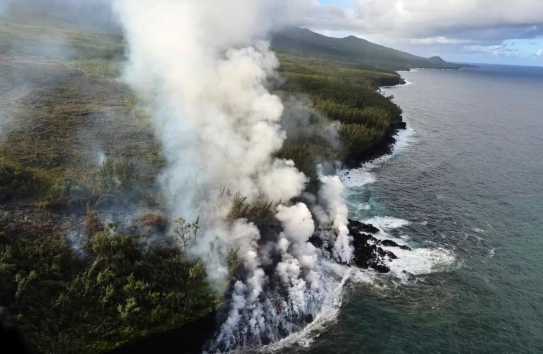
Fifty days of eruptive activity between February 13 and April 12; flows of nearly eight kilometers that reach the Indian Ocean; more than thirty million cubic meters of lava having ended up creating a past platform, due to erosion due to the swell, from 8.2 hectares on April 7 to 7.3 hectares on June 1: the last eruption of the Piton de la Fournaise, on the island of La Réunion, is a godsend for science. « An incredible chance, » enthuses Jean-Pascal Quod, marine biologist, director of the association for the protection of coral reefs Reef Check. « A gift from nature, » says Thierry Mulochau, also a marine biologist, at the head of the Vie océane association.
Far beyond the masterful beauty of such an event, the exaltation of scientists finds its source in a new object of study: deep lava flows. In other words, a virgin territory that allows new discoveries about underwater life and its biodiversity. These flows that extend under the sea are « the equivalent of the zero time of the creation of the island, biologically and geologically, » observes Jean-Pascal Quod.
The first observations on the flows of the year indicate that the colonization of these slopes has already begun with algae, hydraria, worms, molluscs, small crustaceans and fish. « In general, pioneer and opportunistic species settle very quickly, » describes Thierry Mulochau. It is a medium in transition, because they are replaced by species that arrive more slowly and find a balance according to the conditions. With corals. In the west of the island are the coral reef and the Saline-les-Bains lagoon, almost 8,000 years old; on the other side, to the east, this lava has not yet been completely cooled. It is this ecological succession that interests scientists. « You also have to look at Mount La Pérouse [located 178 kilometers northwest of Reunion Island], which has become an underwater mountain whose summit peaks 60 meters deep, » observes Jean-Pascal Quod. We are taking a leap in time to understand how underwater life was created in these places. «
Conservation issues
Within their Biolave program (which brings together the Agency for Marine Research and Valorization, the Aquarium of Reunion Island, the University of Reunion Island and the Natural History Museum in Saint-Denis), these scientists described the scenarios of colonization on sea flows of 1977, 2004 and 2007. These studies can also be linked to conservation issues, on an island where the rate of cover of live coral, on all coral reefs, has continued to decrease, and is only 10%.
The observation is that of a slow deterioration of reefs since the 2000s, due to the cumulative and repeated effects of pollution, land use planning, the damage of Cyclone Garance in 2025 and the bleaching of corals caused by the rise in sea temperature. « Better understanding how nature conquers this virgin space is also better knowing how to help recreate, with a view to restoring the lagoon of the west of the island, its external slopes or some of its damaged areas, » summarizes Jean-Pascal Quod. With protection actions that involve cutting resilient corals for the future.
In 2016, this biologist and Florence Trentin, a biological engineering teacher at the University of Reunion Island, published an article in the journal Espèces entitled « Revive après la Fournaise », following studies deployed on nine sites and surroundings, formed by the flows of 1977, 2004 and 2007. « The results obtained were beyond expectations, since, finally, 1,300 species were identified, of which 126 would be new for Reunion Island, and thirteen, new for science, » they wrote. An « astastonishing wealth », which would be explained by « the conjunction of several key factors such as the diversity and originality of habitats and depths, the quality of coastal waters, a well area for larvae in the regional current-logical scheme, the periodic rejuvenation of an ecosystem that rarely reaches a mature stage ».
In the coming weeks, to better observe the colonization of the 2026 flows as well as their geology, a second mission will be organized using an underwater robot. A first took place at the end of April, but it had to be shortened due to technical problems. « The available images and the return of the dives have already shown us 45-degree slopes, a platform that rests on an underwater slope, and the presence of pillow lava, » says Patrice Huet, scientific director of the La Cité du volcan museum. Unlike April 2007, this recent flow into the ocean did not reveal new abysmal fish. That year, the volume of magma coming out of the crater had been seven times higher and had descended more massively through lava tunnels, up to at least 400 meters below sea level. This material, by breaking deep into the water, at more than 1,000 °C, had caused the gas explosion, killing the fish that had not had time to flee.
Unknown species
« Thousands of dead fish were found on the surface, » recalls ichthyologist Patrick Durville, one of the creators of the Reunion Aquarium. Colleagues and he had approached the casting « in Dantesque conditions »: « We quickly realized that these were species that were unknown to us. A rare phenomenon, but already seen in Hawaii. A little more than 400 of these fish have been collected by scientists. The studies validated the discovery of twelve new species for science – only half of which were the subject of complete descriptions – and 47 species that had never been seen in Reunion Island. Most, less than 10 centimeters tall, showed signs of adaptation to great depths, such as hypertrophied eyes or the presence of bioluminescent organs.
« This reminds us that we lack knowledge about organisms living in areas beyond 100 meters deep, » says Thierry Mulochau. Present during this miraculous fishing, he now launches an « SOS to find out where the hundreds of samples of these fish are », at the time embarked by two scientists from the Natural History Museum of La Rochelle. « We sent a lot of messages and we ran into a wall of silence, » adds the marine biologist. Museums lack human resources and specimens pile up on shelves without being described, and this can last for years. «
Contacted by Le Monde, the Museum of La Rochelle replied that it « keeps only three specimens from this collection: two paratypes [specimens of a series, different from the holotype, which is the typical example of the series] of the species Argyripnus hullei and Chromis durvillei, and a third specimen of the species Neocentropogon profundus, new for Reunion Island ». « The holotypes should logically be preserved at the National Museum of Natural History in Paris, » we add.
Patrick Durville’s greatest regret, however, remains that in April 2007 he left in a hurry on the stream, pressed by the event, without the necessary equipment to collect more abyssal fish floating on the surface.
Source : Le Monde