Fishermen and observers warn of a decrease in octopus in the Mediterranean, despite a lack of scientific data on the subject
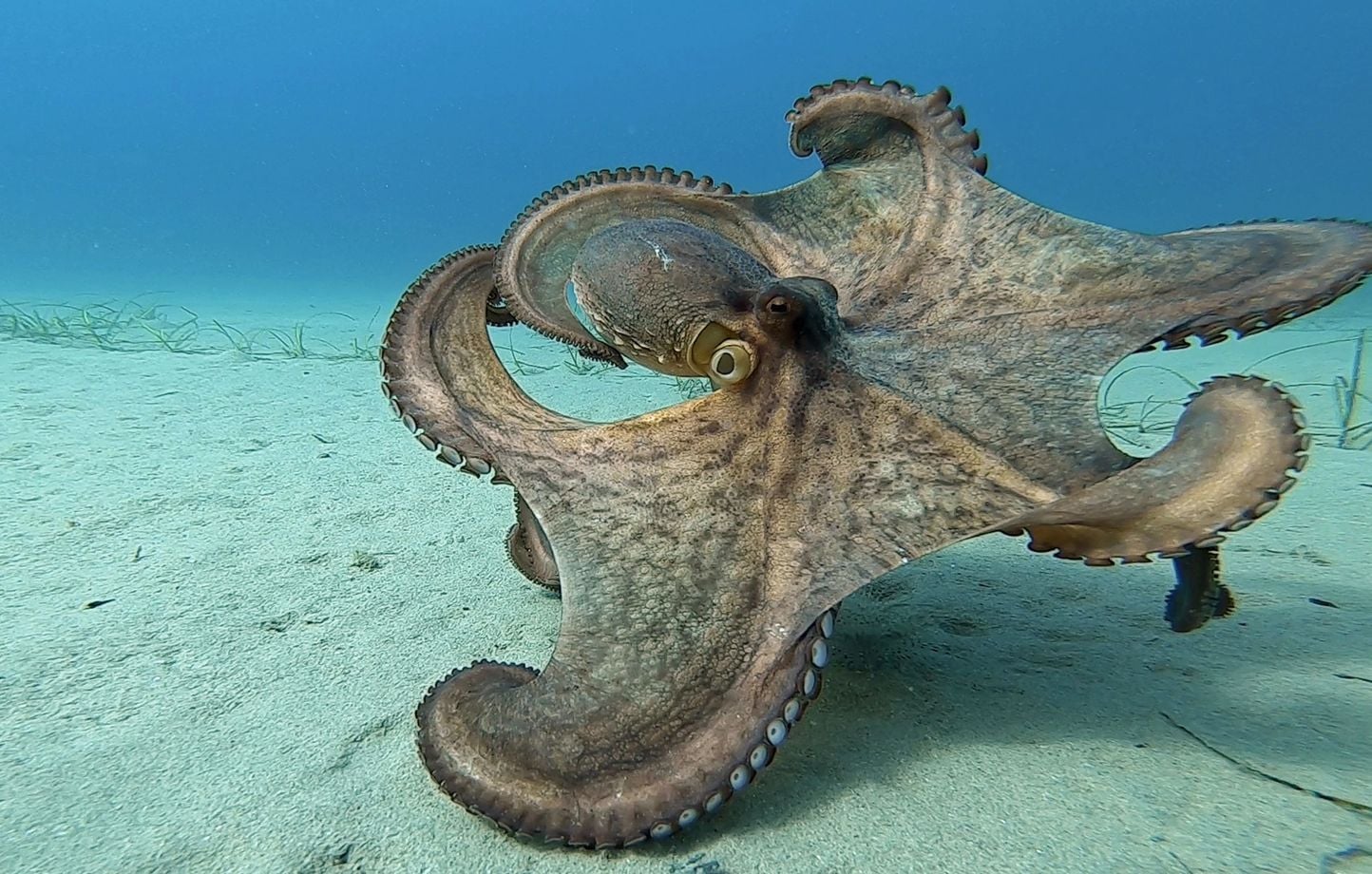
When Gérard Carrodano is asked when the octopus became discreet in the Mediterranean, his answer is clear: « For a decade. This fisherman from La Ciotat (Bouches-du-Rhône) has more than 7,000 palm dives. Former underwater hunter now specialized in the capture of live marine animals for museums, aquariums and scientific institutes, he has seen the population of octopus vulgaris, from his Latin name, become rare.
In Cannes, the association « Angels de poulpes », founded by Marie Muzard, relentlessly warns of the decline of the cephalopod. According to his observations, shared in Nice Matin, « between 2020 and 2024 its population has halved ». To protect the species, recreational octopus fishing is prohibited in the waters of the Port-Cros National Park and in the Calanques National Park from June 1 to September 30, during the animal’s breeding period. The measure, taken since 2016, exposes offenders to a fine of up to 22,500 euros in the event of poaching.
Fishermen and murènes
During this key stage, octopuses are particularly vulnerable. « The females put themselves in what are called huts, shallow holes to lay their eggs. Then, they will only stop ventilating and monitoring them, says Gérard Carrodano. There, they are very easy to collect, especially since most of the time there are one or two males next to them: the fisherman can make a triplet. In 2025, Tunisia had completely banned the fishing of cephalopods on the coast in the face of a « catastrophic » decline in octopus populations highlighted by fishermen.
Off the coast of La Ciotat, octopuses also have to cope with the proliferation of murrenes, according to the fisherman, a predatory species of the cephalopod. « Adult eight-legged octopuses almost no longer exist in our region: they lack limbs or they get eaten, » he says. In Greece, the species is also threatened by a fish from the Indian Ocean that eats the eggs, according to fishermen interviewed by TF1.
Lack of data
But these observations at sea are not supported by reliable scientific data, says Laure Bonnaud-Ponticelli, professor of evolutionary biology at the National Museum of Natural History, in the BOREA laboratory. « There are no time series, so it is difficult to know how octopus populations are really evolving, » she explains.
She cites the example of the proliferation of the species on the Breton or Vendée coasts, observed after the Covid-19 period. Impact of global warming? End of overfishing? So many hypotheses that remain on the table, for lack of « physico-chemical data » on water temperatures, currents or salinity.
As for the new predators, which would decimate octopus populations, it also remains difficult to establish a causal link without scientific studies. « The octopus is also beginning to have abundant food with the invasion of blue crabs, » she points out. The functioning of an ecosystem is always complex: there are more predators, but also more prey. «
Local observations
Nevertheless, if there is not yet enough scientific data, Laure Bonnaud-Ponticelli relies on fishermen and local observations. « The fishermen of Marseille were the first, to my knowledge, to self-limit in quantity and size, because they had noticed a decrease from one year to the next, » recalls the teacher. If they put this regulation in place, it is because they were aware that the population was in danger. In Brittany, a license has also been introduced for octopus fishermen in recent years.
A recent interest report on the north of Corsica has been noted. « It must now be done over several years to have a real idea of the evolution of the population, » adds Laure Bonnaud-Ponticelli. And to launch an appeal: « Let’s finally take a look at these populations since the field observation of professionals still shows that there is a problem. «
source : 20 minutes