

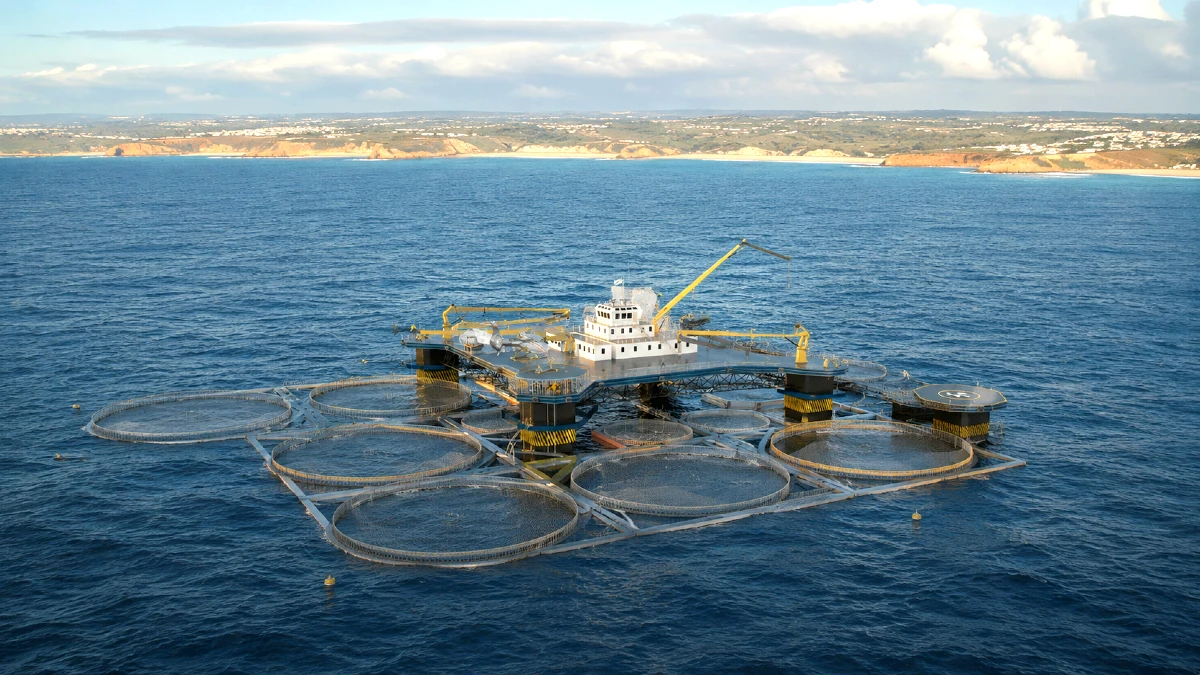
Portugal has just taken an unprecedented step in the development of its Maritime economy. For the first time, the authorities issued an authorization to operate a farm Aquaculture in the open sea, about fifteen kilometers from the coast of the Algarve. Behind this decision lies a much broader challenge: strengthening the national production of fish in a country that remains heavily dependent on imports to meet demand. FarmsAgricultural
This advance comes just a few days after the publication of figures recalling a well-known paradox: despite its maritime tradition and its position as the leading consumer of fish in Europe, Portugal imports nearly 80% of the fish it consumes each year.
A historical first off the Algarve
The project, called Coralis, will be located about 15 kilometers from the coast of the Algarve. This is the first authorization granted in Portugal for an aquaculture farm installed directly on the high seas, far from the coast.
Eventually, this offshore farm will be able to produce up to 8,000 tons of fish per year thanks to infrastructure designed to withstand the conditions of the Atlantic. Beyond its production capacity, the project marks above all an evolution of the Portuguese maritime strategy, which now focuses more on innovation and new technologies related to the sea.
Reduce high dependence on imports
This authorization makes sense in the current situation.
Each year, Portugal consumes about 25,000 tons of bar and seam, but almost 20,000 tons come from abroad, mainly from Turkey and Greece. More broadly, about 85% of the bar and sea sea bam consumed in the European Union are imported.
For a country that has one of the largest exclusive economic zones in Europe, this dependence is a real paradox. The development of offshore aquaculture could gradually increase domestic production while strengthening food security.
The blue economy goes from theory to practice
Mariculture Systems – Sustainable Deep-Sea Aquaculture. Aquaculture 2.0
For several years, Portugal has displayed great ambitions around the Blue Economy. Marine energy, biotechnology, underwater robotics, ocean surveillance and aquaculture are among the sectors considered strategic for the coming decades.
Until now, however, these ambitions remained largely theoretical. With the authorization granted to the Coralis project, the country is taking a concrete step by launching its first industrial aquaculture project on the open sea. Scienceof water and oceanography
This development also confirms the authorities’ desire to better exploit the immense potential offered by the Atlantic, which has long been one of Portugal’s main geographical assets.
A project that could pave the way for others
For project leaders, this authorization is only a first step. The main challenge will now be to raise the necessary funding to build infrastructure and accelerate the development of this new sector.
If this first operation demonstrates its economic and environmental viability, it could serve as a model for other similar projects along the Portuguese coast. Eventually, offshore aquaculture could become a new pillar of the national maritime economy, alongside fishing, tourism and marine energy.
A new page for the Portuguese Atlantic
Long perceived as a formidable space for navigation, fishing or tourism, the Atlantic could now become a real industrial engine for Portugal.
Beyond fish production alone, this first offshore aquaculture farm symbolizes the emergence of a new generation of projects focused on innovation, food sovereignty and the sustainable exploitation of marine resources. For a country intimately linked to the ocean for centuries, this first authorization could mark the beginning of a change of dimension.
source : Portugal