
The average temperature on the surface of the oceans averaged 21 degrees in June. A new record, announced this Wednesday by the European Copernicus Marine Observatory.
The oceans, which absorb 90% of the excess heat generated by human activities, have just experienced the hottest June ever observed, according to data published by the Copernicus Marine Observatory. Since the beginning of the year, four-fifths of the ocean surface have experienced marine heat waves, and almost half have suffered from extreme heat waves. New records could be broken in 2026, under the combined effect of El Niño, which leads to rising temperatures, and global warming. « One or two degrees more on the surface is already huge, as if we had more than 40 degrees of fever, » according to Julie Deshayes, oceanographer, physicist and research director at the CNRS Oceanography and Climate Laboratory.
franceinfo: Has this warming of the seas been observed for a long time?
Julie Deshayes: Yes, we have been observing it for decades. To be able to observe this warming, we need means of observation. Large-scale data has only been available since 2003, with the international Argo program measuring ocean temperature. However, at the moment, the funding of these major observation programs is weakened.
« Without these observations, we will not be able to continue to describe, study and anticipate the future of global warming. « Julie Deshayes, oceanographer, physicist, research director at the CNRS Oceanography and Climate Laboratory
To franceinfo
The warming of the oceans accelerates over time, it is increasingly intense, and its magnitude shows that it is not due to natural variations, which can, for example, cause El Niño. With El Niño, the oceans are warmer, but then the anomalies disappear. There no, we see a real trend, significant in ocean warming, for at least 20 years.
Does warming have effects on deep-sea ecosystems?
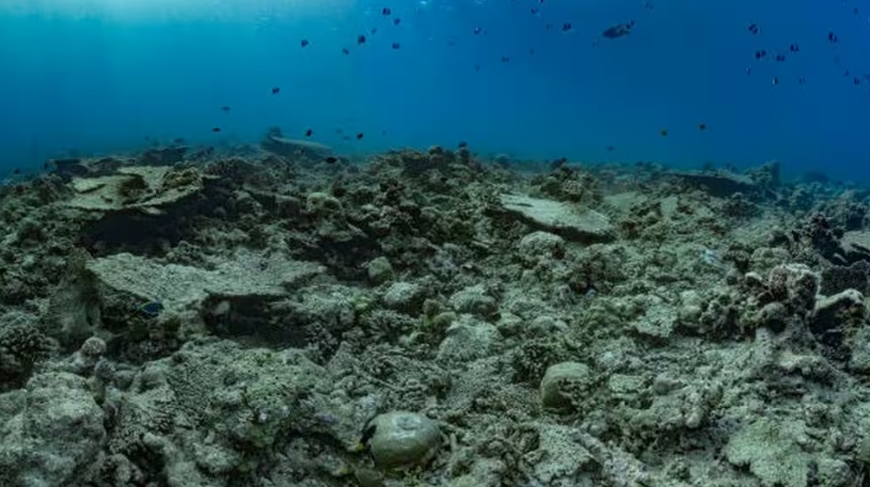
Warming is causing damage at all depths, down to the bottom of the ocean. In the ocean, the water temperature naturally varies very little. One or two degrees more on the surface is already huge, as if we had more than 40 degrees of fever. And the deeper we go, the less the temperature is naturally variable. So, even a few tenths of deep warming, it is considered a major anomaly, and it has a very strong impact on fauna and flora. All ecosystems on the planet are affected by climate change.Also read
Ocean at 21 degrees, toxic algae, « smaller » fish: how marine heat waves destabilize ecosystems and threaten biodiversity(New window)
Do some seas warm faster than others?
Yes, we observe accelerated warming at high latitudes, at the pole level. These are very climate-sensitive regions, which can accelerate ocean warming and affect polar ice caps, as is the case in Antarctica. In the Arctic, we see effects on sea ice, which has declined very rapidly in recent decades. The ecosystems of the poles are very vulnerable and the warming of these areas has large-scale impacts.
Can the sea regenerate if it is properly protected?
Climatologists have long been saying what are the solutions to adapt to climate change and to limit it. With regard to the seas, for example, protected marine areas have been defined.
« These areas have only the name protected, since intensive fishing can be authorized there. « Julie Deshayes, oceanographer, physicist, research director at the CNRS Oceanography and Climate Laboratory
To franceinfo
We must start by really protecting the ecosystems of these areas and then, change their geographical definition, so that they adapt to the migrations of certain species, which are caused by global warming. If we really want to protect the oceans, let’s seize this tool that is protected marine areas.
Does sea warming accentuate that of the air and extreme weather events?
Absolutely and it accentuates the direct pressures of man on these ecosystems. The first reason why Earth’s ecosystems are in danger is anthropogenic pressures, pressures that man exerts on resources and pollution of all kinds. Global warming is a consequence of these pressures. This is all that must be stopped if we want to be able to really protect ecosystems. At present, it is not scientific knowledge that is lacking, it is political will.
Source: France info