
A very bulky legacy of the years when it was thought that the ocean could swallow everything safely, which the CNRS is now forced to analyze.
There was a distant time when the abysses were considered an ideal trash can: far from everything, we mistakenly believed that they were empty of life. Thus, between 1946 and 1990, fourteen countries therefore poured their nuclear waste there, wisely sealed in metal barrels belded with concrete or bitumen. The United States was the first in 1946 off the coast of California, then France, Belgium, the United Kingdom, Switzerland and a few others followed suit. On more than 80 sites in the Pacific and the Atlantic, it is estimated that hundreds of thousands of barrels have been submerged.
Even if the practice has been totally banned since 1993, the barrels are still there and have not magically disappeared. In the Northeast Atlantic, some 1,200 km from the French coast, there are still 200,000 barrels per 4,000 meters of depth. Since the rare observation campaigns conducted in the 1980s, no one had gone to check what had happened to this gigantic underwater landfill, before the CNRS took the bull by the horns last year.
Diving in troubled water
It is for this reason that the largest French public research organization launched the Nodssum project in 2025, accompanied by the ASNR (Autorité de Safety Nuclear and Radiation Protection), a team from Ifremer (French Institute for Research for the Exploitation of the Sea), as well as several other European partners. After a first mapping campaign in the summer of 2025, about thirty researchers went back to sea from May 27 to June 28, 2026 aboard the oceanographic ship Pourquoi Pas?, built by Alstom Marine in 2005.
They are also supported, to be able to observe the barrels as closely as possible, by the Nautile, the legendary small bright yellow pocket submarine of the Ifremer. It is one of the very few manned machines in the world capable of descending up to 6,000 meters deep. This theoretically gives it access to 97% of the ocean floor: an extraordinary capacity, especially when we know that the pressure at these depths would crush any military submarine. In all, he made twenty dives, which allowed him to reach the barrels one by one and to scrutinize their surroundings.
According to the first analysis, several containers are in very poor condition and others have completely poured their contents into the ocean. As close as possible to the barrels, the researchers were able to distinguish the various containment materials used in the past, concrete or bitumen coatings supposed to retain radioactivity while the barrels degrade.
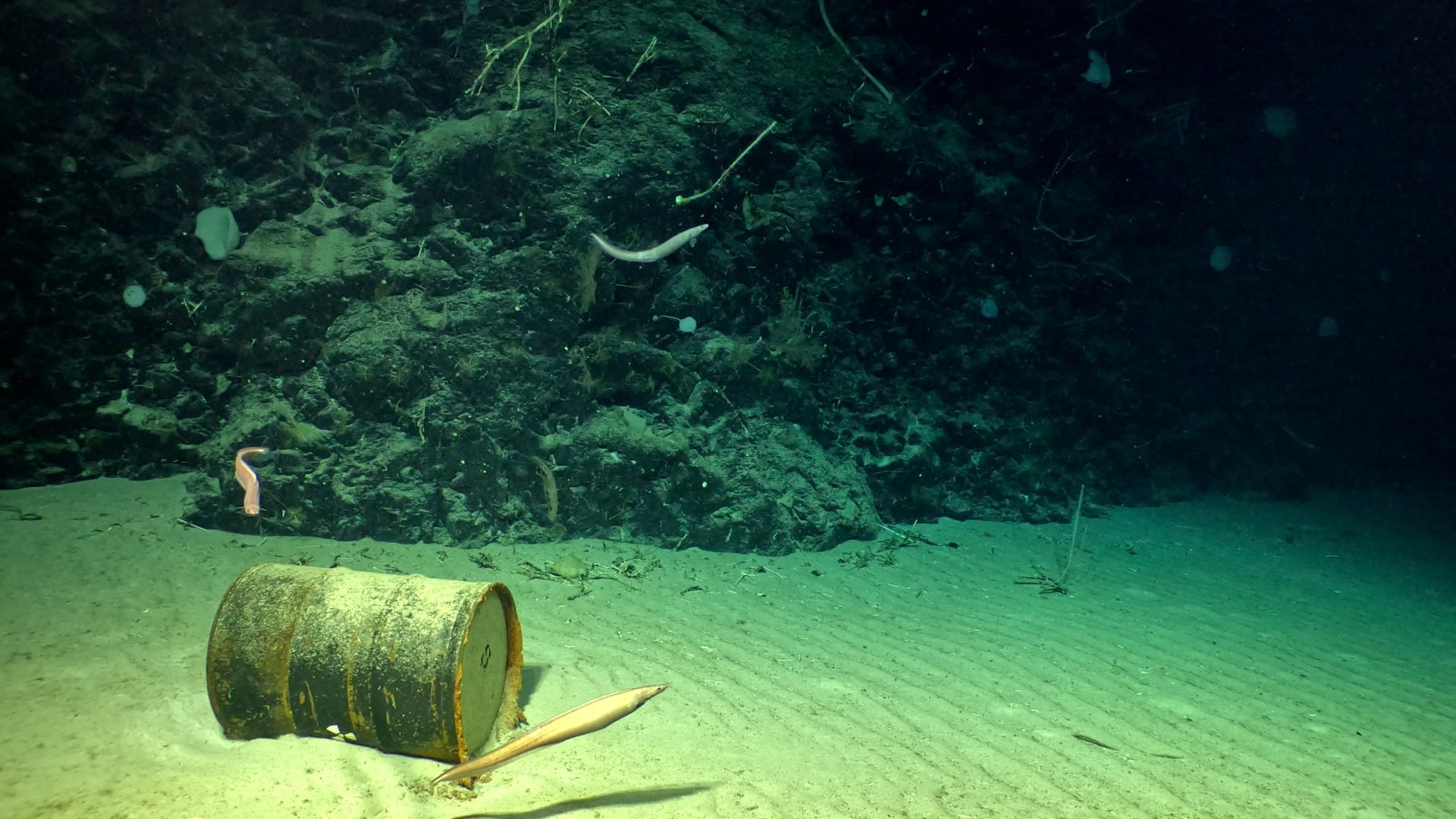
Official cliché of the NODSSUM mission: a metal barrel surrounded by the extreme fauna of the deep sea © NODSSUM Cruise, CNRS, French Oceanographic Fleet, IFREMER, MISO
The problem is what they measured around: radionuclides (unstable atoms that radiate by disintegrating), at higher rates than those expected in a virgin area of any pollution. The rates recorded remain relatively low, in any case sufficient for scientists to work on their samples without a particular radiation protection protocol.
An observation, at first glance « reassuring« , but the mission can only be concluded once the samples have been fully examined. By analyzing everything that has been in contact with the barrels, researchers will be able to establish whether there is real danger or not, and whether the radioactivity of the barrels is problematic from an environmental point of view. Perhaps the elements they contained dispersed in the water, were captured by the sediments, passed through the tissues of the abysmal fauna, or even the links of the trophic networks went up. We will see if the doctrine « out of sight, far from the heart » followed by the pioneers of civil nuclear in the 1940s will have been without consequences, but we will have to wait a few more months, for the samples to give their verdict.
source : journal du geek