
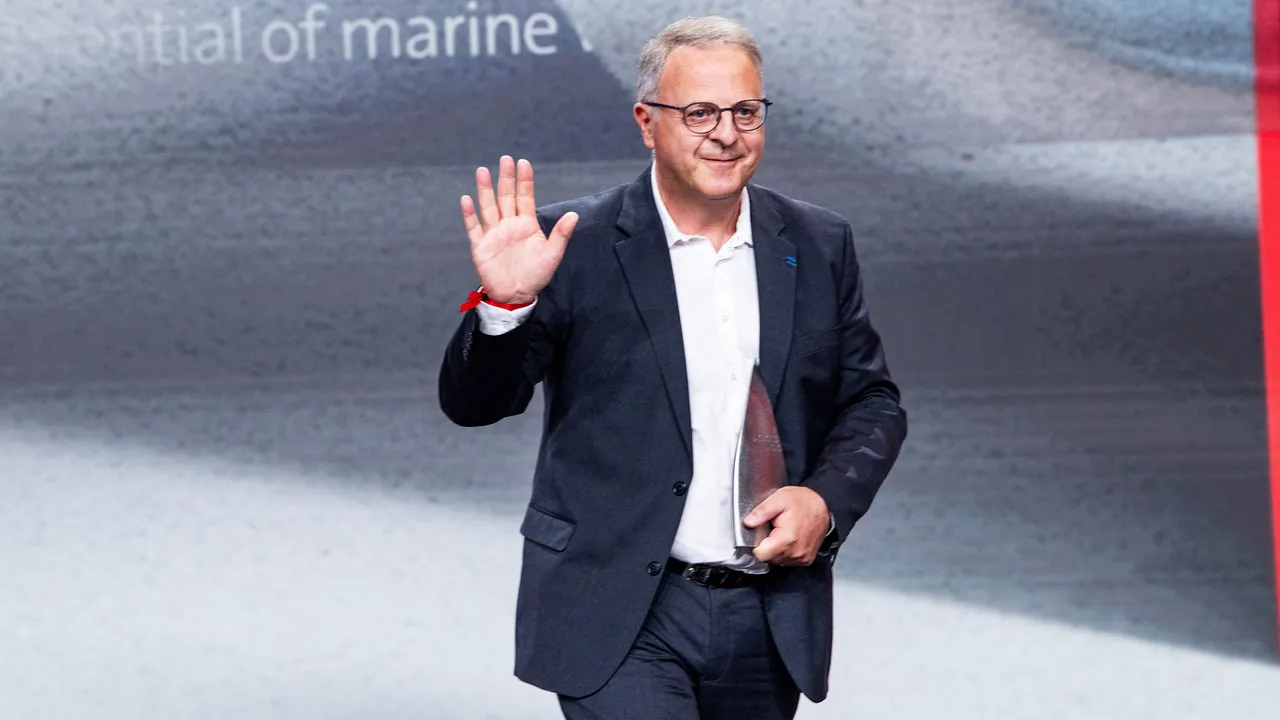
The French biologist wins this prestigious competition (SME category) organized by the European Patent Office and considered « the Eurovision of innovation ». He made a molecule, present in a small marine worm, a global medical innovation.
Taped in front of the living room television, it is in black and white that Franck Zal discovered images of the underwater floors in the 1970s. In the Parisian apartment nestled at the foot of the Montparnasse Tower, the one who was then only about ten years old marvels at Commander Cousteau’s broadcasts and the Calypso Odyssey. « It really guided my childhood. And in addition, when I was a kid, my parents sent us to Brittany on a summer camp. It was in the south of Finistère, in Kersidan, where I discovered this sea expanse and I was fascinated. What was on the other side of the horizon line? What was below this blue expanse? It was really the mystery and especially waw! But it’s so huge! We can do so many things and go discover the world. »
To satisfy his curiosity, Franck Zal studied biology in Paris before joining the CNRS on the advice of Commander Cousteau, and a little later Brittany. Employed at the Roscoff biology laboratory in Finistère, he discovered under his windows what will become his playground: the beach and sand morms, which appeared 450 million years ago.
« Everyone saw these little piles of sand while walking on the beach at low tide. These verses are present between Biarritz and the North Sea. In Brittany. The Bretons call it the Buzhug and they go bass bass fishing. For me, it was the same object. But I asked myself another question ‘how do they breathe between high and low tide? ‘And I realized that the worm breathed only when it was underwater and it stopped breathing when it was at low tide. He stops breathing for 6 hours, but he lives with the oxygen stock that he has fixed on his hemoglobins. »
A major discovery, synonymous with medical advances
For the rest of Franck Zal’s career, this discovery is essential. In his company called HemarinaOuverturein un nouveau tab and created in 2007 in Morlaix, the biologist isolates the molecule that transports oxygen on the invertebrate. « I started using this oxygen transporter in different applications. We needed oxygen, the cell, the tissue, the organ or the body. Today, with this molecule, we make solutions to preserve organs awaiting transplantation, dressings to heal, dressings for periodontal diseases, blood transfusions, products for ophthalmo, for cancer, etc. The innovation has led to considerable progress for transplants. Because the molecules of the arenicoles extend the shelf life of the organs. « The surgeon will remove the heart, for example. And so this heart, we only have 4 hours to reconnect it. It’s a race against time. Because if I disconnect an organ, the organ will no longer be oxygenated. Well in fact, what we do with the organs is that when I disconnect, for example, a heart, I will actually put the hemoglobin molecule of arenicole around it. And so it makes it possible to give oxygen reserves to the graft. So, instead of keeping a heart for 4 hours, we can keep it for 11 hours, instead of keeping the lung for 6 hours, we did 48 hours. So these are really major results. »
Questions and stupor when Franck Zal begins to study marine verses
At the beginning of the year, the biologist’s technology also made it possible to treat severe burns from the Crans-Montana fire, Switzerland, and to prevent certain patients from being amputated. Twenty years after the company’s creation, Franck Zal’s successes are widely recognized and medical advances have been around the world. But the beginnings were difficult.
« At the time, people in my family or people around me said ‘what’s the point of studying the breathing of a sea worm? Don’t the people of the CNRS have anything else to give a fuck?’ At the start, I was crazy, the guy who wants to save people with a marine worm. Then now, people tell me ‘I thought about it before you’. And so in fact, this is the circle that was described by Schopenhauer on disruptive innovations: it is ridiculous, dangerous, obvious. I think what’s a bit of a shame is that we know it. So we should shorten this cycle a little, it would save us time and especially save lives. »
Franck Zal no longer needs to walk the beaches of Finistère to collect sandplas. He created a 13-hectare farm in the marshes of the island of Noirmoutier where he produces 30 tons of vermolds every year.
« We made swimming pools, so swimming pools that are 450 square meters. And inside these pools, we reproduce the beach. So we put sand. We do all the reproduction, that is to say that today we completely control the reproduction cycle of these verses. So we do in vitro fertilization, we recover gametes, we make larvae, these larvae turn into mini towards these mini worms, we grow them up to two to five grams and then we collect them. So we invented the whole zootechnical process to produce versums per ton. »
Since yesterday, the scientist has an additional trophy, that of the European inventor of the year 2026 Opening in a new tab… Franck Zal assures him, each distinction honors him but only one thing matters to him: saving lives.
source : radio france