

A new study reveals that plankton no longer has any areas classified as « good ecological condition » in a vast region extending from Portugal to Norway, via the waters of the Cantabrian Sea, while such areas existed before. This situation worries researchers.
Microscopic plankton is one of the most important organisms on the planet.Phytoplankton alone produces about half of the oxygen we breathe, while all plankton forms the basis of marine food chains, supports fish resources, contributes to carbon storage and maintains life in all oceans.
A new study, conducted by researchers at the University of Plymouth, relies on more than sixty years of data to show that the abundance of plankton is declining over large areas of the North-East Atlantic, a region that extends from Portugal to Norway and encompasses the entire North Sea.
An unprecedented assessment of the ecological status of planktonic habitats
The researchers analyzed 23 data sets from 13 research institutes, supplemented by satellite observations, to carry out the first quantitative and integrated assessment of the ecological status of the pelagic habitats of Western Europe, in accordance with the criteria defined by the Framework Directive « Marine Strategy » of the European Union and the United Kingdom.
These habitats correspond to the vast expanses of open water dominated by plankton, essential to the proper functioning of the oceans. Until now, the assessments used for environmental policies were essentially limited to describing the evolution of plankton, without allowing a real quantitative assessment of the ecological status at the regional level.
This new study made it possible to fill this gap by combining monitoring data from assessment units and fixed observation stations. The scientists then integrated this information from indicators relating to plankton and different types of habitats in order to establish a diagnosis of the ecological state at the regional level.
The results show that no pelagic habitat of the northeast Atlantic can be considered to be in good ecological condition. Of the ten « pelagic habitat-region » combinations studied, six were classified as « bad condition », three in « uncertain state » and one remained « unevaluated » due to a lack of data.
On a regional scale, the Celtic Seas, the Bay of Biscay and the waters of the Iberian coast were classified as « poor ecological condition », while the North Sea received an « uncertain » assessment. Habitats located on the continental shelf are generally the most worrying situation, with particularly marked changes in plankton communities, a decrease in phytoplankton biomass and a decrease in zooplankton abundance.
Responsible factors
The study also shows that several factors are closely related to these developments: the increase in sea surface temperature, changes in nutrient availability, decrease in pH related to ocean acidification and changes in the mixing of water bodies.
The researchers believe that the most important measure to preserve the proper functioning of pelagic habitats is to combat climate change by accelerating the reduction of global carbon emissions.Related articleWhy does the « fire season » start earlier and earlier?
They also call for stronger action to limit nutrient pollution, including nitrogen inputs, as well as to ensure sustainable investments in plankton monitoring. Several series of long-term observations conducted in the OSPAR assessment area are now interrupted or threatened by the lack of funding, while they are essential to detect ecological changes and guide marine protection policies.
The study, published in the scientific journal Ecological Indicators, was led by Abigail McQuatters-Gollopy and mobilized a consortium of European universities, scientific organizations and environmental agencies.
A quantitative assessment of the condition of plankton
This is the first study to propose a quantitative assessment of the state of plankton in key regions such as the Celtic Seas, the Bay of Biscay and the North Sea. His findings highlight the urgency of improving the health of these waters and reducing the pressures of human activities on the oceans, both locally and globally. They also highlight the need to strengthen collaboration between scientists and decision-makers in order to produce more data and to define ways to achieve a good state of conservation in the future.
The observation is clear: plankton evolves in some of the most important marine areas in Europe, with consequences that far exceed these microscopic organisms. These changes affect food chains, fish resources, the carbon cycle and the many services that the ocean renders to humanity. The challenge now is to transform these scientific results into concrete actions, ranging from the fight against climate change to better management of nutrient intake and strengthening long-term monitoring of plankton.
The study is based on the work of about forty plankton specialists gathered as part of OSPAR. It is based in particular on the OSPAR 2023 Quality Report, which takes stock of the health of marine ecosystems in the Northeast Atlantic.Related articleFour days of rain would have killed 7% of the world’s rarest orangutans
Finally, the researchers believe that future evaluations will have to integrate more complete long-term data series, better coverage of coastal and estuarial areas, as well as new technologies, such as automated imaging and environmental DNA analysis, in order to better represent the components of plankton that are still insufficiently studied.
The results of this analysis are presented on the map below.
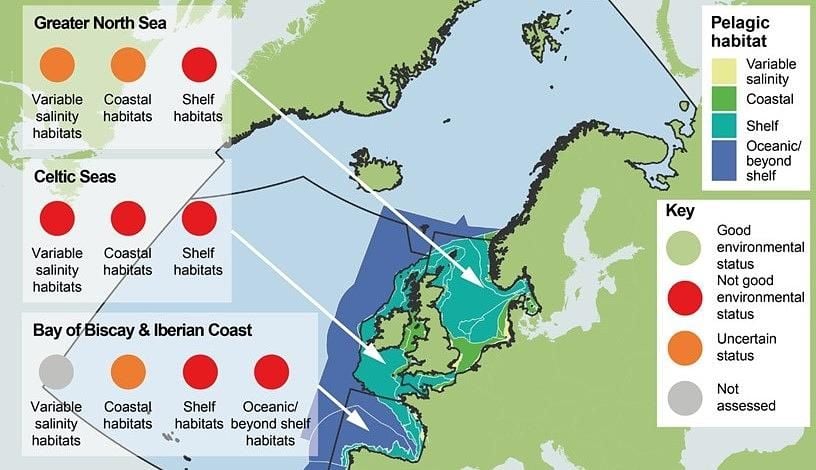
Health status of plankton habitats in the Northeast Atlantic. Source: Abigail McQuatters-Gollopy et al., Ecological Indicators (2026). DOI: 10.1016/j.ecolind.2026.115005.
As part of a new study on the health of the oceans, conducted by the University of Plymouth, the different regions and habitats were classified into four categories: good ecological condition, bad ecological condition, uncertain or unevaluated state. This classification is based on an integrated analysis of the available data and their level of coverage, in order to determine whether a reliable assessment could be carried out.
source : tameteo