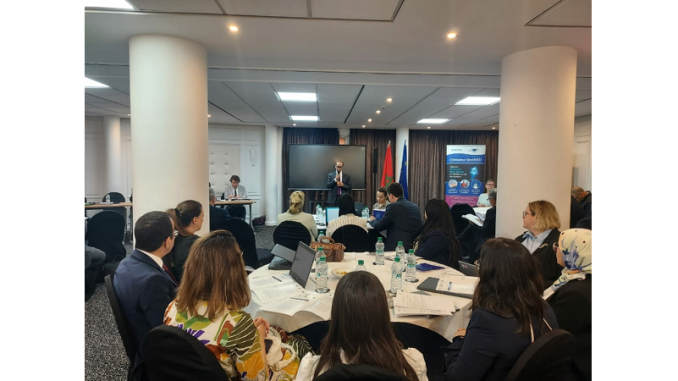
The Combined Maritime Operational Force is a collective response to piracy and other maritime crimes that plague Senegal to Angola.
A new rapid intervention force for the Gulf of Guinea has made it its mission to prevent maritime threats, especially piracy, and to protect the region’s blue economy. Launched on June 1, the Combined Maritime Operational Force (CMTF) is an ambitious joint initiative led by six countries: Côte d’Ivoire, Gambia, Ghana, Liberia, Nigeria and Sierra Leone.
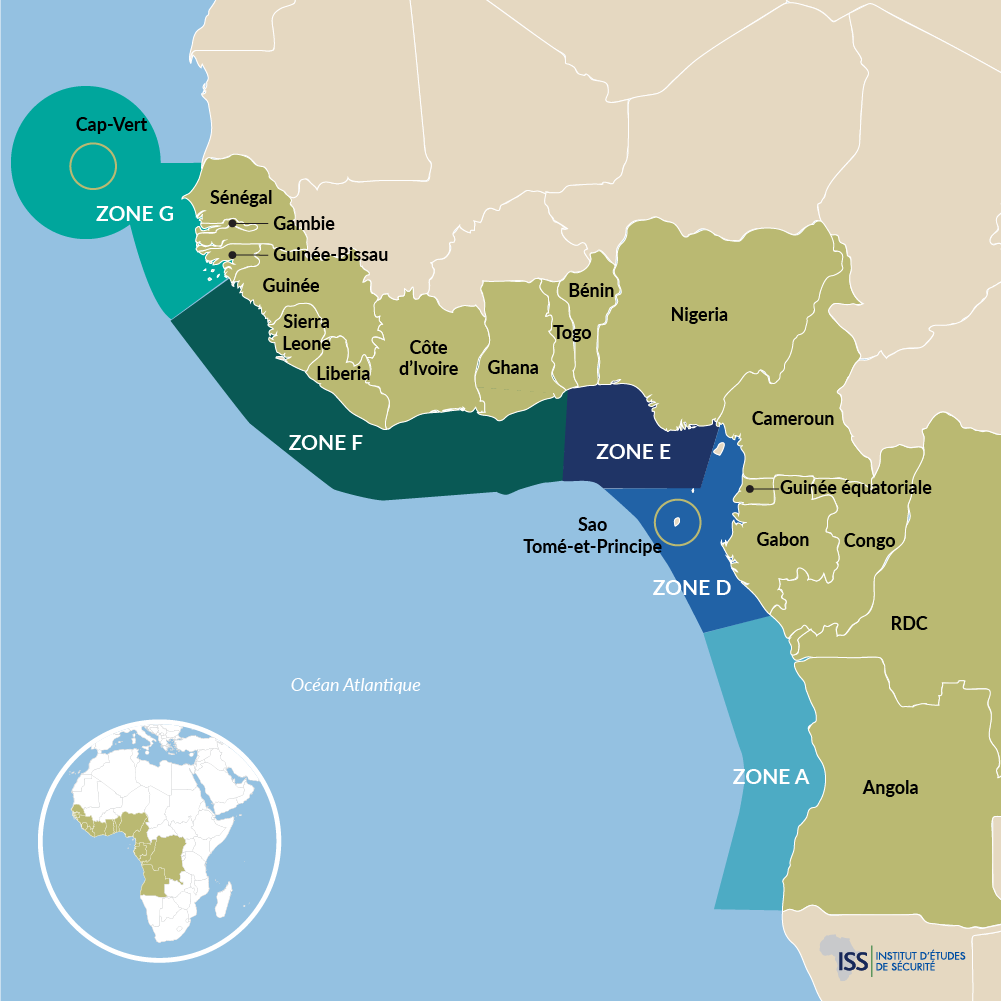
The CMTF covers 26 countries that total more than 6,000 km of coastline, from Senegal to Angola. Over the past ten years, the Gulf of Guinea has become infamous for its maritime crime. It was once considered the world’s high place of piracy. The region is also facing illegal souting, armed robbery, kidnapping, transnational organized crime, illegal fishing and terrorism.
Sustained regional efforts have made it possible to curb piracy in the Gulf of Guinea. However, the recurrence of kidnappings and other violent attacks shows that maritime insecurity remains. It disrupts trade and development and undermines investor confidence in the blue economy.
Countries and maritime areas of the Gulf of Guinea
Based in Lagos, Nigeria, the CMTF embodies the renewed commitment of member countries to combat these threats. The Force will undertake surveillance, interception, intelligence, patrol, search and rescue operations.
The CMTF is not the first regional maritime mechanism set up in the Gulf of Guinea. Among other initiatives, the Yaoundé Code of Conduct was introduced in 2013 to govern cooperation between West and Central African states on piracy and other illicit maritime activities. However, serious problems hindered these initiatives. The CMTF must learn from this to avoid a similar fate.
CMTF Commander, Commodore Mohammad Shettima, told ISS Today: “The mission of the force is to complete and fill a significant gap in [Yaoundé] architecture, by providing fast, kinetic and 24/7 surveillance capabilities.”
Until now, the most obvious weakness of the Yaoundé Code of Conduct has been the lack of a rapid military response to piracy and other threats on the high seas, particularly following early warnings or incident reports. However, this capacity for military intervention is essential to deter criminal activities in the region.
The existence of the working group testifies to a political will that should not be underestimated
Insufficient political will and the failure of member countries to comply with their responsibilities also explain the slow progress of the code of conduct. The disparities in the functioning of state structures responsible for maritime security are another factor. If not corrected, these weaknesses could compromise the efficiency of the force.
As a mechanism launched and promoted by the Peace and Security Council of the African Union (AU) and the United Nations Security Council (UN) since 2021, the CMTF could ensure their support to obtain the support of member countries.
While the CMTF establishes the necessary political, legal and operational foundations, external partners can continue to provide support in terms of training, financing and technical assistance. However, the long-term goal is for the states in the region to provide the required capacities themselves. This will strengthen African appropriation and domination in this initiative.
The operational force should have 1,500 members and have a fleet with surface, aerial means and electronic maritime surveillance capabilities. To date, only Nigeria, which has played a leading role, has supplied the CMTF fleet, consisting of three ships, a helicopter, three military trucks, two vans and two pick-ups. Nigeria has also provided temporary offices and 12 members of the navy.
CMTF’s challenges are common to most new multilateral security devices
Although the CMTF can mobilize the support and resources of private and international partners, it currently depends entirely on the commitments of the Member States.
The operational, political and resource-related challenges facing the CMTF are common to most multilateral security devices in their early days. The very existence of this operational force testifies to a political will that should not be underestimated.
Nigeria’s role as the main promoter deserves to be praised. In order to promote the sustainability of the initiative and broader ownership, Member States should agree on burden-sharing so as not to give the impression that Nigeria assumes a heavier responsibility than other countries.
The strengthening of the collective commitment of the Gulf of Guinea States in the field of maritime security reflects an international trend that extends over three decades. Initiatives conducted in the Indian Ocean, such as the Combined Maritime Forces (CMF), Operation Atalante of the European Union Naval Force and the Combined Operational Force 151 have recognised the transnational nature of maritime security. They confirm the interest of collective maritime platforms to build trust and share information, as well as common operational practices.
The CMTF shows that the Gulf of Guinea states are ready to adapt these principles to an African initiative. External partners still have an important supporting role through training, technology transfer, legal reform and the provision of specialised capabilities such as satellite surveillance. However, it must supplement the regional responsibility but not replace it.
The CMTF must demonstrate its added value to maintain regional dynamics
Although 11 States have signed the CMTF’s concept of operations, only six have decided to become « pioneer » countries. This is nothing unusual. The CMF, for example, was created in 2001 with only 12 countries and now has 47 members. However, this highlights the challenge of unifying the Gulf of Guinea and establishing cooperation between Member States.
The other concern concerns funding and resource mobilization. The fact that Nigeria has provided the CMTF for the launch of its operations is an encouraging sign. However, much more is needed, and the operational force must demonstrate its added value as soon as possible in order to maintain momentum and increase participation at the regional level.
The pioneer countries of the operational force have the responsibility to forge a unity of intent and mobilize the resources of the region. They must also ensure the support of external partners, including training, technology transfer, capacity building and specialised technical assistance.
Above all, it will be necessary to obtain continued political support from the UN, the AU and other international, continental and regional institutions.
If you wish to republish ISS Today articles, please write to us. Exclusive re-publishing rights were granted to Premium Times, Nigeria, and News24, South Africa.
source : ISS africa