
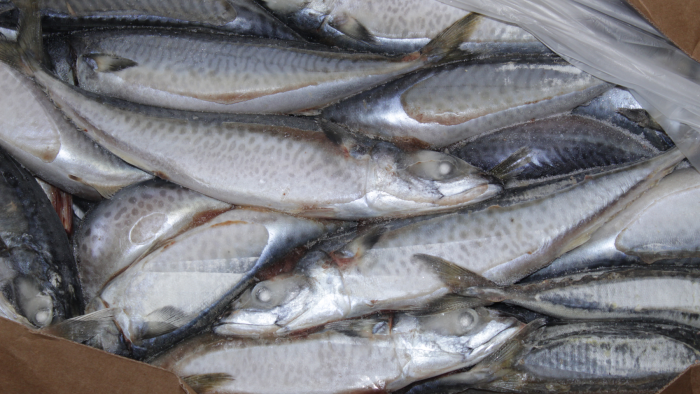
Chile has approved the entry of Atlantic mackerel from Morocco for fishing needs in the Far South, according to an exempt resolution of the National Fisheries and Aquaculture Service (Sernapesca), published by the Library of the National Congress of Chile (BCN). The text covers « the import of Atlantic mackerel (Scomber colias) from Morocco » and reserves its use « as bait in the region of Aysén del General Carlos Ibáñez del Campo and in the region of Magallanes and Chilean Antarctica ».
Exempt resolution DN-01594/2026 responds to a request from two Chilean operators of Magallanes: Global Pesca SpA, a company founded in 2003 and specializing in the capture and marketing of southern legine, called in Chile bacalao de profundidad, and Pesca Cisne S.A., a deep-to-sea fishing company established in Punta Arenas, active in southern hake, golden congrio and southern legine.
The Atlantic mackerel, Scomber colias, belongs to the scombrid family, which includes mackerel, tuna and bonites. Pelagic marine fish, it lives in the water column, forms schools and feeds several commercial uses according to the catch areas. In the Chilean file, it does not join the food market: Sernapesca classifies it as bait, with a Moroccan origin and a destination limited to southern fisheries.
The file falls under Supreme Decree (DS) No. 319 of 2001, which establishes the health regulations for aquaculture (RESA), and the Chilean regime of high-risk diseases (EAR) applicable to hydrobiont species. Before any entry of bait from abroad, the Chilean administration examines the country of origin, the species, the mandatory notification animal diseases and the health guarantees attached to the product.
Morocco’s examination establishes the Chilean green light. The technical report cited by Sernapesca holds that the WAHIS platform of the World Animal Health Organization (WHO) does not identify for the kingdom « any health event report associated with medical diseases of aquatic animals with mandatory notification ». The last Moroccan semi-annual report available from the OMSA, for the first half of 2025, reports neither a positive outbreak nor diagnosis in fish; viral hemorrhagic sepsis (VHS) appears as an « absence of disease » in wildlife.
Sernapesca is also part of Moroccan surveillance, notification, restriction of movement and border control measures. For the species itself, the Chilean administration notes that Scomber colias is not among the fish susceptible to the notifiable diseases taken up by the OMSA, nor among the species susceptible to the fish myocarditis virus (PMCV), according to the data sheet consulted by the Chilean service.
Southern fisheries and state of resources
The decision does not deliver any tonnage, no price, no Moroccan port of departure and no exporter name. It sets a perimeter: Moroccan mackerel should serve as bait in the regions of Aysén and Magallanes, two maritime territories where extractive fishing and aquaculture weigh in the local economy.
The same resolution admits a second species, unrelated to Morocco: the sardine crinuda, Opisthonema libertate, from Guatemala. The document clearly separates the two sectors: Morocco for Atlantic mackerel; Guatemala for the crinuda sardine; the same destination, bait, under Chilean health control.
The framing takes place in a sector closely followed by the Undersecretariat for Fisheries and Aquaculture (Subpesca). In its 2025 report of the main fisheries, published in March 2026, the Chilean administration lists 25 up-to-date fisheries: 60% are in a healthy situation, of which 8% are underexploited and 52% are in full operation; 24% are overexploited; 16% are exhausted.
source : barlamane