
Innovating to meet the challenges of maritime mobility
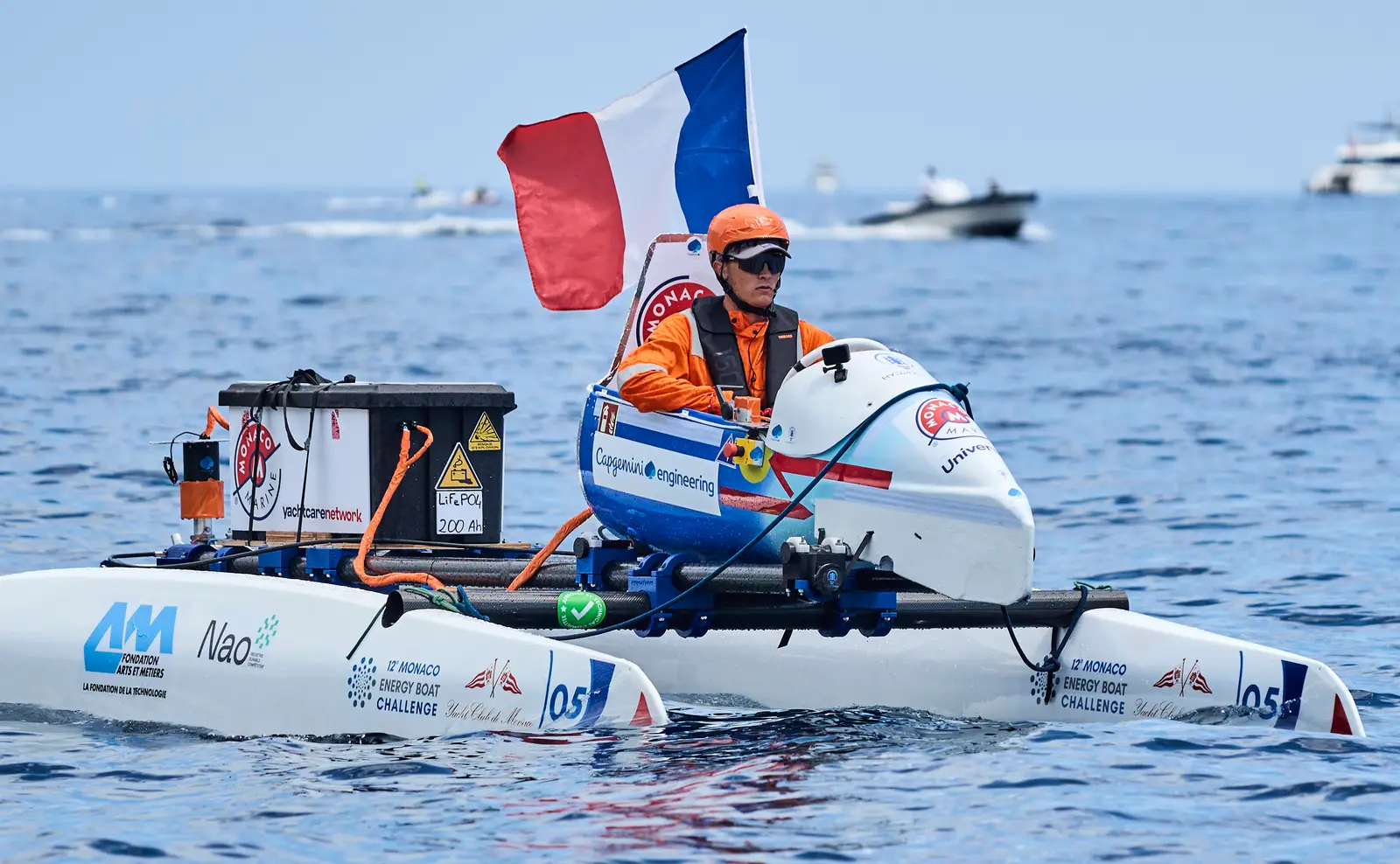
Our Technology & Innovation teams are developing a catamaran with a racy design and equipped with a hybrid hydrogen propulsion chain and other alternative energies to fossil fuels. All our system design skills are in the spotlight on this prototype.
Responding to the challenges of maritime decarbonization
The transition to low-carbon maritime mobility requires a profound rethinking of energy architectures, system management and their optimization in real conditions.
By developing an electric hybrid catamaran, Capgemini Engineering explores new approaches to design, integrate and pilot complex naval systems. This demonstrator is a true experimental laboratory, at the crossroads of technological innovation and industrial challenges.
Developed in collaboration with the École Nationale Supérieure des Arts et Métiers, Aix-en-Provence campus, the project illustrates the convergence between academic research and applied engineering, in the service of sustainable mobility.
Hybridization as a lever for naval innovation
This project aims to fully exploit the hybridization of different energy sources for maritime applications, by integrating it into a multi-source hybrid power chain.
Beyond energy alone, the challenge lies in the ability to orchestrate a global system, combining:
- Hydrodynamics
- Mechanical design
- Electrical engineering
- Thermal engineering
- new generation propeller design
This systemic approach addresses the complexity of naval environments while paving the way for more efficient and adaptable solutions.
« This demonstrator allows us to concretely explore the different possible hybridizations in complex naval architectures, beyond theoretical approaches. «
Maxime Chiletti, Scientific Expert Lead – Capgemini Engineering France
A demonstrator at the service of experimentation and evidence
Designed to meet an international challenge of reference, this catamaran is also a high-value experimental platform.
It allows you to:
- test innovations in real conditions
- validate energy architecture choices
- demonstrate the performance of emerging technologies
- generate concrete use cases for manufacturers
Presented at international events, such as the Monaco Energy Boat Challenge organized by the Yacht Club Monaco every year in July, it helps to make tangible sometimes still emerging concepts in the field of clean mobility.
Optimizing performance: from design to piloting
The work carried out is structured around two major axes:
Architecture optimization: Rethink the overall design of the ship to better manage energy needs and maximize system efficiency.
Piloting and trajectory optimization: Use advanced tools to control energy and navigation in real time, integrating all system parameters.
These approaches are based on:
- multi-criteria and multi-objective optimization methods
- modeling the physical laws of the ship
- the development of advanced algorithms
- an embedded control-command system
The whole makes it possible to identify optimal configurations more quickly than with traditional approaches.
source : cap gemini