Fires hit Occitania hard. Another fire silently strikes underwater life. In the form of unprecedented heat waves, more intense, long and frequent. Early laying of oysters, modification of herbariums, decline of gorgons, bleaching of corals and cashs… Ifremer scientists witness a hecatomb. Including in lagoons victims of a « magnifying glass effect ». Researcher at Ifremer, Franck Lagarde evokes an awareness of five years.
Ecologist at the Ifremer de Sète, Franck Lagarde says: « Parisians have felt in their apartment what a heat wave is but marine organisms and especially phytoplankton have been feeling marine heat waves for 30 years! And deviations from normal are as much in summer as in winter. This pushes living organisms to their tolerance limits. Some no longer have the strength to resist and are replaced by others.
These are called emerging actors. The best known appeared in 2018. This was the phenomenon of « green waters » due to a new species, picochlorum tauri, a first in Thau. An emerging organism that supports heat. Oyster shells also had an unusual greenish hue: it is also an emerging organism in the Thau lagoon, called ostreobium, which has never been described.
The species is not yet characterized, it will take a few months or even a few years of work depending on the funding to make it genomics. «
We relaunch the breeding of mussels at sea
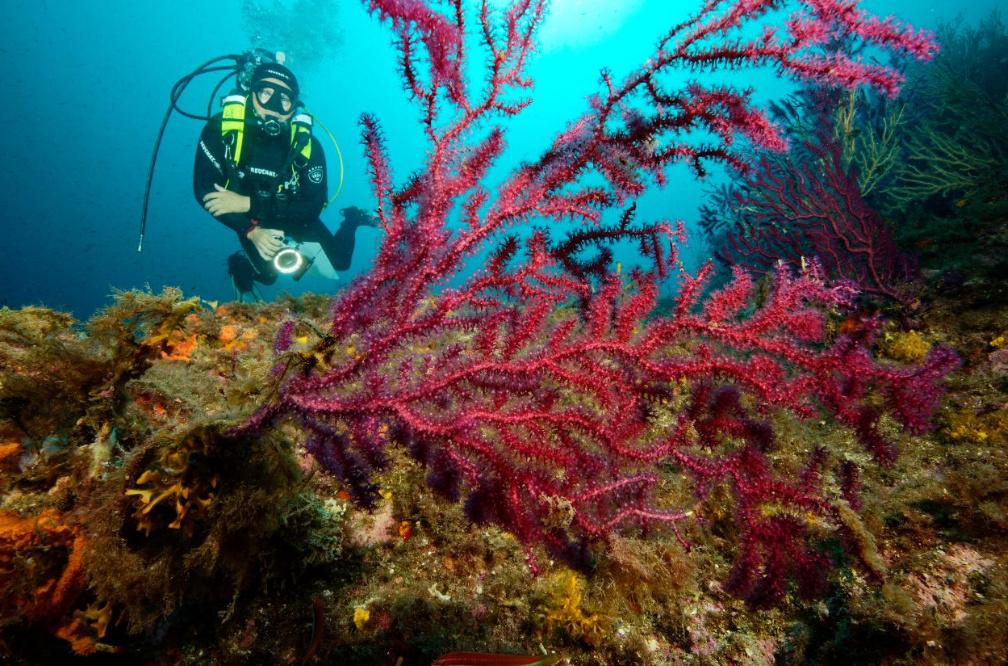
Under the water, the landscapes are changing. The lagoons are starting to boil. At sea, gorgons, posidonia and so many species, so useful to the marine environment of the Mediterranean, suffer, are exhausted, try to adapt. Some grow faster and change their life cycle… Others are patronized like the cynodocea nodosa in the Thau pond which progresses year after year without knowing what consequences this will generate… In any case, it loses its leaves in winter; a foliage that served, in other species, as a shelter for local species.
Mussel farming promises to be « compromised » in the Thau pond « where the average temperature has risen by 1.5 degrees in 20 years and by + 2.7 degrees since the 1960s, which is colossal, » according to Franck Lagarde of L’Ifremer, based in Sète. The Regional Committee of Mediterranean Shellfish Farming (CRCM) has even relaunched the famous sectors at sea. President of the CRCM, Patrice Lafont valid. « The goal is to experiment with Italian sectors. There are also protective nets against sea bream that love molds to be placed around breeding ropes but it is expensive, tedious; it harms growth and it produces plastic waste so we would like to avoid… » So that mussel farming does not disappear. And that an additional threat does not fall on the 2,000 or so direct jobs in shellfish farming.