

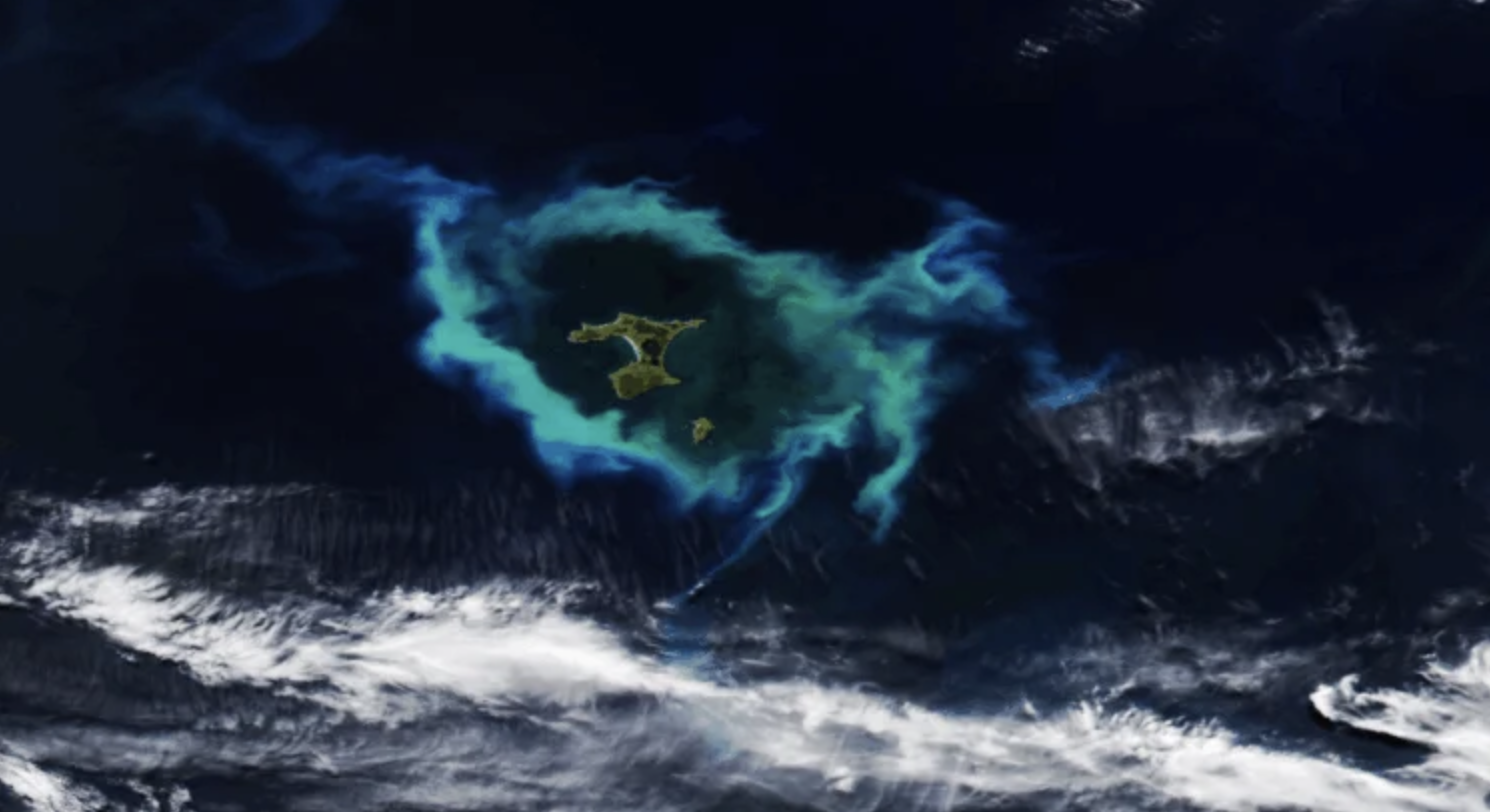
A spectacular natural phenomenon was observed around the Chatham Islands, where a huge ring of phytoplankton reveals the interaction between underwater relief and marine biodiversity.
Space sometimes reveals invisible scenes from the coast. On January 10, 2026, the NOAA-20 satellite captured a large colored ring around the Chatham Islands, located in eastern New Zealand. According to NASA’s Earth Observatory, this structure corresponds to a summer dephytoplankton bloom. It developed in an area where colder Antarctic waters and warmer subtropical waters are encountered. The main lesson is clear: the relief of the seabed directly influences the productivity visible on the surface. This observation describes a punctual natural phenomenon. It does not allow, alone, to draw definitive conclusions about its future evolution.
The Chatham Islands are located above the Chatham Rise, a vast underwater plateau connected to the New Zealand South Island. This elevation under the sea separates deeper waters to the north and south. By modifying ocean circulation, it promotes the rise of nutrient-rich waters. When the austral summer brings more light, these conditions become favorable to the rapid growth of phytoplankton. The observed ring therefore illustrates the direct link between underwater geology and surface biological activity.
A signature visible from orbit
The image was obtained thanks to the VIIRS instrument on board NOAA-20. This sensor observes the color of the ocean and makes it possible to detect high concentrations of photosynthetic microorganisms. NASA specifies that a near infrared treatment has strengthened the contrasts to better distinguish the shapes of the phenomenon. The filaments, spirals and volutes visible on the image reflect the action of surface currents and marine disturbillions.
Instead of forming a uniform spot, the flowering was stretched and then reshaped by the movements of the water. This explains the spectacular circular shape around the archipelago. According to NASA, the area could contain many cocolithophores, microalgae surrounded by limestone plates. These structures strongly reflect light and often give the sea milky, turquoise or light blue stones. However, no direct debit is mentioned here. This identification is therefore based on the signature observed from space and on the episodes already documented in the region.
What it changes for the understanding of the oceans
Phytoplankton plays a central role in marine ecosystems. It forms the basis of many food chains, feeding first zooplankton and then fish, seabirds and mammals. A large flowering can therefore signal a favorable period for the entire local biological network. The waters surrounding the Chatham Islands are also recognized for their richness and productivity.
Following these episodes also helps researchers better understand the seasonal variations of the oceans. The satellites show when and where these blooms appear, as well as their extent. This can then guide field campaigns to measure temperature, salinity or nutrient concentration. On the other hand, an image alone does not allow a precise assessment of the consequences on fishing, nor to automatically link the event to climate change. Long series are still necessary.
A natural laboratory in the South Pacific
The Chatham Islands region has long interested oceanographers. It is located in the face of different water bodies, separated by a dynamic ocean front. This type of marine border often concentrates biodiversity and organic production. The Chatham Rise acts here as an anchor point that partly stabilizes these interactions between currents, temperature and nutrients.
The episode observed in January 2026 finally recalls the importance of environmental satellites. They make it possible to follow immense phenomena, sometimes ephemeral, impossible to grasp from a single ship. By mapping these microscopic explosions of life, they help to understand how the world’s ocean works. What appears as a simple colored ring from space actually tells the deep mechanics of an entire ecosystem.
source : science et vie