
Conventional underwater drones disrupt marine life with their noisy propellers. A high school student from Ontario wanted to do the opposite. His robot turtle swims in silence to spot sick corals and invasive species.
Evan Budz, a fifteen-year-old Canadian high school student based in Burlington, Ontario, has developed a stand-alone underwater device that tracks down threats to aquatic ecosystems. Monitoring a reef closely remains difficult, because the slightest whirlpool of a machine can tear off polyps already weakened by heat. His robot turtle lifts the obstacle by copying the swim of a serpentine turtle, so flexible that it runs along the coral without disturbing the slightest fish.
A silent swim copied on a freshwater reptile
Everything started from a campsite. Watching a serpentine turtle slide in the water, Budz was struck by his fluid and discreet swim, a thousand leagues from motorized vehicles, as he told Popular Science. The high school student then studied the locomotion of the reptile, watched videos of sea turtles and interviewed the specialists of his local aquarium, before modeling a prototype on computer-aided design software.
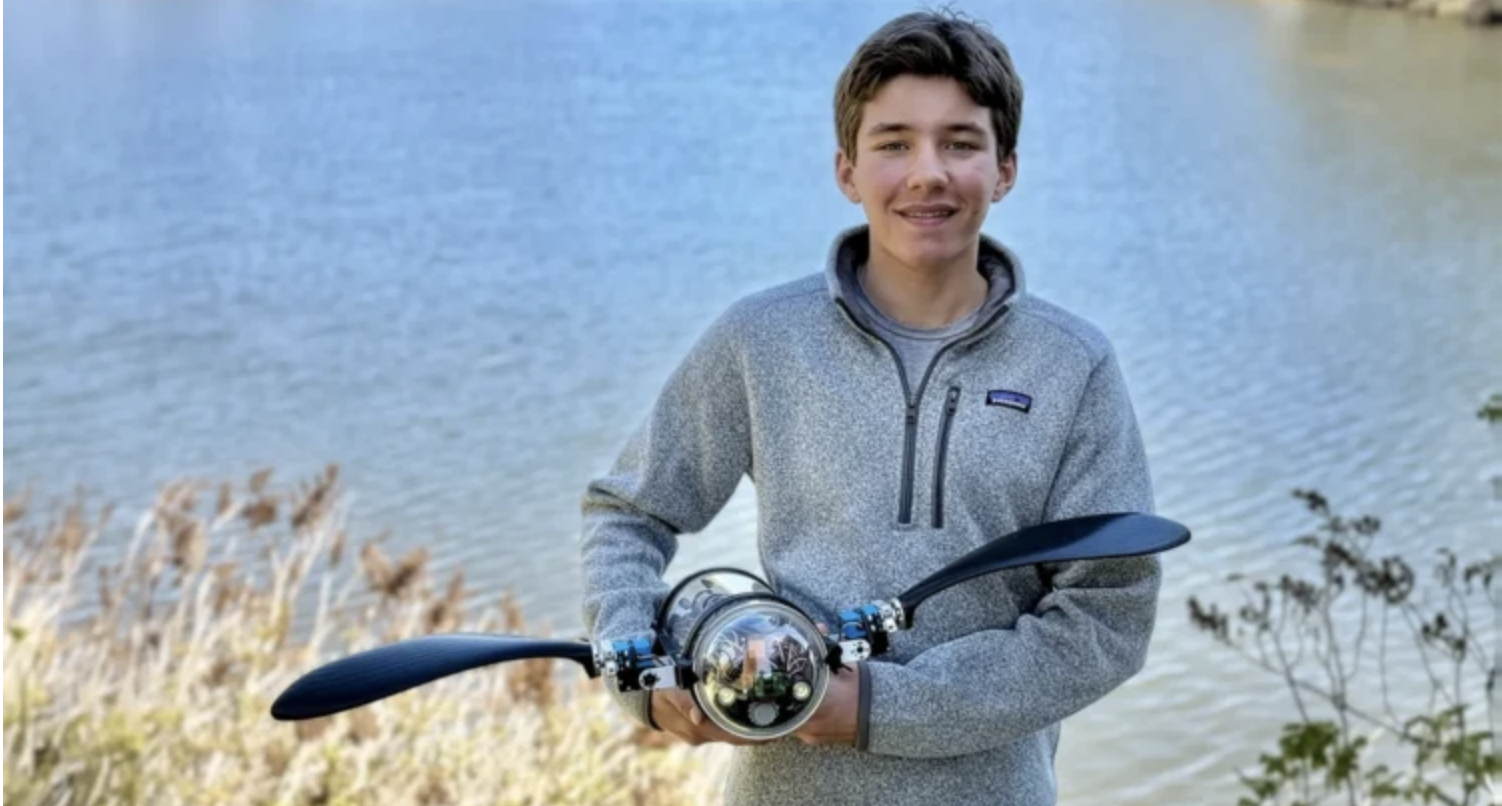
His robot advances thanks to four fins, the two large ones at the front providing propulsion, the small ones at the rear used to turn and stabilize, just like in the animal. An acrylic tube contains electronics, including a Raspberry Pi microcomputer that runs artificial intelligence models. A front-facing camera films the funds, while a GPS module and various sensors guide the device along a programmed-in-ad-advance framework. The whole weighs just five kilos, small size that allows it to sneak into various environments.

© Evan Budz
It was in the swimming pool installed in his grandparents’ garden that Budz carried out most of the BURT tests.
What the robot turtle can spot underwater
Once submerged, the machine scrutinizes its environment and entrusts the images to its microcomputer. It already distinguishes three plagues, coral bleaching, invasive species and microplastics. In the absence of access to a real reef, the teenager reconstructed a coral decoration from models printed in three dimensions, then trained his system to recognize a healthy coral of a sick coral. During these tests, conducted in his grandparents’ pool and then in Lake Ontario, the machine detected simulated bleaching with 96% success.
Leasted with about ten kilos of metal to defeat the thrust that would make it float, its robot turtle dives well below the surface. It swims about eight hours on a single charge, and a solar panel further extends its autonomy. Its speed remains modeled on that of a real turtle, nearly 0.8 kilometers per hour, but it is enough to accelerate the beat of the fins to move it faster.
A fleet of turtles to monitor the reefs
This year, Budz added to his creature a holographic imaging device and a home neural network that sorts, particle by particle, whether or not it is microplastic. For troubled waters, he installed headlights and an ultrasonic sensor that identifies obstacles to sound. The work has already been distinguished by a first prize at the European Union Competition for Young Scientists, organized in Latvia in 2025, then by an award at the Pan-Canadian Science Exhibition, which brings together some 25,000 candidates. The teenager now wants to measure how deep his robot can descend, and dreams of an entire fleet of turtles released into the oceans to track down, bench after bench, the signs of ecosystem distress.
source : science et vie