
« The rush on the ports » (4/16). The United Arab Emirates is beting on the Gulf of Oman to reduce its dependence on the Strait of Hormuz. Titanic work is underway. The ports of Foujeyra, Khor Fakkan and Dibba will be the subject of new expansions and thus compensate for the slowdown of Djebel Ali, one of the largest container ports in the world, located in the Arabian-Persian Gulf.
Children swim in Ras Al-Dahrah while watching a Chinese boat pass by in the distance. It’s June 24 and the Strait of Hormuz is on fire at sunset. For two days, cargo ships have been evacuating the Arabian Gulf under the supervision of the International Maritime Organization, and taking this gorge separating Iran from the Arabian Peninsula, through which 20% of the world’s oil usually transits.
A relief for the entire planet, which unfortunately did not last more than a month. Despite the memorandum of understanding signed on June 17 by Washington and Tehran, providing for the unconditional reopening of the strait for sixty days, the Revolutionary Guards announced on Sunday, July 12, the return of restrictions. A few hours before, they hit a Cypriot boat that did not follow the required route. Freedom of navigation is a lure, and the prospect of a future right of way, taken by Iran and the Sultanate of Oman, only adds to the panic.
An intolerable threat to the United Arab Emirates, which built one of the largest container ports in the world two hours later. Located on the outskirts of Dubai, Djebel Ali represents a pinnacle of technology and efficiency. A forest of yellow cranes deposit the containers on about sixty docks. Right next door lies one of the largest aluminum foundries on the planet. Stuck between the sea and the highway, it imposes itself over several kilometers and continues to invest in the future: a new extension, allowing to recycle 200,000 tons of aluminum per year, was inaugurated on June 24.
The port of Djebel Ali stands out proudly on the seafront of Dubai, not far from the famous artificial island of Palm Jumeirah which hosts the jet-set of the whole world. A striking contrast between bling-bling luxury and industrial logistics, which embody the two main pillars of Dubai’s success.
Commerce there is also much older than tourism. From spices to gold to textiles and hydrocarbons, the Arab Emirates, which only united in 1971, have seen all the world’s riches pass for centuries. So much brilliance has aroused a lot of lust, to the point of making the region known as the « Pirate Coast » – a name that lasted until the 19th century. In front of a shipyard, in Khor Fakkan, in the Emirate of Charja, on February 25, 2026. GIUSEPPE CACACE/AFP
Pirates are less visible today, but commercial ambitions remain: « The United Arab Emirates is a thalassocracy. The national port company, DP World, has stakes in ports around the world. They need the Emirates to remain a crossing point on the roads of globalization, « explains Laurent Vigier, a Frenchman who has lived in Dubai for seven years and runs the private equity fund Five Capital.
Yes but here it is: Djebel Ali fell on the wrong side of the room. Or rather on the wrong side of the strait. Since February, he has been locked up in this Arab-Persian Gulf to which Iran has cut off access. Despite the partial reopening of the Strait of Hormuz, there are only a thousand containers to transit every day. This is forty times less than before the war, explains a logistics manager on site (people whose names are not indicated have required anonymity). Fortunately, the United Arab Emirates extends over two coasts: that of the Arab-Persian Gulf, to the west, on which Abu Dhabi and Dubai were built, and that of the Gulf of Oman, to the east, opening onto the Arabian Sea.
Reception of containers
It is enough to observe the two waters to understand the issue: the first is a sea of oil, no wave comes to hem its mirror. The second is agitated, windy, open to all the oceans of the world. The boats that dock here come directly from international waters. It is there, in this off-center emirate of Foujeyra, that the new commercial hopes of the United Arab Emirates rest.
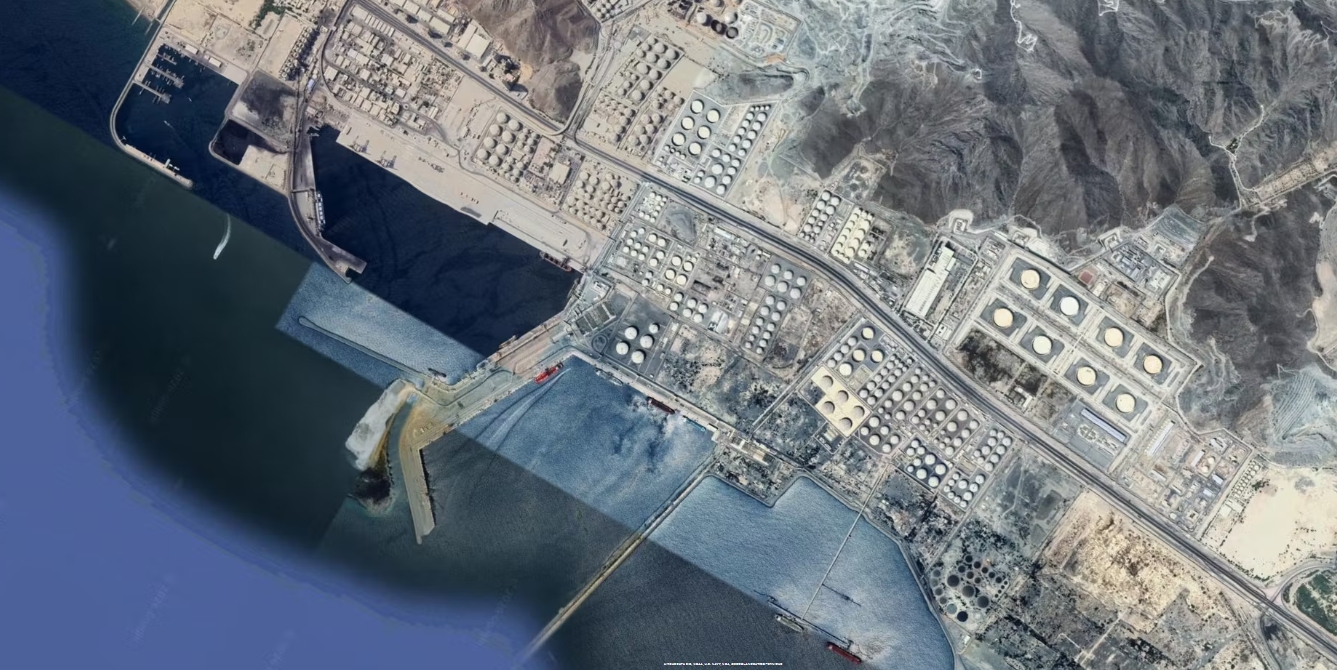
The port, located in the uncharmed city of Foujeyra, was not designed for this. Located at the end of the oil pipeline that transports Abu Dhabi oil, it is the first hub in the Middle East for storage (with a capacity of 18 million cubic meters) and oil trade. The north of the city is only a vast succession of fuel oil tanks, squeezed between the sea and the Hajar Mountains. Its activity has exploded since the beginning of the war, at the end of February: the volumes of crude oil exported there every day have increased by 38% since February, local authorities say.
Loading of a ship at the port of Foujeyra, United Arab Emirates, on May 6, 2026. AMR ALFIKY/REUTERS
But the port is now much more than an oil terminal. For the first time in its history, it welcomes container carriers. On June 24, dozens are waiting off the coast. « Everyone has a number. They are waiting for a call to dock. It can take days: we only have four container docks, it’s undersized, « explains a docker. Beyond hydrocarbons, the city has become the gateway to all foreign products, from medicines to mobile phones to fruits and vegetables. In this suffocating desert where nothing grows, it guarantees the food security of the country, which imports 80% of its food.
Multinationals rush to deliver their goods as soon as possible. But efficiency is not decreed. The Clarins cosmetics group knows something about it: shaken by the closure of Djebel Ali in March – following Iranian fire – it sent its containers to Foujeyra. The boat was too big to dock, so it was diverted to India. The containers were then transhipped to smaller ships and then returned to Foujeyra. « Our products come from France. Normally, it takes them two to three weeks to reach the Emirates. There, it took us three more months, « explains Osama Rinno, president of Clarins in the Middle East. Cartons were also shipped by air to avoid stockouts, but this option is not viable: « Air transport costs three to four times more than by boat, » he continues. It is also impossible to return to Djebel Ali as long as negotiations with Iran remain as uncertain: « We will wait for the Strait of Hormuz to reopen completely. The insurance paid by boats to reach the Arab-Persian Gulf is too expensive, « adds Osama Rinno. For him as for others, the development of the port of Foujeyra is a necessity.
« Absolutely strategic project »
Located twenty kilometers further north, that of Khor Fakkan is undergoing an even more spectacular transformation. Designed as a simple transhipment platform, it managed the equivalent of 2,000 containers per week at the beginning of the year. He sees twenty-five times more now. The trucks then take over to serve the Emirates, and beyond Qatar, Kuwait and Bahrain, three countries landlocked in the Arabian Gulf. On the three-lane road that joins Dubai, these trucks form a long snake that ripples according to the turns. The vision is all the more striking as they struggle to climb the heights of the Hajar Mountains. Some are almost at a standstill and give off thick black smoke. The relief was not necessarily adapted to such traffic, but geopolitics is right about everything.
The Emirati power is doing everything to streamline traffic. The Schneider Electric group, which has also learned to do without Djebel Ali, says it is « bluffed » by its pragmatism and responsiveness. « Part of our merchandise arrives through Foujeyra, another through the port of Salalah, in the Sultanate of Oman. But this port is not designed for customs clearance. The two governments have therefore arranged for the goods to be transported to the Emirates and cleared through customs there. It was the smartest thing to do to avoid bottlenecks, » explains Schneider Electric Regional Manager Amel Chadli.
The Emirati government does not intend to stop there. On June 17, he presented a strategy to end the country’s dependence on the Strait of Hormuz and free itself from Iranian blackmail. « We are heading towards zero dependence on Hormuz, and whatever happens, » said Foreign Trade Minister Thani Al-Zeyoudi.
The ports of Foujeyra, Khor Fakkan and Dibba, further north, will be the subject of new extensions. The pipeline that transports oil from Abu Dhabi will be doubled from 2027, for a total capacity of 3.5 million barrels per day. A third is envisaged to transport refined products (diesel, gasoline, kerosene). « This project is absolutely strategic, because global refining capacities until then depended a lot on the Arabian Gulf, » explains Arnaud Lacheret, a political science professor living in Dubai, a teacher at the Skema Business School.
Aware that existing infrastructure is limited by space and cannot be extended indefinitely, the United Arab Emirates even plans to bring a completely new port out of the ground, near Foujeyra, the Financial Times revealed on Monday, July 13. It could be completed in eighteen months, adds the financial daily. A feat for such a project, which says a lot about the degree of urgency.
Hard to replicate Djebel Ali’s success
Other ports also thrive further south, in the Sultanate of Oman. The French shipowner CMA CGM thus plans 400 million euros to develop that of Sohar, about a hundred kilometers from Foujeyra. Nevertheless, this diversification remains fragile. First because the ports of the Gulf of Oman are also within range of Iranian missiles. The Revolutionary Guards recalled this by setting fire to part of the Foujeyra oil complex with drone fire on March 14. They also published a maritime map, on May 21, which integrates the port of Foujeyra in their sphere of control. A provocation, so far from the Iranian territorial waters.
The Emirates will in any case find it difficult to replicate the success of Djebel Ali, the Dubai port. « We can imagine that the transport of petroleum products is independent of the Strait of Hormuz. For the rest, it is impossible: urea, fertilizers, metallurgy and aluminum will never be able to do without Djebel Ali. The infrastructure is so colossal that it cannot be reproduced elsewhere, « explains Arnaud Lacheret. New trade routes, which require boat and then truck trips, are also more expensive, of the order of 12% on average, according to an economist on site. A significant additional cost.
The success of the Gulf of Oman is all the more fragile as the land transport that drains the Arabian Peninsula is archaic and regional cooperation is difficult. « We are actually witnessing a regional competition: each country has its port and airline. The sums devoted to it are pharaonic. But at the collective level, nothing is happening, « confirms an economist from the region. A train is due to be inaugurated in September, which will eventually connect the port of Foujeyra to the west of the country. But he will not venture beyond national borders.