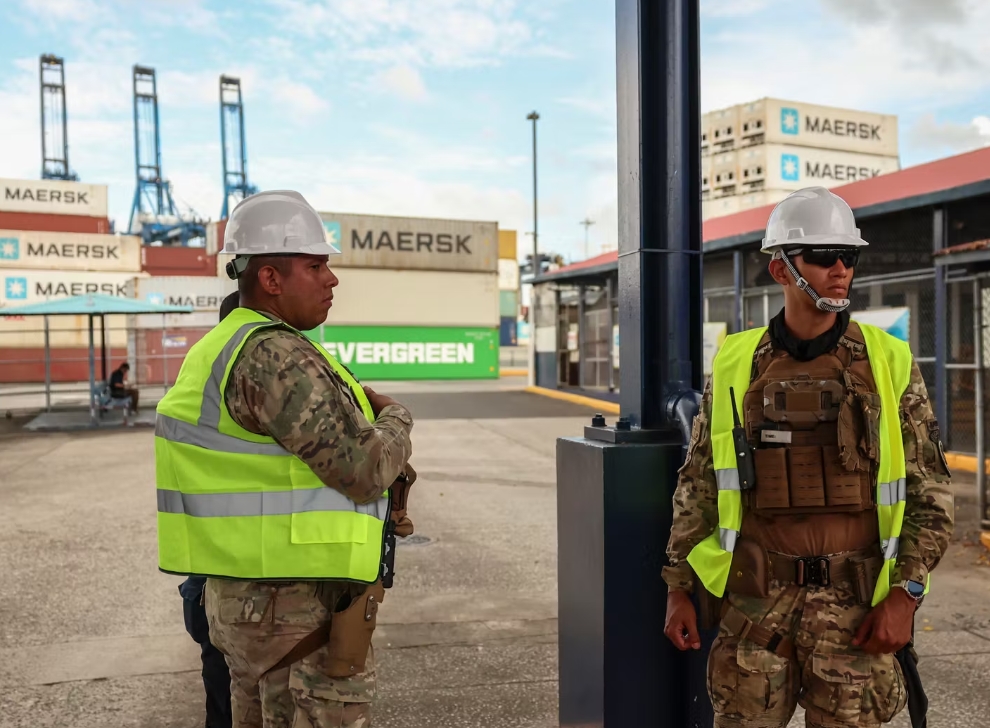
The scene lasted only a few hours, it did not give rise to any outpouring of violence, but it marked a historic turning point for Panama. On the morning of February 23, a delegation of about fifteen representatives of the Panamanian state, lawyers and senior officials entered the port of Balboa, located at the mouth of the canal overlooking the Pacific, right next to the capital.
Almost a month earlier, the Supreme Court of Panama had declared « unconstitutional » the port concession granted to the Chinese company CK Hutchison since 1999. On that day, the delegation comes to execute the judgment. It takes possession of the premises, its 28 cranes and its 2,000 employees.
« They had been managing this port for twenty-seven years, the conversation was of course complicated, » concedes with euphemism Luis Roquebert, the director of the Panama Maritime Authority, who was present. After a few hours of tense negotiations, the handful of Chinese company executives unplug the communication systems, including the software indicating the location of the containers, and then leave the premises for good.
At the same time, a similar scene takes place at the other end of the canal, on the Atlantic side, in the port of Cristobal, which has also been under concession from CK Hutchison since 1999. The leaders of Chinese society are forced to leave. « Everything stopped, a new computer system was set up the next day, and it took a few days to start returning to work, » reports a union source. At the end of June, after four months of catching up, the two ports had barely regained the volumes made before the takeover.
With this coup de force – legal, Panama assures, which CK Hutchison disputes – the storm triggered by Donald Trump’s return to the White House in January 2025 had just reached its climax. Panama, a small Central American country with 4.5 million inhabitants, is at the heart of the new Cold War between China and the United States.
The canal, opened in 1914, is a key passage in world trade, allowing you to pass in eight hours between the two main oceans of the planet – instead of making a detour of 8,000 kilometers and three weeks through Cape Horn. More than 13,000 ships transit there each year, accounting for 5% of world trade, but especially 40% of containers to and from the United States. For the world’s first economy, this is a serious vulnerability: « The best way to hurt in the United States would be to block the channel, » explains Eddie Tapiero, a professor at the University of Panama.
On the day of his inauguration, January 20, 2025, Donald Trump quotes Panama six times in his speech. The canal, which has long belonged to the United States, was « idiotically given to the country of Panama, » he roars. Even worse, « China [the] operates ». « We didn’t give it to China, we gave it to Panama, and we’re going to take it back. «
This bumper, which took the Panamanian authorities by surprise, caused an escalation between the two superpowers. Furious, China could not bow without reacting. « The problem is that Trump directly accused her in this case and that Panama has become a test [for Latin America’s dominance], » explains Michael Cunningham of the American think tank Stimson Center. China has chosen to send a very harsh response. «
It replied on two levels. Initially, a year before the Supreme Court’s decision, CK Hutchison wanted to sell its ports. The Hong Kong group has announced the sale of its two sites in Panama, but also the other 43 that it manages around the world, to the American investment fund Blackrock, allied with the Italian-Swiss shipping company MSC. No question, reacted Beijing, which was obviously able to find the arguments to block the transaction.
Then, the Chinese authorities, without saying it officially, began to very regularly inspect the ships flying the Panamanian flag that arrive at its ports. Each inspection immobilizes the boats for several days, in an industry where speed and reliability are at the heart of the system. « Obviously, you can always find a defect on a boat, » Luis Roquebert is annoyed.
Concerned, the shipowners began to abandon the Panamanian pavilion. Nearly 250 ships (out of 8,500) have already changed their flags. The shortfall for the country remains low for the moment – around $5 million (€4.38 million), according to Luis Roquebert – but it could get worse if the situation lasts. And that’s why the President of Panama, José Raul Mulino, made the trip on June 1 to Greece, to the great Posidonia 2026 Shipowners’ Conference. The goal was to persuade them that the problem was only temporary.
But the worst could be yet to come. The Panamanian flag currently gives access to Chinese ports at a reduced price, negotiated a decade ago. No luck for Panama, this agreement expires on July 31. Its renewal is now in the balance.
« Panama is a collateral victim [of the battle between the United States and China], » says Omar Jaen Suarez, an advisor to the president, historian and former ambassador to France. « The reaction of the Chinese is exaggerated, » adds Miguel Antonio Bernal, another president’s advisor, a fatalist, quoting an African proverb: « When two elephants fight, it is the grass that suffers. «
In 1903, Panama did not yet exist, it was only a province of Colombia. For two decades, the French have been bogging down in the work to dig a canal that joins the two oceans. Ferdinand de Lesseps, the engineer who dug the Suez Canal, got the wrong technology: a level channel is not possible, you need a lock system. Cholera, yellow fever and malaria wreak havoc.
The Americans bought the project and fomented a coup d’état by supporting the independence movements. Panama is supposedly becoming a country, but the route of the canal – and 8 kilometers on each side – are under the sovereignty of the United States. And to avoid any misunderstanding, a soldier quickly takes the direction of operations. In 1914, it was the success, the 80-kilometer-long canal was dug, thanks to three lock systems that still work today, their gigantic gates having been forged in Pittsburgh (Pennsylvania).
US President Theodore Roosevelt (sturled on the wagon and dressed in white) reviewed American troops in the Panama Canal area during an inspection of the canal construction work in November 1906. AP PHOTO
Theodore Roosevelt (1901-1909) made the trip to Panama. This is the first time that a sitting American president has left the United States. Military bases are present everywhere – three will remain until 1999. On the Caribbean coast, the « School of the Americas », whose building is now a hotel under renovation, trains all the counter-revolutionaries who fight against Latin American governments judged too left by Washington. Many future dictators learn about fighting in the jungle and foment coups d’état. « This country was our colony, no need to deny it, » acknowledges John Feeley, the former US ambassador to Panama.
The channel is then not a commercial issue. From the Second World War until 1960, it was even exclusively for military use. Globalization is then almost non-existent, China a non-economic entity. The priority objective is to get American warships moving quickly from coast to coast. Even when trade is growing, the United States is not interested in it: they do not make any profit from the channel, simply imposing fees that cover their costs.
Doubled capacity
In these circumstances, the retrocession of the canal to Panama marks the real birth certificate of this young nation. Negotiated in 1977 by Jimmy Carter (1977-1981) and his Panamanian counterpart, Omar Torrijos (1968-1981), it became effective on December 31, 1999, at noon. « For the first time in our history, we had full control of our main resource: our geography, » explains Alberto Aleman Zubieta, who was the first Panamanian administrator of the canal.
At the time, the nagging question was whether the very corrupt Panamanian authorities would succeed in managing this key infrastructure. « Many people did not believe it, » continues Alberto Aleman Zubieta.
A quarter of a century later, success was unanimously noted. Not only are the operations working perfectly, but Panama has doubled the capacity of the canal, building two new sets of locks. Since their opening in 2016, the « neo-Panamax », these gigantic new generation containers, can pass through this road. Ships such as the Maersk Skarstind, for example, which transited on June 22, from the port of Savannah, Georgia: 300 meters long, 48 meters wide, eight rows of containers piled on top of each other. This can load just under 10,000 containers (equivalent to twenty feet). Not much: in 2025, a ship carrying 17,000 containers took the canal.
During the passage, Panamanian control is total. The Canal Authority (ACP) decides the order of transits. A pilot of the ACP then takes the direction of the ship. Above all, management changes logic: from now on, trade prevails.
The « Ever Lucent » tanter carrier, engaged in the Panama Canal towards the Pacific Ocean, on September 4, 2023. TARINA RODRIGUEZ FOR « LE MONDE »
The passage of the canal is on average between 700,000 and 1 million dollars (up to 880,000 euros), or even more, depending on the type of ship and its size. In twenty-seven years, thanks to the new locks, the transit of goods has increased from 350 million tons per year to 510 million. In 2025, the channel generated $5.7 billion in profits, donating half to the government – or nearly 10% of the government’s budget. Counting the five ports, the two free zones, the logistics industry that surround the canal and the indirect spills (tourism, hospitality, etc.), it is a third of the country’s gross domestic product that depends on it. Enough to sometimes compare Panama to an income economy, which depends on its geography.
The ACP, independent of the government, has become a real state within the state. Its offices are located in an imposing building located on top of a hill in Panama, the capital, with a breathtaking view of the port of Balboa, the same one that was seized in February. At the foot of the building, a small building without charm houses the Ministry of the Canal, which depends on the government and has little authority. The interview with the minister is also organized by the communication officer of the ACP, who even allows himself to roll his eyes when the answers annoy him.
Which fly stinged Donald Trump? When it returns to power in January 2025, the channel works smoothly and is the key to American trade: 57% of containers heading to the east coast of the United States pass through it. As for the United States, despite their withdrawal in 1999, they keep a more than close eye. « All the agencies we had in three letters – CIA, FBI… – were very present when I was an ambassador to Panama [in 2016-2017], » recalls John Feeley. Did the Chinese of CK Hutchison have the means to install cameras and sensors in the ports? Obviously. But we knew exactly everything that was happening in the canal. «
« Trump has politicized the channel »
Every year, the American military exercise Panamax took place there. And when a ship left Cuba in 2013 for North Korea, hiding spare parts of MIG-21, a Russian fighter plane, in a double-hull, it was stopped in Panama. « If Trump had read the file, he would have known that the channel was in good hands. The drama is that he politicized the canal. «
However, a historic change occurred in 2017. Panama, which then officially recognized Taiwan, changes its allegiance and switches to Beijing, saying that there is « only one China in the world ». The diplomatic gesture is an economic obvious: 23% of the ships crossing the canal come or go from China. The Chinese authorities accompany this gesture with a series of gifts. President Xi Jinping makes an official visit to the country in 2018, and he offers reduced access to Chinese ports for ships flying the Panamanian flag.
Chinese President Xi Jinping, alongside his Panamanian counterpart, Juan Carlos Varela, near a lock on the Panama Canal, on December 3, 2018. LUIS ACOSTA/AFP
At the same time, Hong Kong, where CK Hutchison has its headquarters, is taken over with an iron fice by Beijing. The company, a multinational that has not been in the bosom of the Chinese Communist Party for a long time, is obliged to give pledges. Its president, Victor Li Tzar-kuoi, is also a member of the Political Consultative Conference, the main advisory body in China, brought together under the leadership of the Chinese Communist Party (CCP). What to worry Americans about a takeover by Beijing? « The United States will not allow the CCP to continue its growing and effective control of the Panama Canal, » warned Marco Rubio, US Secretary of State, during a trip there in February 2025.
Faced with the storm, Panama clings to a key argument: the neutrality of the channel, guaranteed by a treaty signed in 1977 in parallel with the retrocession. « This is our shield, » summarizes Ilya Espino de Marotta, the deputy administrator of the Canal Authority. Russian or Ukrainian, American or Chinese ships, all can pass indifferently, as long as they have paid the toll and meet the necessary technical conditions.
In May 2025, when Pete Hegseth, the US Secretary of Defense, came to give a speech in front of the canal, surfing on Donald Trump’s provocations, Panama stood up to him. He claimed a free right of way for American warships (in addition to the priority right of way, historically in place). He did not get it, says Ilya Espino de Marotta. To keep the pressure, and send the message of its domination, Washington has however decided to send soldiers to conduct training exercises in the Panamanian jungle.
For Eddie Tapiero, of the University of Panama, this neutrality is absolutely the key to the future of Panama. « During globalization, the basis was that countries trusted each other. This is no longer the case. From now on, we must provide a guarantee of this trust, « he continues. Treating all ships on a complete level basis is essential.
« In 1914, the canal was designed for war, to allow military ships to pass, » recalls Ilya Espino de Marotta. The battle is now commercial, with customs duties or the question of passage through the canal. And Panama is at the heart of this struggle.