
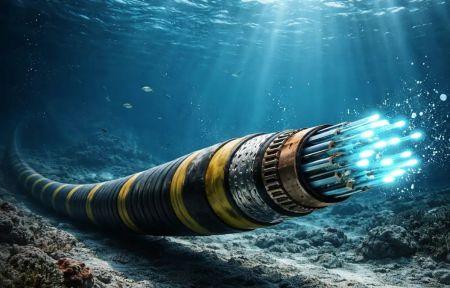
In March 2024, several submarine cables providing Internet connectivity in 13 West African countries were cut. This incident caused severe disruption, prompting the authorities to take action, but the sub-region is still not out of business.
On Monday, July 13, the Assembly of Telecommunications Regulators of West Africa (WATRA) called for enhanced regional coordination to protect West African submarine cables.
The call follows the publication of reports from the International Advisory Committee on the Resilience of Submarine Cables, a joint initiative of the International Telecommunication Union (ITU) and the International Cable Protection Committee (ICPC).
The statement comes two years after the March 2024 crisis, which paralyzed the connectivity of 13 West African countries for several days. On March 14, 2024, four major cable systems (WACS, ACE, MainOne and SAT-3) were sectioned almost simultaneously off the coast of Côte d’Ivoire. Internet traffic had fallen by more than 50% at the peak of the crisis. Banks had to close in Nigeria, fintech platforms were out of service and cloud-dependent companies had suffered prolonged interruptions.
This incident is not the result of chance. According to the WATRA Infrastructure Working Group, 12 wired systems, with 37 landing points, currently provide more than 613 terabytes of capacity to West Africa. This geographical concentration is the main vulnerability factor: the four cables cut in 2024 converge precisely towards the same point off the coast of Côte d’Ivoire. In addition, 85% of cable breaks are caused by human activity (fishing and anchoring in the lead), which means that the majority of incidents are preventable with better regulatory coordination.
« The disruptions of March 2024 were an important warning signal. They have demonstrated that the resilience of submarine cables is not simply a technical or telecom issue, « said WATRA Executive Secretary Aliyu Yusuf Aboki, who sat on the International Advisory Committee. And to add: « when connectivity is interrupted, the consequences extend to companies, financial transactions, public services, trade, jobs and livelihoods of our economies ».

Aliyu Yusuf Aboki (left), Executive Secretary of WATRA and the Nigerian Minister of Communications, Innovation and Digital Economy and co-chair of the International Advisory Body on the Resilience of Underwater Cables, Dr. Bosun Tijani, at the meeting in Zurich, Switzerland.
Slow and expensive repairs
Repairing these cables illustrates the structural vulnerability of the region. A single repair costs between $1.5 million and $2 million (and up to $8 million in the case of multiple breakdowns), largely because specialized ships are stationed far from West Africa, often in Cape Town, South Africa. Some countries such as Sierra Leone, Liberia and Mauritania are connected by a single cable, which makes any break synonymous with a total blackout.
Cable networks operate at the regional level, but governance remains national. Authorisation procedures, emergency protocols and cable protection rules vary from one country to another among the 16 Member States of the Assembly. This fragmentation exposes a regional digital economy estimated at $150 billion, in an area with a combined GDP exceeding $800 billion.
The satellite as a relief buoy
The March 2024 crisis has nevertheless accelerated awareness. During the blackout, satellite services (Starlink and NigComSat in Nigeria) had provided uninterrupted connectivity, highlighting the resilience of space networks to cable failures. This demonstration accelerated the adoption of the satellite as a backup solution on the continent.
Nigeria licensed Amazon Kuiper in 2026 and, via NigComSat, entered into a multi-year partnership with Eutelsat/OneWeb. Angola has deployed Angosat-2 and several telecom operators, in this case Airtel, MTN or Orange, have signed partnerships with satellite Internet service providers. So many initiatives that testify to a strategy of diversification of connectivity infrastructures to reduce dependence on only submarine cables.
However, these satellite solutions remain supplements, not substitutes. Their high cost limits their massive adoption: a Starlink subscription still represents 22 to 37% of the average monthly income in sub-Saharan Africa, according to the ITU. And Nanyang University of Technology in Singapore notes that making African resilience rely on foreign satellites creates another form of dependence, with its own sovereign risks.
The advisory body’s recommendations published this week focus on simplifying authorization processes and emergency repair procedures, harmonizing cable protection regulations, strengthening incident information sharing, and encouraging investment in road diversity and network redundancy. These are regulatory interventions with economic consequences, « said Aliyu Yusuf Aboki.