
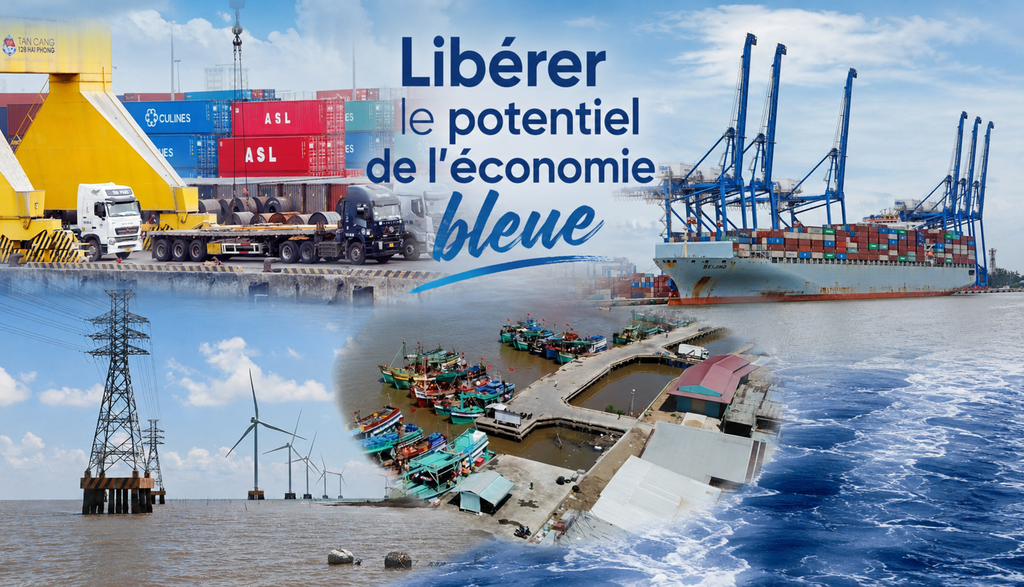
Vietnam adopts a new vision of development that positions the sea as a strategic space for national development, and no longer as a simple source of natural resources. This integrated maritime governance should unleash the potential of the country’s blue economy while strengthening national defense, security, science and technology, as well as international integration.
The orientation involves a profound evolution towards a modern, unified and integrated maritime governance model, in order to end fragmentation and partitioning between sectors and coastal communities. The sea must be considered as a strategic space for development, capable of connecting national and international economic corridors and creating new growth engines for the country.
A development towards the sea
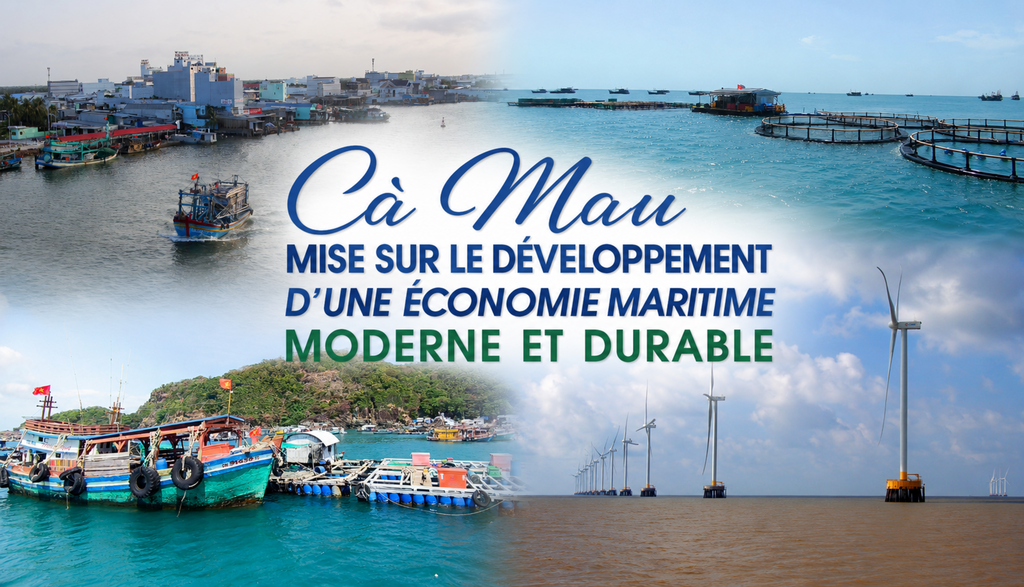
Bordered on three sides by the sea, the province of Cà Mau, the southernmost in the country, pursues a strategy aimed at developing a complete, modern and sustainable maritime economy in order to become one of the main maritime economic centers of the Mekong Delta.
The Deputy Director of the Provincial Department of Agriculture and Environment, Pham Van Muoi, said that Cà Mau has more than 300 km of coastline, about 120,000 km2 of fishing grounds and abundant marine resources, offering favorable conditions for fishing, renewable energy, seaports and maritime tourism.
Fishing remains the pillar of the provincial economy. Between 2021 and 2025, the production of processed fish products exceeded 1.49 million tons, generating more than $10.4 billion in export revenues. With more than 435,000 hectares of shrimp farms, Cà Mau is also the first shrimp-producing region in Vietnam.
The province aims for annual growth in regional gross domestic product (GDP) of at least 10% between 2026 and 2030, with maritime industries contributing 40 to 45% to budget revenues. By 2045, it aims to become a modern, green and sustainable maritime economy.
 |
| Photo: VNA/CVN |
At the same time, Quang Ninh is restructuring its maritime economy with a greater focus on environmental protection and industrial aquaculture.
As part of its 2021-2030 master plan, this northern province will devote more than 45,000 ha to aquaculture, with the objective that it represents more than 75% of total production by 2030, with an annual growth of 8 to 10%.
At the end of June 2026, Quang Ninh Province had allocated more than 5,200 ha of maritime area to 57 organizations and more than 800 individuals for aquaculture, thus helping to improve access to bank financing and attract investment in modern marine farming.
However, more than 50 applications for the allocation of maritime areas remain pending due to legal obstacles related to investment approval procedures, highlighting the need to continue institutional reform.
Accelerating institutional reform
The Deputy Secretary-General and Head of the Legal Affairs Department of the Vietnam Chamber of Commerce and Industry (VCCI), Dâu Anh Tuân, said that institutional blockages remain a major brake despite Vietnam’s 3,260 km of coastline and its considerable maritime assets.
He added that investors in offshore wind, cutting-edge aquaculture, marine tourism and coastal planning are still experiencing difficulties because property rights on maritime areas are not yet clearly established. Without transferable or mortgageable rights, companies struggle to access long-term financing.
The Deputy Secretary General of the Vietnamese Aquaculture Association, Bùi Tuân Anh, advocated coordinated infrastructure planning, simplification of long-term allocation procedures for maritime areas, as well as the establishment of insurance and financing mechanisms to support the aquaculture sector.
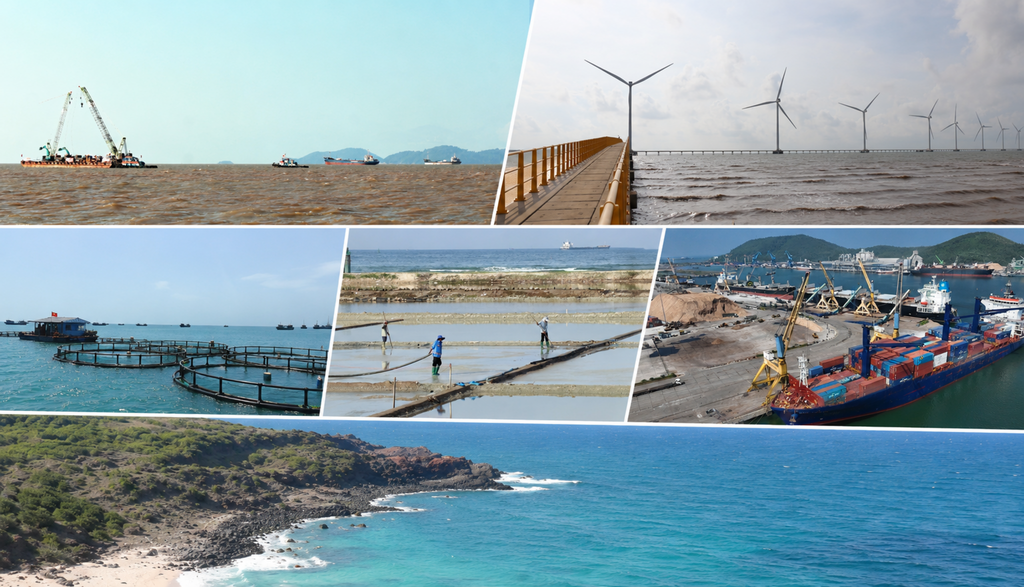 |
| With more than 3,260 km of coastline, Vietnam has many assets to develop its maritime economy, but its potential is still insufficiently exploited. |
| Photo: VNA/CVN |
The director of the Vietnamese Seas and Islands Agency, Nguyên Quôc Toan, announced that the government had approved the general policy proposals for the revised bill on marine and island resources and the environment (Resolution No. 182/NQ-CP). This bill introduces specific incentives to promote the sustainable development of the maritime economy and establish a stronger legal framework to exploit the potential of the marine environment.
A transparent and stable legal environment, with attractive incentives, should generate a new wave of investment and help make the maritime economy a key driver of Vietnam’s expected double-digit economic growth.
Eight years after the adoption of Resolution No. 36-NQ/TW on the Sustainable Development Strategy of the Vietnamese Maritime Economy by 2030, with a 2045 vision, Vietnam has strengthened public awareness, improved institutional frameworks, developed maritime industries, improved the quality of life of coastal and island populations, and strengthened the protection of its maritime sovereignty and national security.
However, experts believe that the maritime economy has not yet fully exploited its potential. As part of the country’s new strategic vision, the sea is redefined as a strategic development space integrating economic growth, national defense, scientific innovation and international integration, thus laying the foundations for long-term sustainable development for Vietnam.
Source: CVN