Oil is expensive, very expensive. And to avoid a dry breakdown, Japan brings out of the cardboard a 40-year-old concept: transforming the unpredictable energy of the waves into electricity thanks to a kind of giant top.
When we talk about renewable energies, we immediately think of solar panels or huge wind turbines that rotate in the distance. The energy of the oceans is often left on the sidelines. And for good reason: if the waves make surfers happy on the Basque coast, they are a real nightmare for engineers. A wave is never the same. It hits hard, then slowly, it changes rhythm and direction constantly. Producing current with such an unstable source is almost mission impossible. But that was before a Japanese researcher decided to look at it seriously.
The unexpected solution to tame the waves
The idea comes to us from Takahito Iida, a researcher at the University of Osaka. His project is called the GWEC (for Gyroscopic Wave Energy Converter). Rather than building a rigid system that would take the waves in the hope that it would hold, he imagined a much more flexible mechanic: a flywheel that rotates inside a buoy.
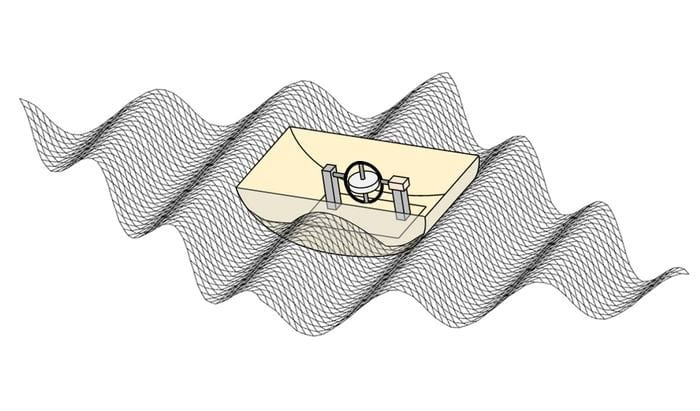
Basically, the buoy does not stupidly suffer the ocean, it adapts to it. The chaotic movement of the water is transformed into a very regular rotation that turns a generator. And the real tour de force of the invention is that the speed of this internal « toupe » is adjusted in real time. The system is made with what the sea gives it, without forcing.
The researcher also made all his calculations in a very in-depth study published in the Journal of Fluid Mechanics.
The urgency of a country stuck by the price of oil
The timing of this publication is not a coincidence because, at the moment, the barrel of oil is happily flirting with the $100 (about €92). For a country like Japan, which imports 95% of its oil from the Middle East, the bill becomes high. Finding an alternative is no longer just a desire for ecological transition, it is an absolute emergency to preserve its economy.
The irony of the story is that the basic technology does not date from yesterday. The concept was patented in 1981 by two engineers, Laithwaite and Salter.
Lots of prototypes have been put into the water since then, from Spain to Italy, but without ever doing miracles. What was missing was precisely this famous theoretical base in reinforced concrete to understand how to adjust the machine live in the face of the vagaries of the weather.
Push the limits of physics… or almost!
The old systems all blocked on the same technical concern. They only worked well with a single specific type of wave, thus reaching an efficiency of 50%. This number is not linked to bad equipment, it is the strict maximum limit authorized by physics for a symmetrical object. To put it simply: when a wave hits an object, its energy cuts in half. A conventional machine can technically only recover half of it.
Iida’s feat with its GWEC is to succeed in maintaining this famous 50% yield consistently, regardless of the frequency of the waves that come on it.
| Conventional wave systems | Iida’s GWEC | |
| Basic mechanics | Basic vertical movement | Gyroscopic inertia flywheel |
| Maximum efficiency | Only on a very specific frequency | Maintained over a wide frequency range |
| Adaptation to waves | Passively suffers the swell | Adjusts in real time |
The hard return to reality
On paper, everything is beautiful. In the laboratory too, since the tests conducted by Iida confirm that his equations hold up. But be careful, we are talking about a test pool with perfectly controlled waves, far from the chaos of the high seas.
The real current problem is that as soon as the waves get a little too big, the calculations jump. The physics of the water changes its behavior, and the efficiency of the buoy collapses.
Takahito Iida remains extremely cautious about the rest of events in his scientific article:
The valid amplitude range is very small for convenient use.
It is also necessary to take into account the mechanical losses related to the friction of the system, which have not yet been properly measured. The next big step for the Japanese team will therefore be to test the machine in the great swell canal of the University of Osaka. We are not yet quite ready to connect our PCs or consoles to the Pacific Current, but the idea is slowly making its way.
source : JVTECH