

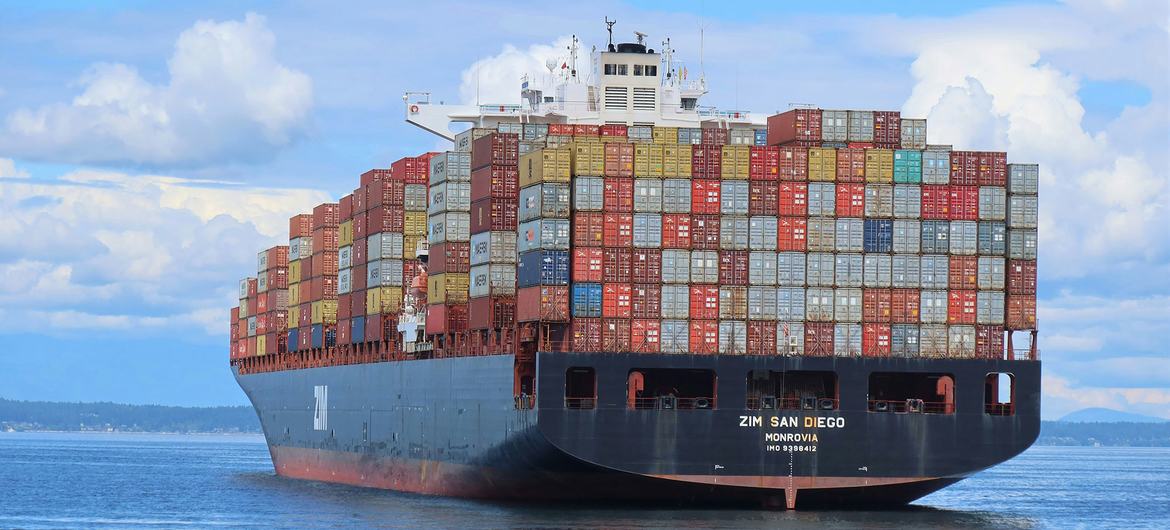
« Stop attacking merchant ships and seafarers »: the Secretary-General of the International Maritime Organization (IMO), Arsenio Dominguez, launched this appeal on Wednesday to the Subcommittee on the Transport of Cargo and Containers, urging Member States to refrain from any action endangering merchant ships and the lives of crews.
Before the delegates, he warned against the heavy repercussions of geopolitical tensions on maritime transport.
« We are reaching a point where these conflicts serve as a pretext to attack merchant ships and innocent sailors, » he said, deploring a black year for the sector – geopolitical crises, disruptions in supply chains and, too often, sailors who are leaving their lives there.
Black Sea, Red Sea, Ormuz: sailors targeted
In the Black Sea and the Sea of Azov, attacks on international navigation have killed dozens in recent months, without the results being able to be verified precisely.
In the Strait of Hormuz, the crisis is unprecedented: 2,000 ships and 20,000 sailors affected from the first days of the conflict. Since the opening of hostilities in the Middle East on February 28, the IMO has identified 80 attacks on navigation, which have cost the lives of at least 22 sailors and injured many.
In the Red Sea, attacks have also resumed: the last one, conducted by the Houthis against a merchant ship on August 11, killed four people.
So many threats that accumulate on strategic trade routes and which, emphasizes Mr. Dominguez, are not the fact of a single actor.
Maritime trade overtaken by conflicts
« In the Strait of Hormuz, not a single country attacks merchant ships. In the Black Sea and the Sea of Azov, not a single country attacks merchant ships, « he argued.
While acknowledging that the treatment of the root causes of these geopolitical conflicts is beyond the mandate of the IMO, the Secretary-General of this UN agency stressed that their repercussions on global maritime trade and transport operations were now evident.
« The consequences extend far beyond the maritime sector, affecting economies, supply chains and daily life. »
Mr. Dominguez therefore called on diplomats to bring these consequences to the attention of their governments and competent international bodies « so that this issue can be dealt with within the United Nations, if necessary ».
The IMO Secretariat indicates that it is ready to contribute to the development of viable solutions for the maritime transport sector that Member States can propose at the technical and operational levels.
The responsibility remains political: « It is up to you, as well as your capitals and the competent United Nations bodies, to tackle the root causes and find solutions ».