
According to a report by Greenpeace Middle East and North Africa, plastic pollution currently costs between 170 and 560 million dollars per year in Tunisia. In the absence of sufficiently ambitious measures, the cumulative cost of inaction could reach $3 to $10 billion by 2040. Despite the existence of regulatory mechanisms and waste recovery programs, prevention remains a major challenge.
La Presse – Plastic pollution is an environmental issue whose consequences far exceed the degradation of landscapes and ecosystems. It also represents a significant economic burden for Tunisia, called upon to mobilize more resources to prevent discharges, collect waste and limit its effects on the coast and economic activities.
This is the alert launched by Greenpeace Middle East and North Africa in its report entitled <The hidden price of plastic: evaluation of the economic and environmental costs of plastic pollution in Egypt, Morocco and Tunisia ». According to this study, the annual costs associated with plastic pollution in Tunisia are estimated at between 170 and 560 million dollars. In the longer term, the cumulative cost of inaction could reach between $3 billion and $10 billion by 2040.
These amounts correspond to two different scales: the first estimate is on current annual costs, while the second is a long-term projection. However, the available elements do not make it possible to accurately reconstruct the calculation method or the assumptions used to establish this range. These figures should therefore be presented as estimates attributed to Greenpeace, and not as certain expenses.
A highly exposed coastline
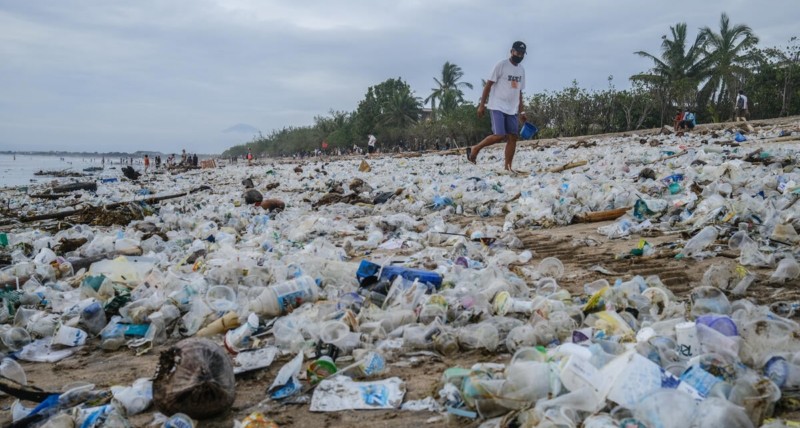
The magnitude of the phenomenon is clear in the collection operations carried out on nine Tunisian beaches. According to the results presented in the report, 77% of the waste collected was plastic.
The analysis of the origin of identifiable waste also reveals that 98.2% of them were of Tunisian origin. This result highlights the weight of national sources of pollution and the need to act on consumption patterns, packaging and collection circuits.
These figures concern the nine beaches studied and do not constitute an exhaustive measure of plastic pollution in the country. Nevertheless, they illustrate the pressure exerted on coastal areas, where waste abandoned on land can be carried towards the sea. Their accumulation threatens ecosystems and contributes to the degradation of natural environments on which tourism and coastal activities depend.
The problem is not limited to visible waste. Over time, some plastics fragment into smaller and smaller particles, making them difficult to recover. This persistence in the environment reinforces the interest of a policy that is not only based on the cleaning of beaches, but that intervenes in production and consumption.
Existing devices to be made more effective
Tunisia already has several instruments to combat this pollution. The National Ecological Transition Strategy, adopted in 2023, includes in particular the circular economy and sustainable production and consumption patterns among the orientations of environmental policy.
At the regulatory level, Government Decree No. 2020-32 of January 16, 2020 prohibits certain categories of plastic bags, according to the criteria defined by the text. Initiatives have also been taken to limit their distribution in certain sectors, including bakeries.
The ECO-LEF system, piloted by the National Waste Management Agency (Anged), aims to promote the collection of used plastic packaging and their recovery through recycling. In addition to these measures, there is work devoted to the « Littoral sans plastique » project, developed with the support of the World Bank, which highlighted the persistent difficulties in collection, sorting and recycling.
The existence of these instruments is a basis for strengthening public action, but their effectiveness depends on the application of regulations, the means devoted to infrastructure and the mobilization of producers, distributors, communities and consumers.
Reduce waste at the source
For Greenpeace, the answer cannot be limited to improving the management of waste once produced. The organization advocates an approach to the entire life cycle of plastic, from its production to its use and disposal.
This orientation involves reducing unnecessary packaging, gradually limiting single-use products when replacement solutions exist, developing reuse systems and facilitating the integration of recycled materials into production.
The transition also involves supporting the companies concerned and supporting the investments necessary for the development of recycling. For Tunisia, where public resources are limited and environmental needs are important, prevention can help reduce future spending.
A global treaty to support national efforts
Greenpeace finally calls on Tunisia to support a legally binding international treaty on plastics, covering their entire life cycle. The organization advocates for more ambitious commitments regarding production, single-use products and the development of reusable solutions, as well as for financing adapted to the needs of countries.
An international agreement could help to harmonise the obligations of States and support the necessary investments, provided that sufficiently robust implementation and financing mechanisms are provided.
However, this approach cannot replace national action. Reducing waste, improving sorting, controlling the application of prohibitions and consumer awareness remain essential levers.
Limiting the bill to 2040 means reducing waste at the source, developing reuse and recycling and giving public policies the means of their ambitions.