

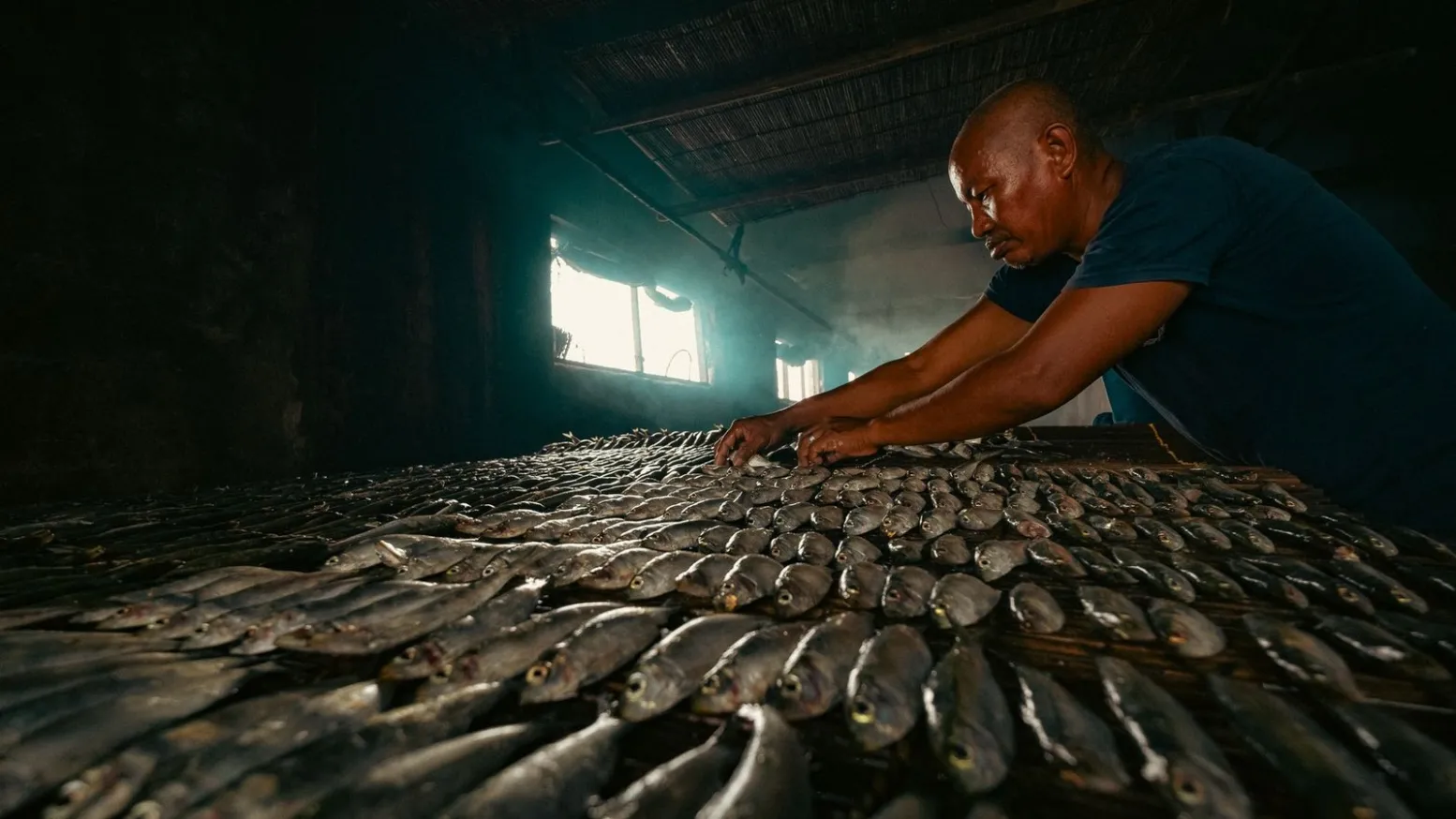
Rarely will a sector deemed peripheral have obtained such an estimate. By handing over its work on the country’s maritime economy to the Cameroonian executive on October 13, 2026, the United Nations Economic Commission for Africa (CEA) places the processing of fishery products at 573.4 billion CFA francs of value added, or nearly 875 million euros. The document, the summary of which was released by a press release of October 19, 2026, is based on the 2023 and 2024 national accounts and gives a statistical framework for an activity so far dispersed between artisanal circuits and industrial units.
A figure that changes the perception of the Cameroonian fishing sector
The first results were presented in January 2026: the maritime whole would weigh about 5.8% of gross domestic product and 3% of national employment. The final report refines the decomposition. Fishing and aquaculture, considered upstream of the chain, generate 635.7 billion CFA francs, or 36.87% of the estimated maritime added value. The processing and conservation of fish, crustaceans and molluscs capture 33.25%. The addition of the two links exceeds 1.2 trillion CFA francs, an order of magnitude that brings the Cameroonian Sea closer to the economic weight of certain agricultural export sectors in the country.
The social dimension is just as striking. The CEA allocates 180,000 jobs to the processing branch alone, or 60.44% of the positions identified throughout the maritime perimeter. These jobs cover heterogeneous realities: family smoking workshops on the coast of Kribi or Limbé, dryers installed along the Wouri, but also shrimp packaging plants for export to the European Union. Salting, drying and smoking remain the dominant processes in the craft industry, while the industrial sector focuses on products with a higher unit value.
A lever for diversification in the face of the expected contraction of hydrocarbons
The report’s timeline is not neutral. Cameroonian oil production has been declining since the mid-2010s, below the 25 million barrels per year, and the projections of the Société nationale des hydrocarbures are projected on a continuation of erosion as the offshore fields of Rio del Rey are exhausted. In this context, the authorities are looking for identifiable, measurable and exportable growth relays. The maritime economy meets these three criteria, provided that it is structured.
The regional comparison sheds light on the issue. Within the Economic and Monetary Community of Central Africa (CEMAC), only Gabon has consolidated maritime accounting, while Senegal, cited as a continental reference, derives nearly 3.2% of its GDP from its fishing alone according to the assessments published by the African Development Bank in 2023. Cameroon, with 402 kilometers of coastline and a reduced continental shelf, starts from further away, but the job deposit identified by the CEA is higher than that of most of its neighbors.
Transformation, losses and financing: the three priority projects
The un recommendations converge towards the same logic: to capture more value on the national territory. The CEA advocates strengthening processing and conservation capacity, reducing post-capture losses — which can reach 30 to 40% in certain West African craft sectors according to the FAO — and improving access to regional and international markets. The organization also suggests the establishment of a structured set of projects, with impact indicators and risk analyses, to convince multilateral lenders and private investors.
The authors, however, recognize the limitations of their exercise. Artisanal fishing, dominant in volume, remains partially out of statistical radar, and port activities such as maritime transport are probably underestimated. « The port and maritime transport economy does not appear to be at its fair value, » emphasize the drafters of the report, in an observation that invites us to strengthen national collection systems before any major sectoral policy exercise.
For Yaoundé, the political exploitation of the document will be played out in the next budgetary arbitrations and in the place given to fisheries transformation within the National Development Strategy 2020-2030. The estimate of 573.4 billion CFA francs is ultimately only valid for the decisions it will rush.


