
The protection of the national economy and the population in Tunisia against climate disturbances will require financing estimated at US$29 billion over the period 2026-2035. This amount represents about 53% of the total needs of the contribution determined at the national level (CD 3.0), presented during a national debate organized by the National Forum for Adaptation to Climate Change.
According to this roadmap, the water sector concentrates the largest share of adaptation needs, with $10.7 billion, followed by agriculture and food, estimated at $8 billion.
The needs related to capacity building, technology transfer and support for adaptation programs are estimated at $1.58 billion.
Economic and social impacts considered of concern
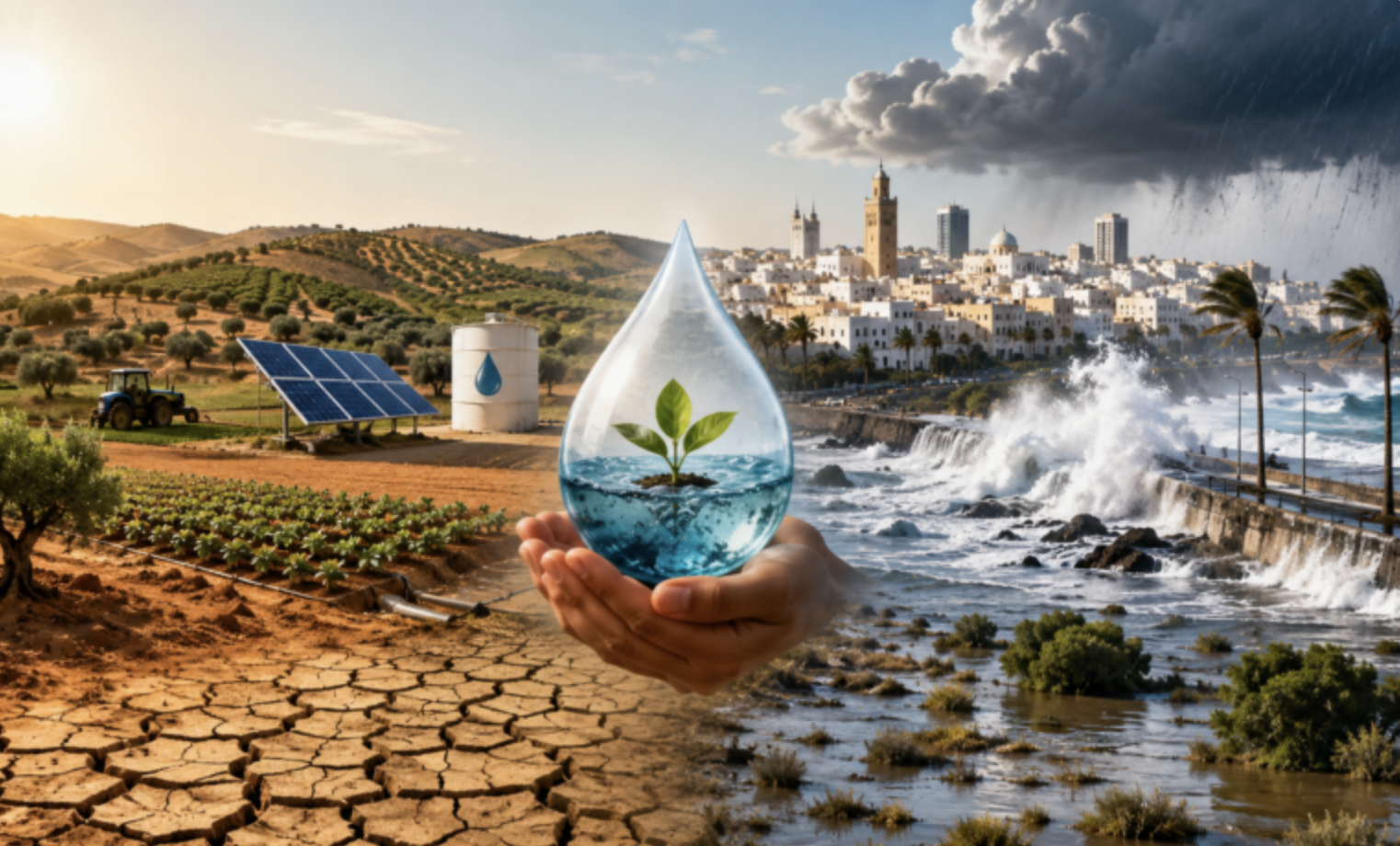
The strategic document highlights that Tunisia is directly exposed to the effects of climate change, including rising temperatures, falling rainfall and rising sea levels.
According to World Bank estimates, in the absence of urgent climate risk management measures, the Tunisian economy could contract by 3.4% of GDP by 2030, or about 5.6 billion dinars per vear.
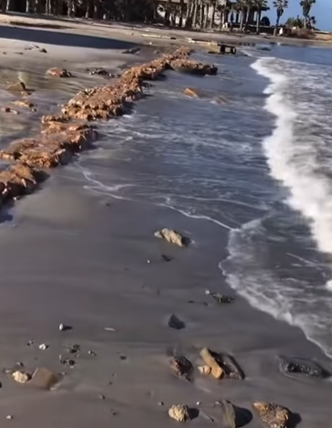
Annual losses related to water scarcity, coastal erosion and floods could reach 6.4% of GDP by 2050, or about 10.4 billion dinars.
The agricultural sector appears to be the most vulnerable, with an expected decrease in its added value of 15% by 2030 and 29% by 2050.
This contraction is also expected to lead to an increase in imports and a decrease in exports, worsening the current account deficit by more than 6% of GDP by 2030, thus weakening the country’s external balance.
The poverty rate could reach 21.3% in 2030, an increase of 1.5 points compared to the reference scenario.
CDN 3.0: a strategy structured around seven axes
The CDN 3.0 takes an approach aligned with the Global Goal of Adaptation (GAG), aimed at transforming the country’s vulnerability into sustainable resilience by 2035.
It is based on seven priority areas, including the sustainable management of water resources, with increased use of unconventional resources such as the desalination of seawater and the reuse of treated water.
The agricultural sector relies on seeds resistant to climate change, digitization and better direct access for small farmers to public aid.
The strategy also provides for the protection of ecosystems and biodiversity, including forests, oases and wetlands.
The health system will be strengthened to cope with heat waves and vector diseases.
In the field of infrastructure, CD 3.0 provides for the protection of coastal areas against erosion, as well as the integration of climate risks in urban planning. It also includes the enhancement of traditional knowledge, such as « sharfia » fishing and sand farming.
All these measures aim to improve living conditions, reduce poverty and promote the creation of green jobs through sustainable regional development.
Finally, the strategy focuses on strengthening monitoring and assessment systems, integrating climate risks into development policies, developing innovative insurance mechanisms, and strengthening institutional and local capacities.
source : La presse