
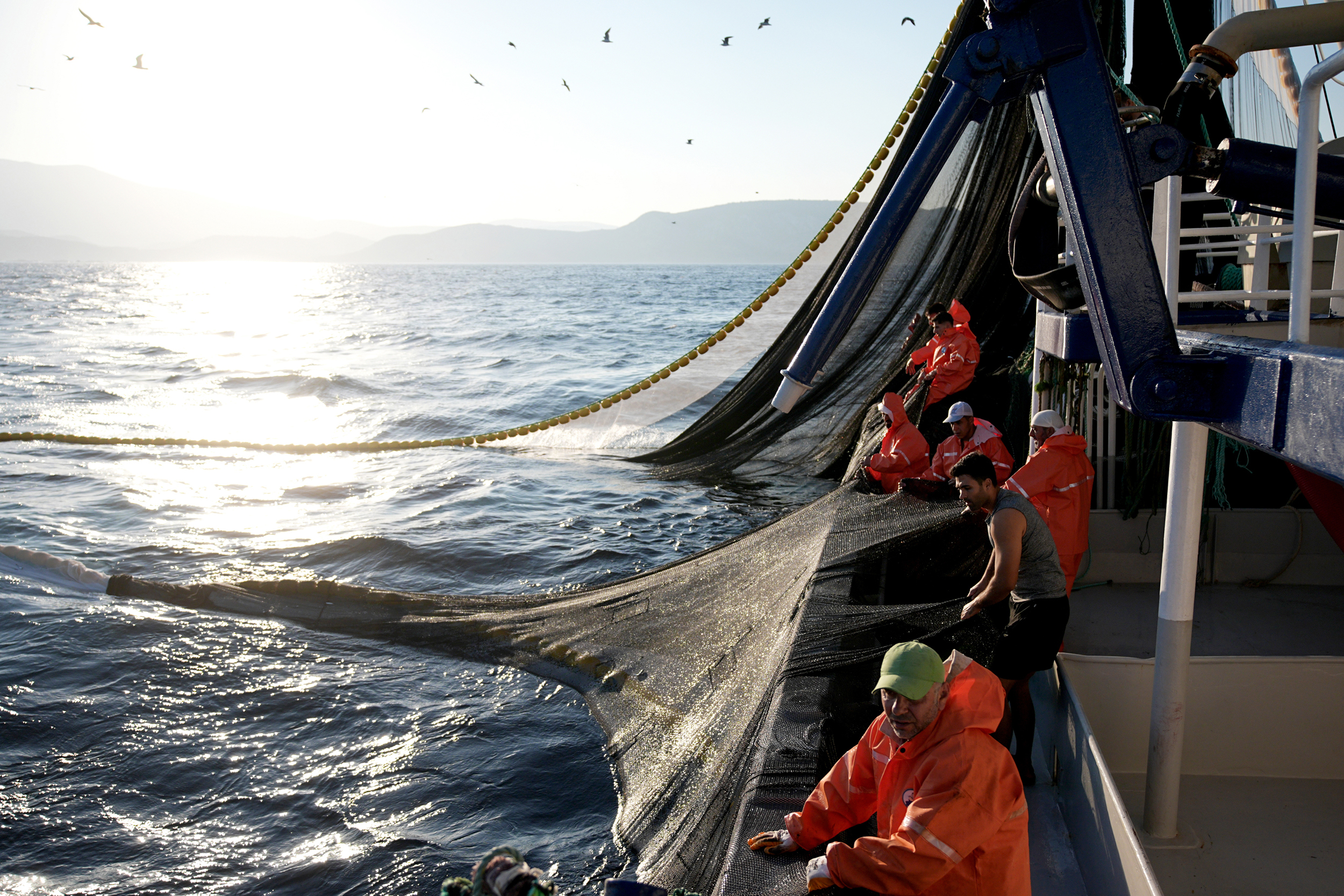
From torn nets to decimated local stocks, species drifting in on warmer waters are causing headaches for European fishermen.
Reeling rods, pulling pots and hauling nets this summer, fishermen from Greece to the U.K. discovered unexpected visitors popping their heads above the surface.
In the Aegean, it was silver-cheeked toadfish—an invasive pufferfish with powerful, prominent teeth. In the English Channel, it was the unprecedented arrival of uncommon common octopuses. And in the Adriatic, it was the aggressive and aptly named blue crab.
Across the continent’s seas and straits, warming waters and decades of overfishing are throwing marine ecosystems off kilter and sending species swimming in new directions. For the fishermen landing unfamiliar tentacled and scaled sea creatures, the novel arrivals haven’t always been welcomed on deck.
“The fisheries I found 30 years ago were more or less the species that archeozoologists found in [archaeological] remains many thousands years back. But today, this is changing really fast,” said Anastasia Miliou, the science director at Archipelagos Institute of Marine Conservation, a Greek nonprofit.
“Fishermen are [already] having a hard time because of a lack of fish. Changing temperatures and the new invasive and alien species don’t make it any easier,” said Miliou, noting the surprising spikes in certain stocks were adding financial pressure for artisanal fishermen struggling to survive.
This summer was Western Europe’s warmest on record. Above the waterline, a wave of wildfires, droughts and heat-related deaths ravaged the continent. The blue-jewelled depths of the Aegean and even the more-bracing North Sea and Baltic basins also experienced mass heat.
Globally, June to August 2026 saw the highest mean sea surface temperature on record. In Europe, this included sea surface temperatures more than 3.6 and 5.4 degrees Fahrenheit (2 or 3 degrees Celsius) above the last three-decade average.
As global ocean heat content rises for the ninth consecutive year, “ectothermic” fish—species unable to regulate their own temperature that depend on finding suitable surrounding conditions—are on the move.
These newcomers across the continent have brought economic challenges to fisheries who have, at times, struggled to adapt.
In Greece, the arrival of the fatal-if-consumed toadfish and their large, sharp gnashers has significantly damaged fishing gear as the rabbit-like front teeth chomp nets.
“It’s got to the point where we might go out fishing one day and then spend the next three days fixing our nets,” Giorgos Kyriakakis, a Cretan fisherman, told Greek public broadcaster ERT in June. “They eat our catch and damage our nets—that’s very costly.”
Over the summer, Greek fishermen were offered almost $6.00 (€5.33) per kilo to catch the invasive species by the Agriculture Ministry.
Off Britain’s southern shores, eight-legged, suction-cupped common octopuses have arrived from breeding grounds in the Channel Islands and northern France in record numbers. The largest population bloom in 75 years, the arrival is tied to temperature increases, according to researchers at the Marine Biological Association.
The newcomers have proven both a blessing and a curse. Staggeringly lucrative catches have been recorded for those able to catch the creatures. But for traditional shellfish fisheries, the landings of brown crabs, European lobster and king scallops have dropped dramatically.
With octopods expected to stay in U.K. waters, the Department for Environment, Food & Rural Affairs held its first “octopus conference”earlier this month.
“They are both a threat and an opportunity for fishermen and a massive challenge for fisheries management,” said Mike Cohen, CEO of the National Federation of Fishermen’s Organisations, at the event. “The sudden arrival of this fast-growing, short-lived and highly predatory species into British waters upends a lot of our established knowledge and expectations about our coastal ecosystems.”
In many cases it’s more than just warming water. It’s also the consequences of rampant overfishing.
“We forget to put in the equation the human [fishing] impact because in the Mediterranean, and especially here in the Aegean Sea, our seas are very overfished,” said Miliou, explaining that this creates gaps in the ecosystems.
“When the new species arrive here, they find a lot of space to grow because the native species are no longer there,” added Miliou, highlighting that many invasive species hitch a ride in the ballast water of ships transiting the Suez Canal.
Europe’s not alone.
More than 125 fish species in Japanese waters were found to have moved north to cooler waters, according to an eDNA study released this week by the Okinawa Institute of Science and Technology.
“Fishermen across Japan are already finding differences in the types of fish they reel in compared to a few decades ago,” said the paper’s lead author Timothy Ravasi in a press release.
“A sudden influx of new types of fish means you need new techniques, tools, and knowledge to catch them, which is especially hard on small, family-based fishing businesses,” Ravasi said, noting people might not be able to make their culturally or historically significant dishes.
With European fish moving north to cooler confines—and also deeper to colder, darker depths—fisheries management will have to adapt. And as El Niño hits the Pacific Ocean, fish stocks are likely to be further disrupted the world over.
“Healthy marine ecosystems have their own mechanisms to restore balance and resist the spread of invasive species,” said Miliou, who remains optimistic.
“Nature will remake the balance as long as we let it. Right now we’re not letting it.”