
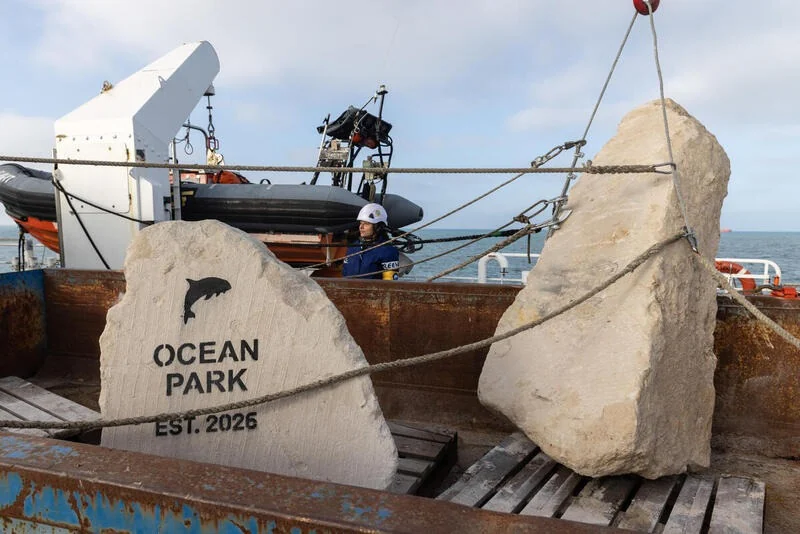
Last Saturday, Greenpeace United Kingdom laid huge rocks on the seabed of the South North Sea, to form an underwater barrier against bottom trawling. The target area is a marine protected area (MPA), a marine reserve located off the east coast of England. Created specifically to protect porpoises, this marine reserve was nevertheless the ground for 37,200 hours of bottom trawl fishing last year alone.
This rock barrier now truly protects 116 km² of the South North Sea AMP against bottom trawling. In the coming days, Greenpeace will carry out patrols with its ship the Arctic Sunrise to prevent other destructive forms of fishing.
Several British celebrities, including Benedict Cumberbatch, have written their names on the rocks to demand that marine areas be properly protected.
« Imagine a bulldozer crossing the Soignes forest and destroying everything in its path. Well, in the North Sea, this type of destruction occurs every day, without anyone noticing. And this, in areas that are supposed to be protected. Huge industrial ships crisscross the sea day after day, emptying it of its resources, killing dolphins, sharks and seabirds. With our ship, we do what the authorities do not do: we really protect the sea, » says Ruth-Marie Henckes, head of the Oceans campaign at Greenpeace Belgium. “We demand a ban on destructive fishing techniques in marine reserves and ask our ministers to take the initiative to create a network of truly protected marine reserves throughout the Atlantic Ocean.”
The South North Sea is an essential area for porpoises. It is home to nearly 20% of the population of the British part of the North Sea. No restrictions on fishing are imposed in most of this area, yet supposed to be an AMP. Deep-to-bottom trawlers and other industrial ships therefore threaten the population of porpoises every day.

More photos of the action can be found here.© Andrew McConnell / Greenpeace
Greenpeace’s study shows that bottom trawlers and sea dredgers moved a cumulative area of 55,600 km² in all marine protected areas of the United Kingdom in 2025. In total, 115,000 hours of fishing, the equivalent of 13 years if they were accumulated by a single fishing boat, were recorded in these protected areas in 2025 alone. [1]
Note
[1] Estimates of the number of hours of activity of bottom trawlers in British marine protected areas as well as estimates of the surface are based on an analysis of Global Fishing Watch data. Methodology and calculations are available on request. The figures take into account each passage of fishing gear, which means that the seabed caught several times is also counted several times. The measurements relate to the total volume of fishing, not to the single area of the seabed fished. Repeated fishing in the same area accentuates the damage caused to the ecosystem.