
At the bottom of the oceans, where sunlight never penetrates, hot water springs spring from the earth’s crust. Around their mineral chimneys thrive animals that scientists did not imagine finding in such large numbers in the depths. Their discovery, in 1977 near the Galápagos, upset ideas about the limits of life.
An expedition left to get heat
In February 1977, the American research vessel Knorr reached the Galápagos rift, several hundred kilometers west of the Equator. The team wants to measure the heat flow that escapes from oceanic ridges, these long volcanic chains where two tectonic plates separate and where the ocean floor forms. Researchers know that seawater can circulate in cracked rock and warm up. They do not yet know what this traffic has built or who can live nearby.
On board, a towed camera named ANGUS photographs the bottom up an underwater slope. The images show discolored areas and water that appear to ripple above the rock. On February 17, the submersible Alvin goes down to check. At about 2,500 meters deep, his instruments spot waters warmer than their icy environment. The researchers observe fluids that come out of cracks and cloud when mixed with seawater. They have just identified the first known active hydrothermal field.
The strongest surprise is biological. Mussels, clams and tube worms cover portions of the bottom. The team, composed mainly of geologists and geochemists, had not embarked a biologist: no one had foreseen such an animal abundance. In the absence of preservation material, samples will even be placed in vodka brought back from Panama. This detail tells of the unexpected nature of the discovery.
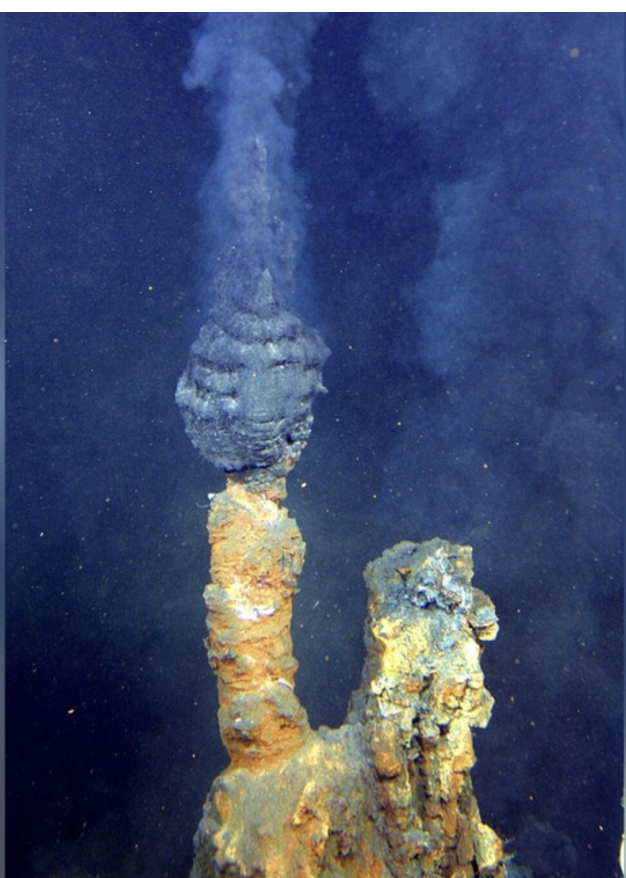
This discovery must be distinguished from that of « black smokers ». In 1977, Alvin observed relatively warm fluids and unexpected animal communities near the Galápagos. The first black chimneys were filmed two years later, on April 21, 1979, on the eastern Pacific ridge, at 21 degrees north latitude. Scientists see a chimney of about six feet, or 1.8 meters, which releases a fluid loaded with dark particles. This chronology counts: hydrothermal springs and black smokers are related, but the latter are not what the team had initially discovered.
How a black chimney is formed
Seawater infiltrates through fractures of the crust, near a volcanic area. In depth, it warms up in contact with hot rocks and reacts with them. It then takes care of minerals and chemical compounds, including hydrogen sulfide. Having become less dense, this water rises and emerges through vents from the ocean floor.
When the very hot fluid meets cold seawater, the dissolved minerals precipitate, that is, they solidify into particles. They accumulate around the exit and gradually build a chimney-shaped structure. « Black smokers » owe their color to the fine particles of metal sulfides, especially iron. « White smokers » reject clearer deposits, rich in baryum, calcium or silica compounds. The temperature of the fluids can exceed 340 °C, without the water boiling as on the surface: the pressure of the great depths greatly raises its boiling point.
A chimney is not an immutable duct. It grows as long as the mineral flows feed it, then can collapse or go out if circulation changes. Hydrothermal springs move and evolve with tectonics and volcanic activity. The teams study them with manned submersibles, remote-operated robots, sensors and water and rock samples.
The size and life of the buildings vary greatly. Some chimneys rise several meters before cracking under their own weight; the fragments then accumulate at the foot and help form mineral reliefs. Other vents diffuse less hot water through a wider area and do not build a tower. Mapping a hydrothermal field is therefore tantamount to identifying fluid outputs, ducts, deposits and remnants of old phases of activity.
A food chain without sunlight
These communities are not based on photosynthesis. At the base, bacteria and other microorganisms draw their energy from chemical reactions: they oxidize hydrogen sulfide or methane in particular and use this energy to manufacture organic matter. This process is called chemosynthesis. Animals house these microbes in their tissues or feed directly on them; others consume the first organisms.
Giant tubular logs, mussels and some clams have become the emblems of these ecosystems. Adult worms do not have a mouth or functional digestive tract: symbiotic bacteria installed in an internal organ provide them with a large part of their food. The discovery showed that dense communities could organize themselves without directly dependent on light energy, from a geological source.
Animals do not all live in the hottest jets. They occupy areas where hydrothermal fluids are diluted and where temperature and chemistry become bearable. A few centimeters away, conditions can change greatly. This mosaic partly explains the diversity of ecological niches around the same chimney. The fields differ according to the basins. In the Atlantic, shrimps dominate some sites where the giant tube tube worms of the Pacific are absent. Lost City is another case: its alkaline and less hot fluids result from reactions between seawater and the rocks of the mantle.
The 1979 dive also revealed the physical violence of the phenomenon. Pilot Dudley Foster approaches a chimney; contact with the submersible weakens it and widens its opening. The black plume then thickens to the point of hindering visibility. The temperature probe reaches its measurement limit and its plastic tip melts, an index that leads the team to design a more resistant instrument. Subsequent measurements give about 350 °C for these fluids. The « smoker » therefore does not burn: the smoke aspect comes from the minerals that solidify in contact with cold water.
A dive led into the darkness
Several thousand meters below the surface, daylight has long since disappeared. The pressure reaches several hundred times that of the atmosphere at sea level; a submersible must therefore withstand a force that is exerted on every centimeter of its hull. Water is often around 2 °C, while fluids that come out of a hydrothermal mouth can exceed 340 °C. This difference is not a contradiction: the maximum temperature concerns a concentrated jet in contact with the rock, while the surrounding water is cold and the temperature drops rapidly as the fluid mixes with the ocean.
Researchers locate the sources before seeing them. A hydrothermal plume transports particles and modifies the properties of water. Sensors measure temperature, electrical conductivity or turbidity, i.e. the amount of suspended particles. A ship can then go up the gradient to an active zone. Basically, the submersible Alvin played a decisive role in the first campaigns. Its manipulative arms make it possible to take rocks and organisms; probes record temperatures; cameras film without illuminating the entire area at once. The observation remains punctual: a dive only gives a glimpse of a vast, rugged and sometimes difficult to find environment.
Artificial light itself changes the scene. Animals sometimes react to it, and the samples disrupt a habitat where organisms concentrate around very localized fluid outlets. The teams must therefore decide where to place the instruments, how long to measure and how to compare the sites without multiplying the interventions. This difficulty explains the interest of remote-operated vehicles and observatories installed on the bottom: they make it possible to return to the same sector, to follow variations and to reduce certain movements of the submersible. The data thus obtained show that the chimney is not a fixed setting, but a system that changes with geological activity and currents.
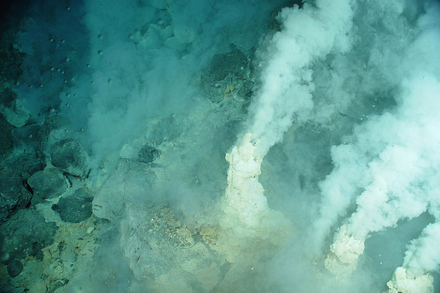
White smokers © Wikimedia
The same name covers different backgrounds
Hydrothermal chimneys form mainly along ocean ridges, where tectonic plates spread apart, and in some volcanic areas. However, they are not all fed by the same rock and do not release the same chemical mixtures. At the East Pacific Ridge, water that circulates in a basalt-rich crust is often loaded with metal sulfides. In other regions, traffic encounters mantle rocks, richer in olivine. The reaction between water and these rocks, called serpentinization, can produce hydrogen and methane, which feed different microbial communities.
The site of Lost City, discovered in 2000 on the mid-Atlantic ridge, illustrates this diversity. Its carbonate buildings are not the tall sulfur chimneys associated with « black smokers ». They stand on a massif composed largely of mantle rocks that have risen to the bottom. The fluids are less hot than those of the most burning sources, but very alkaline, in other words rich in chemical bases. The white towers can reach several tens of meters and are built by precipitation of carbonates. This difference in chemistry affects the microbes present, the animals that consume them and the life of the field.
The comparison between ocean basins also reveals biological provinces. Some groups of species are characteristic of the Pacific, others of the Atlantic or the Indian Ocean. Ridges do not form a uniform network: continents, underwater reliefs, depth and currents limit the movement of larvae. A species observed on a chimney therefore does not necessarily colonize the neighboring field. To understand the links between populations, biologists compare their DNA, larvae and local currents. The mapping of active sites then becomes a question of biogeography: where can organisms live, and by what ways do generations meet?
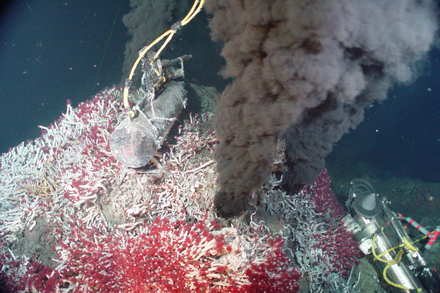
© Wikimedia
Life is organized around a chemical mosaic
A chimney does not offer a single temperature. In the central duct, hot fluids can be devoid of oxygen and contain substances that are toxic to most animals. On the surface of the building, they encounter cold, oxygenated and particle-laden water. Between the two, very short gradients create areas where the temperature and composition change by a few degrees or a few centimeters. Microorganisms exploit these boundaries: some bacteria oxidize hydrogen sulfide, others methane or hydrogen. These reactions provide the energy necessary for the manufacture of organic matter from carbon dioxide.
Bacteria live free in the carpets that cover the rocks, but they can also be housed in animal tissues. The tubular worm Riftia pachyptila is the best known example. The adult has neither mouth nor functional intestine. In his body is an organ, the trophosome, filled with symbiotic bacteria. The worm provides them with sulfur, oxygen and carbon dioxide through hemoglobin-rich blood; the microbes produce organic compounds that the animal uses. Symbiosis, a lasting association between two species, replaces an ordinary diet here. Clams and mussels from springs also host microorganisms, while shrimps, crabs, snails and worms feed on bacteria or animals. Wildlife is not distributed at random. Species adapted to the hottest waters are kept near diffuse outlets, where the fluid remains mixed with seawater. Others settle further away, in areas less rich in sulfide but more oxygenated. A shrimp can gather by the thousands on one wall, while a fish or crab ventures into the field to capture prey. Microbes are the basis of production, but the food chain also includes predators and organisms that take advantage of debris. The real operation is therefore more complex than a one-on-one between bacteria and giant worms.
Oases connected by larvae and currents
Hydrothermal fields form habitat islands separated by large areas of the seabed poor in food. Many adult animals remain in place, but their reproduction produces eggs or larvae that can drift. Their path depends on currents close to the bottom, the duration of their development and their ability to maintain themselves in a particular layer of water. Some plumes can carry larvae or particles above the relief. Researchers describe chimneys as networked habitats: the persistence of a population sometimes depends on the arrival of young people from another site.
The network is vulnerable to natural upheavals. A breakout can cover a community, change the flow of fluids or make a chimney disappear. The pioneer species then recolonize the new surfaces, then the assemblies evolve over the months and years. Photographic follow-ups after eruptions on the Juan de Fuca ridge showed that communities change with the intensity of the flows and the arrival of larvae. The return of life does not necessarily mean a return to the initial state: a community can recompose itself differently if currents, chemistry or neighboring sources have changed. This dynamic complicates the definition of a « good » protection zone. Preserving an isolated chimney is not necessarily enough if the larvae have to circulate between several sites to maintain the populations. Active field maps, genetic data and current modeling are used to identify possible connections. Scientists are also trying to measure the rate at which environments recover after a disturbance. Results vary by species and site; there is no single recovery period applicable to all chimneys.
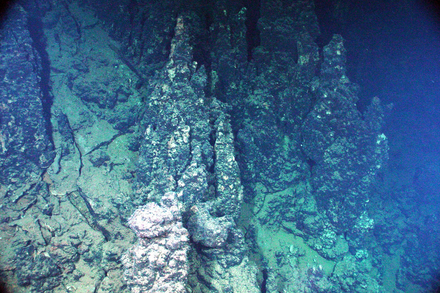
Smoked extinct © Wikimedia
Mining exploration is a matter of time
The metal deposits formed around the hydrothermal springs contain copper, zinc, iron and rarer metals. They attract the attention of companies and states that are considering the exploitation of the seabed. However, the extraction of a deposit could destroy the organisms fixed on the sulfides, lift sediments and modify the flow. The impact would not be limited to the dug area: the particles transported by the mining plume could be deposited elsewhere, while the noise and light of the machines would affect mobile animals.
The International Seabed Authority supervises the mineral exploration of bottoms beyond national jurisdictions and discusses the rules that would apply to commercial exploitation. The discussions focus on the data needed before any decision, the monitoring of effects and the reference areas left intact. Chimneys are particularly difficult to evaluate because their species are often specialized, some have not yet been described and the sites differ greatly from each other. An inventory made on a few fields cannot therefore be transformed without precaution into a global diagnosis.
The discovery of 1977 had already displaced an intellectual boundary: abundant biological production could exist far from light, thanks to the chemical energy of the subsoil. Today, the same particularity imposes a requirement of knowledge. It is necessary to know which communities live in each type of field, how they renew themselves and what damage would be reversible before modifying a habitat that is still observed only in a few parts of the globe. Hydrothermal springs are also of interest to astrobiology, because oceans under the ice of worlds like Europe, Jupiter’s satellite, could have liquid water and chemical energy. This track does not prove that a life exists there; it expands the places where researchers can search for it.
What chimneys learn about life
Hydrothermal springs feed research on the limits of life, the evolution of ecosystems and the exchanges between the ocean and the earth’s crust. They also inspire hypotheses about the origin of life, because they combine water, heat and reactive chemical compounds. They do not prove that life appeared there: rather, they offer current environments where to test certain possible mechanisms.
Their scientific interest is accompanied by conservation issues. The deposits of metal sulfides that form around certain sources attract the attention of the underwater mining industry. However, the ecosystems concerned are fragile, localized and sometimes endemic, i.e. specific to a site. Understanding their functioning and their ability to recolonise is therefore essential before any intervention.
Since Alvin’s dive in the Galapagos, hundreds of hydrothermal sites have been listed, but large portions of the bottom remain little explored. These chimneys are neither miniature volcanoes nor simple geological curiosities: they reveal a way to keep an ecosystem alive thanks to the energy of the Earth itself.