
On November 4, 2026, Alcatel Submarine Networks (ASN) announced the acquisition of Ship-as-a-Service (SAAS), a small 40-person Lorient company specializing in underwater operations and heir to the legendary COMEX of Henri-Germain Delauze from Marseille.
The operation is in fact the third phase of a French consolidation piloted more and more visibly from Bercy. Indeed, since the end of 2024, ASN is no longer a subsidiary of Nokia. The French state bought 80% for 100 million euros via the State Participation Agency, and it is he who, today, is getting his hands on a whole chain of French underwater expertise, at a time when cables that transport 95% of global internet traffic are becoming a geopolitical weapon.
Three cascade buyouts, three pieces of French history
The first acquisition dates back to 2020, when SAAS, created four years earlier in Lorient by Hervé Allaire, got its hands on the marine branch of COMEX, the Marseille Maritime Expertise Company.
For those who did not grow up in ports, COMEX is the industrial history of French diving in a company. Founded in 1961 by Henri-Germain Delauze, it developed the saturated diving techniques that allowed the North Atlantic oil offshore to exist, broke the world record for human diving at a depth of 701 meters during the Hydra 10 experiment in 1992, and trained two generations of French industrial divers. Delauze died in 2012. His company, weakened, sold its marine branch in 2020 to the Bretons of SAAS, who absorbed its ROVs, its ships, its pilots and especially its know-how on the deep sea.
The second buyout will take place in November 2024. Nokia, which owned ASN since its merger with Alcatel-Lucent in 2016, is looking to refocus on telecom equipment and sell its submarine cable business deemed too capitalistic. The French State seizes the file and signs the purchase of 80% of ASN for 100 million euros, a company valuation of 350 million. The operation is led by the State Participation Agency (APE), passes through the historic factory in Calais, and leaves Nokia a residual stake of 20% that it will have to sell in the long run.
The challenge is simple: to keep one of the three world leaders in submarine cables in France, alongside the Japanese NEC and the American SubCom.
The third takeover is therefore that of November 4, 2026, by which ASN recovers SAAS, and therefore ricochet the industrial legacy of COMEX. The French state aligns on the table a whole chain of skills ranging from the transoceanic cable layer to the small intervention team on ROV.
It should be noted that ASN should not be confused with Nexans, the other French champion of submarine cables. The two historically come from the same house (the Alcatel group, split in 2000), but they have since diverged into two separate markets: ASN on fiber optic telecom, Nexans on high-voltage energy for offshore electrical and wind interconnections.
ASN, the world’s first submarine cable
The house employs about 2,000 people, including 1,370 in France, with its main sites in Calais, Greenwich in south London, and Norway. Since its creation, it has laid more than 750,000 kilometers of fiber optic cable at the bottom of the oceans, the equivalent of nineteen towers of the Earth!
It operates a fleet of seven cable ships with names paying tribute to the Breton islands: five installers (Île de Bréhat, Île de Batz, Île de Sein, Île d’Aix and Île d’Yeu) and two maintenance ships (Île d’Ouessant and Île de Molène). Its global market share is about one-third, ranking first in the world, ahead of its Japanese competitor NEC (23%) and the American SubCom (20%).
Last March, ASN announced an investment of 100 million euros to modernize its two plants in Calais and Greenwich, in anticipation of new generation cables with 32 pairs of fiber optics doped with erbium. The arrival of SAAS in the fold completes the industrial device in a segment where ASN was so far dependent on external service providers: the fine inspection of cables already installed, emergency interventions on damaged sections, and the acoustic pre-deployment of future routes. SAAS’ forty employees, including ROV pilots, hydrographs, technicians and ship crews, will bring their small coastal and offshore fleet, as well as a fleet of remote-controlled underwater robots capable of descending to 2,500 meters. For a group like ASN, which lays several thousand kilometers of new cables each year on bottoms that often exceed 5,000 meters, it was a missing link.
The world’s largest producers of submarine cables
| Actor | Country | Global market share | Owner |
|---|---|---|---|
| Alcatel Submarine Networks (ASN) | FRANCE | ≈ 33% (1st in the world) | French state (80%) + Nokia (20%) since the end of 2024 |
| NEC Corporation | Japan | ≈ 23% | Listed company (diffuse shareholding) |
| SubCom | United States | ≈ 20% | Cerberus Capital Management (US investment fund) |
| HMN Technologies | China | ≈ 10-15% (in strong growth) | Hengtong Group (ex-Huawei Marine, detached in 2020) |
It should be noted that ASN is not the only French flagship in the sector. Next to him, Orange Marine, a 100% subsidiary of the Orange operator, operates from Brest and Marseille six French-filled cables (including the Pierre de Fermat and the Léon Thévenin), specialized in installation and maintenance on behalf of third parties. Louis Dreyfus Armateurs, with his subsidiary LDTravOcean, adds a third actor with the Léo Ocean. If we count the whole, France alone weighs about a third of the world’s fleet of 60 active cable companies in the world, as we documented in May 2025.

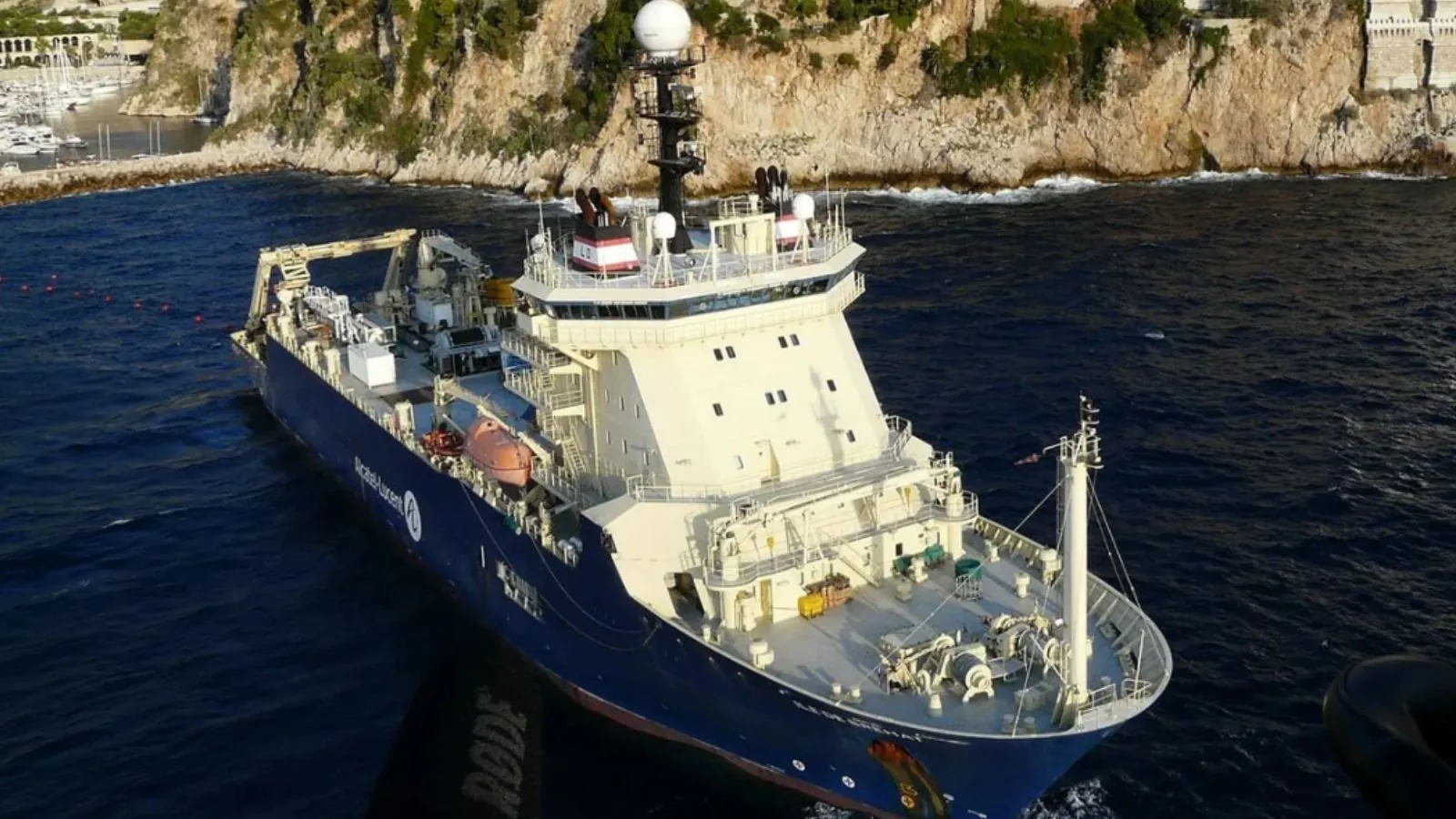
The René Descartes, cable ship of the Orange Marine fleet – credit: Orange Marine
However, ASN remains the only one of the three to control the entire chain, from cable manufacturing in Calais to installation at the bottom of the oceans
While France consolidates, the Baltic burns
If the French state is in a hurry to consolidate the sector, it is not to please the accountants of Bercy. This is because submarine cables have become, in less than three years, one of the most discreet and explosive battlefields of the Cold War 2.0. There are now nearly 600 in service worldwide, for 1.5 million cumulative kilometers, and they transport almost all of international internet traffic, SWIFT system interbank payment orders, encrypted military communications and data flows from tech giants. A cable installed in 2008 costs between 30,000 and 50,000 dollars per kilometer. A new generation 32-pair fiber cable like the ones ASN is preparing can climb to $250,000 per kilometer. To connect Marseille to Mumbai, it takes about 8,000 kilometers of cable, or more than one billion euros.
Since the Russian invasion of Ukraine in February 2022, sabotage has multiplied in sensitive areas. Three cables were broken simultaneously in the Baltic Sea in November 2024 connecting Finland to Germany and Lithuania to Sweden. A Chinese trawler named Yi Peng 3 was accused of dragging his anchor for more than 150 kilometers above the tracks. A ghost Russian tanker, the Eagle S, did the same thing in the Gulf of Finland at the end of December 2024, cutting a major electrical cable. In the Red Sea, several cables were damaged in early 2024 by floating mines or Houthi sabotage. These events made all Western governments realize that an infrastructure that had been left to the private sector for thirty years was in fact a critical national defense infrastructure.
In this context, the French strategy is shoming light. While the Chinese HMN Technologies, a subsidiary of Hengtong, advances at a forced march on African and Asian routes, and while South Korea is gaining power in the cable segment (Hanwha Ocean delivered in 2025 two new ships that shook the balance), Paris discreetly rebuilds its chain of skills from A to Z: cable factories in Calais, engineering in Marseille, cable liners in Lorient and Brest, ROV inspection via SAAS, and now full integration at ASN.
The consolidation is not over, but it is moving fast. Future sabotage could well come up against a better oiled emergency chain.