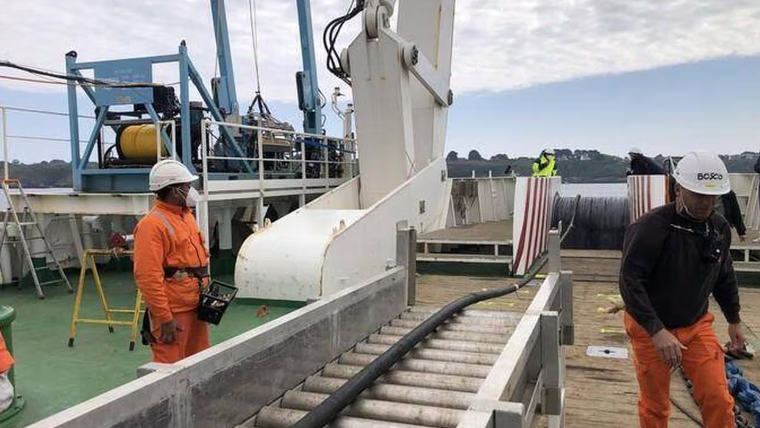

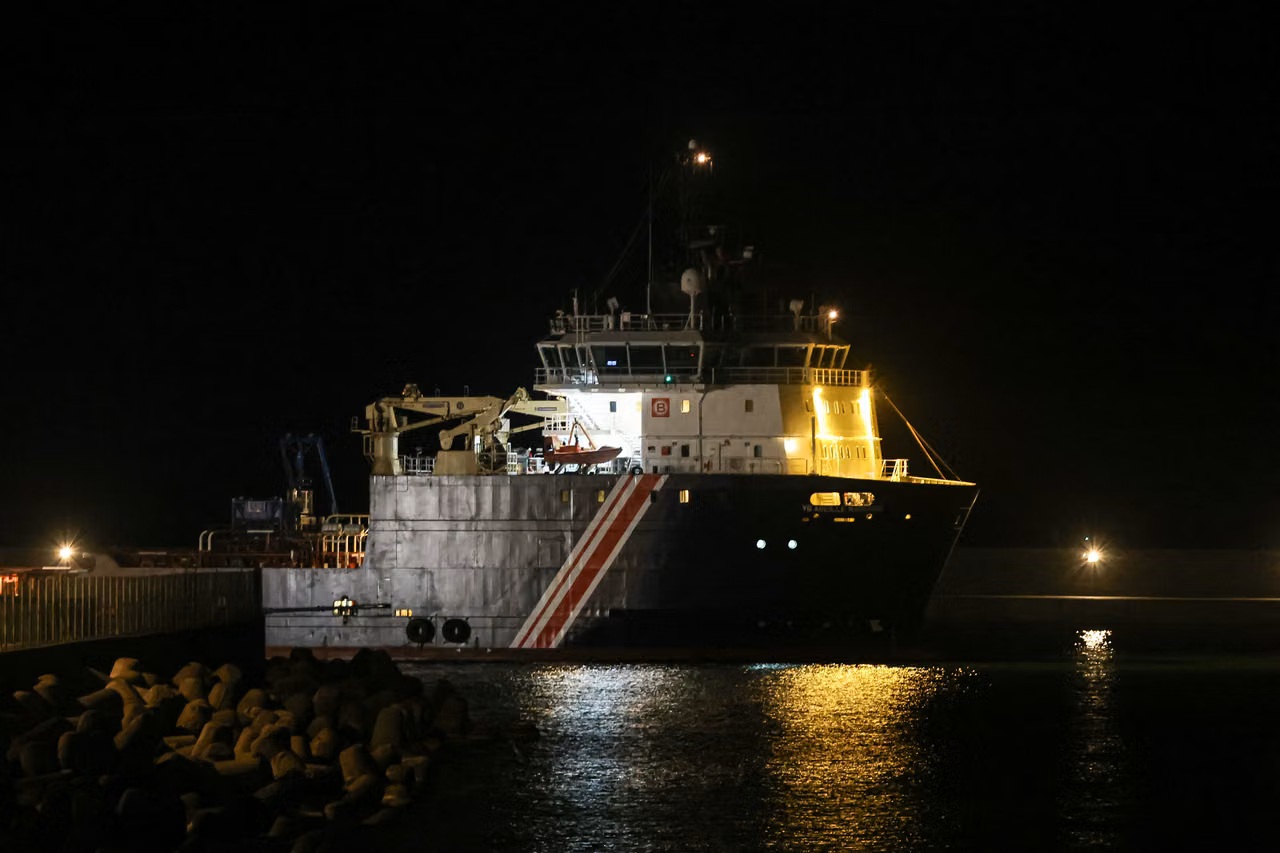
The « Marengo Bee » begins its research as part of a future installation of underwater electrical cable in the Mediterranean, between Greece and Cyprus. The Great Sea Interconnector project is under pressure from Turkey, which claims some of the maritime areas concerned.
The French ship Abeille Marengo left the port of Heraklion, Crete, on Tuesday, November 10, for a navigation in the rough waters of the eastern Mediterranean. He will carry out surveys as part of the Great Sea Interconnector (GSI) cable project, which is to connect Greece to Cyprus, the last European country that has been isolated in energy.
According to information from Efsyn, « the boat will initially sail in Greek territorial waters in order to carry out the tests necessary for the sounding work. The French research vessel should, at the end of the week, sail southeast of Kasos [Greek island at the extreme southeast of the Aegean Sea], where research had been interrupted in July 2024 because of Turkish warships ».

This submarine cable project is part of a context of strong tensions, because, behind this infrastructure, it is the control of maritime spaces, energy routes and regional influence that is at stake. Ankara, which disputes the exploitation of the Mediterranean in Athens and Nicosia, is a key player in projects in these maritime areas and threatens to prevent their implementation.
“Absurd claims”
« The problem is that Turkey insists on being informed of any project crossing delimited areas, on which it expresses absurd demands, » says I Kathimerini.
The GSI project, launched in 2012, has experienced significant delays, due to the economic challenges and geopolitical issues it implies. The entry into the capital of the French company Meridiam, in August, relaunched an initiative that remains under pressure from Ankara.
As the Marengo Bee begins its navigation, « Turkey has made the expected decision to issue a Navtex to give its consent, without even having received a request to this effect. This is not the first time Ankara has chosen this method to clearly express its conception of the ‘blue homeland’ [doctrine defining Turkish claims, especially in the Aegean Sea, and name given to a Turkish military exercise conducted in January 2025] and the limits of its continental shelf, » regrets the great center-right daily.
The issuance of a Navtex, a maritime navigation notice, is frequently used as a diplomatic and legal instrument by States wishing to assert their sovereignty or rights over an exclusive economic zone or a continental shelf.
Turkish-Libyan agreement
“It is still unknown, of course, how Ankara will react when the Marengo Bee enters the area of the Turkish-Libyan agreement, that is to say off the coasts of Kasos and Karpathos [which belongs to the same archipelago, the Dodecanese],” warns To Vima.
Because in October, Turkey and Libya sealed a maritime delimitation agreement on areas claimed by Greece and Egypt. Condemned by the European Union, the United Arab Emirates and Israel, this agreement nevertheless constitutes a new challenge for the ISG.
« The diplomatic confrontation has moved… at sea, without announcing a new imminent crisis, » hopes Naftemporiki.
In a press release published on its website, the GSI announces that the Marengo Bee will « start the planned hydrographic prospecting operations […], in accordance with the Navtex issued by the competent Greek and Cypriot authorities ». « This announcement confirms that the planning of the work is based on the procedures provided for by the two countries, » says the major business daily.
source : courrier international