
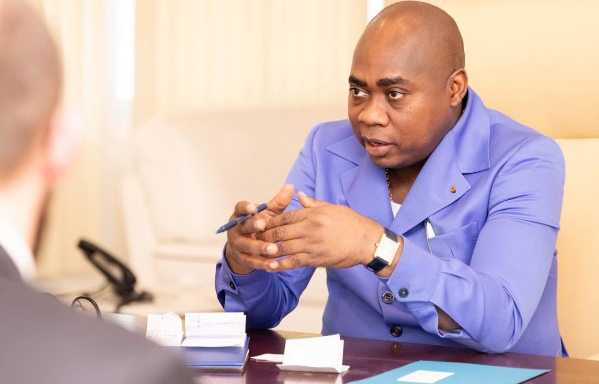
Faure Essozimna Gnassingbé appointed Kokou Edem Tengue as head of the Autonomous Port of Lomé. A choice of strategic importance, at a time when regional competition and political turbulence in the Sahel are redrawing the map of logistics corridors.
Kokou Edem Tengue at the head of the autonomous port of Lome. A choice has the strategic importance, at a time when regional competition and political turbulence in the Sahel are redrawing the map of logistics corridors.
It is a historical passing of the baton at the head of the Autonomous Port of Lomé (PAL). On July 4, Faure Essozimna Gnassingbé, President of the Council of Togo, appointed by decree Kokou Edem Tengue, 45, to the position of Director General. He succeeds Rear Admiral Fogan Adegnon, who has been at the helm of the institution for nearly two decades.
« A page of Togolese maritime history is turning, » a player in the sector tells Jeune Afrique. Adegnon will have been the builder of the infrastructure. Tengue, on the other hand, is expected in the field of commercial finesse and algorithm warfare. The competition will not give him any gifts.
Regional competition and the security tensions, fueled, are reshuffles and will have an impact on the choice of logistics corridors. In short, for the new PAL boss, there will be no state of grace.
1. Why is the appointment of Kokou Edem Tengue so important?
The profile of this fine connoisseur of the arcana of global logistics says a lot about Lomé’s ambitions. Country director of the Danish giant Maersk, then Minister of the Maritime Economy twice, Edem Tengue takes the lead of a flagship: more than 30 million tons of freight processed, the 2 million twenty-foot equivalent (EVP) mark crossed, a good place in the world Top 100 of the magazine Lloyd’s List.
His appointment is not only a technical choice: it is a decision that also aims to improve and secure the state’s financial networks. Macroeconomic indicators underline this hyper-dependence: the activity of the maritime platform and its direct ecosystem (handling companies, logisticians, banks, freight forwarders) supports nearly 70% of Togo’s GDP.
More spectacularly, taxes and customs duties collected at the doors of the PAL represent about 75% of the state’s tax revenues. Every change in traffic on Togolese terminals has immediate repercussions on the government’s ability to finance its social policy and major projects. The PAL directly supports more than 6,000 professionals (including a community of 5,000 dockers) and provides tens of thousands of indirect jobs in the road services and transport sector.
In addition, the competitiveness of the port is the sine qua non condition for the success of a major free zone project: the Adétikopé Industrial Platform (PIA), 25 km north of the capital.
1. What are the priorities of the Autonomous Port of Lomé?
Under the leadership of Fogan Adegnon, the infrastructure has transformed thanks to a masterful poker move: the exclusive alliance that the PAL forged in 2008 with Mediterranean Shipping Company (MSC) and its subsidiary, Lome Container Terminal (LCT). By offering a natural draft of 15 meters, Lomé has become an essential transshipment terminal for the giants of the seas that serve the Gulf of Guinea.
Kokou Edem Tengue will therefore not need to hire large and expensive civil engineering work. The issue has shifted to the activities themselves: operational optimization, dematerialization and customs fluidity.
The urgency, for the new general manager, will be to fully digitize the supply chain. Despite the undeniable progress made by the Single Foreign Trade Desk (Seguce), users still too often encounter bureaucratic bottlenecks at the borders of the port. The displayed objective is that the average processing time of a container does not exceed 24 hours.
The other file on which Kokou Edem Tengue is expected is environmental and urban planning. Dredging, intended to develop the port area, has indeed aggravated coastal erosion east of Lomé.
3. Are the ports of Tema and Abidjan catching up with the PAL?
If Lomé sits at the top of the sub-region’s container port ranking, its position is coveted by sub-region ports. Tema, Ghana, benefited from a makeover of more than $1.5 billion, funded by the Meridian Port Services consortium. Thanks to highly automated terminals, its installed capacity is close to 2.5 million EVP and Tema is following Lomé in terms of containerized freight.
For its part, the Autonomous Port of Abidjan (AAP) has returned to the forefront. Thanks to its second container terminal (Côte d’Ivoire Terminal), managed by AGL and APM Terminals, the Ivorian economic capital can also handle PDP 14,000 ships. Abidjan also relies on the power of its domestic market to break prices in the general goods segment. « Our competitors observed our model and duplicated it using sometimes more recent technologies, » said Edem Tengue’s predecessor during a meeting with the press.
To maintain its competitiveness, Lomé can nevertheless count on exceptional handling rates. In March 2025, a continental record was set with 123,000 container movements in the space of a month, or about 175,000 PVE. The target: 2.7 million PE by 2027. To keep up this pace, Edem Tengue will have to ensure that social peace is maintained on terminals. The management of relations with dockers’ unions and road transport corporations will be his first crisis management test.
4. Has the port of Lome benefited from diplomatic tensions between ECOWAS and ESA?
This is the most political part of Edem Tengue’s mission. The formation of the Alliance of Sahel States (ESA) has only caused an upheaval within ECOWAS. She redesigned the regional trade routes. Or Lomé masterfully pulled his pin out of the game thanks to the advocated opening diplomacy
by Faure Essozimna Gnassingbe.
Maritime transport: how the port of Lomé wants to be the exclusive partner of the LAES countries
While other ports on the coast closed their doors or imposed heavy economic sanctions on the Sahel transition regimes, Togo chose to maintain dialogue with Mali.
Burkina Faso and Niger, and to preserve their access to the sea. This policy of outstretched hand has resulted in an influx of goods on the Togolese docks. According to the Burkinabe Council of shippers, 45% of Burkina’s maritime imports pass through the PAL, compared to 35% via Abidjan.
For a few months, however, Abidjan has been multiplying seduction operations towards Bamako to revitalize flows in the Ivorian-Malian corridor, which is shorter than the corridor that connects Mali to Togo. Edem lengue, who had already dealt with the file when he was minister, will have to maintain the advantage that the PAL took with the countries of T’AES.
5. Could Nigerian uranium transit through Lomé?
The transit through the PAL of uranium produced in Niger promises to be the hottest issue that the new Director General will have to deal with. Neither Lomé nor Niamey confirmed this information, but if the transport of this ore intended
international markets passed through Lomé, Tenjeu, for Kokou Edem Tengue, would be to perpetuate this high value-added traffic by guaranteeing mining companies compliance with international safety standards, the existence of specific storage spaces and the implementation of extremely rigorous handling protocols.