
In Africa, the blockade of the Strait of Hormuz acts as a crisis accelerator by causing a surge in the cost of imports and the worsening of the shortage of fertilizers. A brutal demonstration of the continent’s vulnerability to global geopolitical shocks.
While the media scrutinize the repercussions of the blockade of the Straits of Hormuz and Bab El-Mandeb from the geopolitical and military perspective – the first established by both the United States and Iran in order to control this strategic sea route and the second imposed by the Yemeni Houthis allied with Iran – another reality goes unnoticed and in general indifference: the worsening of the food crisis in Africa.
Food insecurity
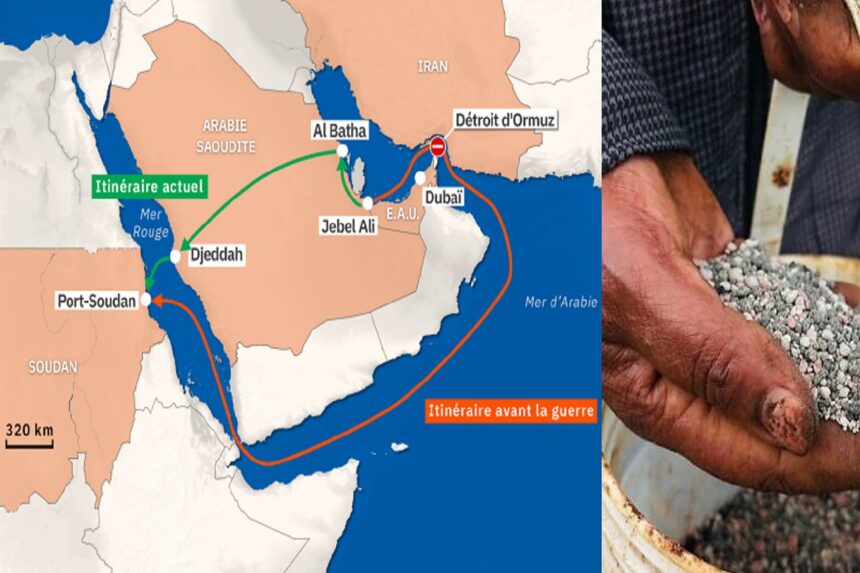
Indeed, the average daily transit in the strait went, according to the United Nations Conference on Trade and Development, from 129 ships in February to only 4 on March 7. That is a decrease of more than 96% compared to the normal flow. At the end of March, the volume of tonnage traffic had decreased by 85%.
As a direct consequence of the slowdown in the flow of maritime traffic, the projections predict a potential collapse in cereal yields in West Africa and the Horn of Africa for the second half of 2026 of up to 50%.
According to the FAO, the absence of nitrogen fertilizers will reduce corn yields by more than 40%. While according to the World Food Program (WFP), the most direct humanitarian consequence of this crisis is the exposure of 45 million more people to acute food insecurity, with cascading consequences: localized famine in already fragile areas (Sahel, Somalia, Sudan) and accelerated political destabilization in states already under pressure.
It should be noted in this regard that Iran now uses the Strait of Hormuz as a selective toll corridor, with a right of veto, charging $2 million per ship, payable in yuan. Result: a deliberate prioritization of authorized goods.
Indeed, oil transits and generates income for Revolutionary Guards, but not fertilizers. No ship carrying them has received authorization. This difference in treatment is strategically important, as it means that a partial military de-escalation will not automatically restore fertilizer flows. Knowing that about 30 to 35% of the world’s trade in fertilizers by sea transits through this strait, including about a third of the world’s urea.
Risk of famine
If this double blockade continues, warned the United Nations SG, Antonio Guterres, during a high-level Security Council debate devoted to maritime waterways, it would risk « triggering a global food crisis, plunging millions of people, especially in Africa and South Asia, into hunger and poverty ». It means that there is an emergency.
« This burden is particularly important to the least developed countries and small island states in development, » added the UN boss. While recalling that « more than 20,000 sailors and 2,000 commercial ships find themselves trapped in a context of risks and restrictions on navigation ».
A selective shortage
« Africa and Asia are at risk of starvation in the literal sense, » warns Gilles Kepel, the famous Islamologist and specialist in the Middle East. He was invited last week to discuss the consequences of the conflict in the Middle East on Africa and Asia, whose economies are largely affected by the American naval blockade in this strategic node of international trade off the coast of Iran.
« The oil is not in a shortage situation in Europe: America produces a lot of it and there is Russian oil that is not delivered. It’s expensive but there are. The shortage is Africa and Asia that suffer from it for food issues. In Europe, it’s more inflation, « he adds.
And to explain: « What has come to light is a new way of waring against the immense power of electronic warfare with the AI deployed by the United States and Israel. We had a kind of war of the poor fought in front with thousands of drones, machines at a few tens of thousands of euros, which destroyed infrastructure, data centers, the great natural gas liquefaction center of Qatar. Asia is in a state of extreme concern because there is no more fertilizer. She is in a very bad position with Africa. »
How long can this situation last? « In Iran, the system is taken hostage by the Revolutionary Guards, who are engaged in a race against the Americans. They hope to hold out as long as possible, even if society suffers a lot. Hoping that Trump will be forced to let go, since the polls are not good in the United States. This is specified by the author of « The Upheaval of the World, from October 7 to the return of Donald Trump ».
Electroshock
In the end, misfortune is good for something. The crisis could well act as an electroshock. The war in the Middle East strongly reminds us that Africa must build its agri-food sovereignty. By 2050, with 2.5 billion inhabitants, the continent has the means to establish itself as a sustainable agricultural power of the 21st century. But to achieve this, it will be necessary to invest massively, integrate markets at the regional level. And, above all, to display an unfailing political will. In the meantime, you must learn to manage your dependencies and take on external shocks without bending. This is called resilience.
source : l’économiste maghrebin